Saturday, April 24, 2010

Chinese Military Seeks to Extend Its Naval Power

The strategy reflects China’s growing sense of self-confidence and increasing willingness to assert its interests abroad.

Chinese Military Seeks to Extend Its Naval Power
By EDWARD WONG Published: April 23, 2010

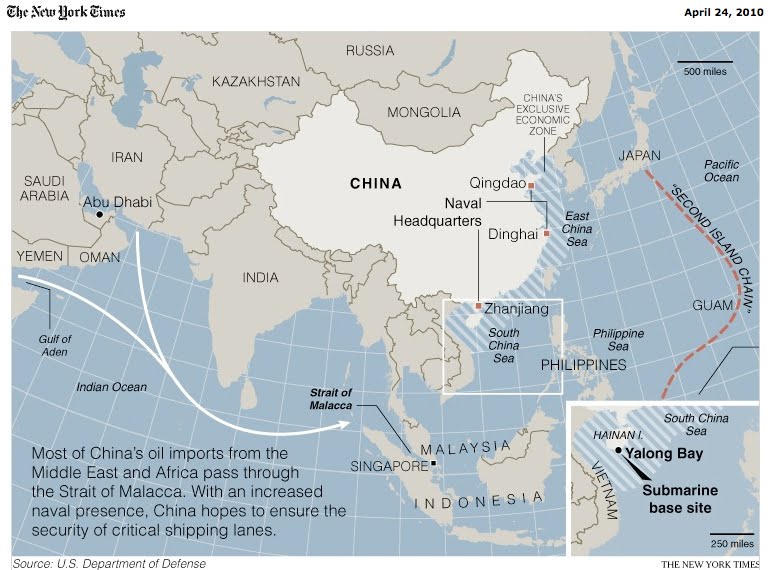
YALONG BAY, China — The Chinese military is seeking to project naval power well beyond the Chinese coast, from the oil ports of the Middle East to the shipping lanes of the Pacific, where the United States Navy has long reigned as the dominant force, military officials and analysts say.

China calls the new strategy “far sea defense,” and the speed with which it is building long-range capabilities has surprised foreign military officials.

The strategy is a sharp break from the traditional, narrower doctrine of preparing for war over the self-governing island of Taiwan or defending the Chinese coast. Now, Chinese admirals say they want warships to escort commercial vessels that are crucial to the country’s economy, from as far as the Persian Gulf to the Strait of Malacca, in Southeast Asia, and to help secure Chinese interests in the resource-rich South and East China Seas.

In late March, two Chinese warships docked in Abu Dhabi, the first time the modern Chinese Navy made a port visit in the Middle East.

The overall plan reflects China’s growing sense of self-confidence and increasing willingness to assert its interests abroad. China’s naval ambitions are being felt, too, in recent muscle flexing with the United States: in March, Chinese officials told senior American officials privately that China would brook no foreign interference in its territorial issues in the South China Sea, said a senior American official involved in China policy.

The naval expansion will not make China a serious rival to American naval hegemony in the near future, and there are few indications that China has aggressive intentions toward the United States or other countries.

But China, now the world’s leading exporter and a giant buyer of oil and other natural resources, is also no longer content to trust the security of sea lanes to the Americans, and its definition of its own core interests has expanded along with its economic clout.

In late March, Adm. Robert F. Willard, the leader of the United States Pacific Command, said in Congressional testimony that recent Chinese military developments were “pretty dramatic.” China has tested long-range ballistic missiles that could be used against aircraft carriers, he said. After years of denials, Chinese officials have confirmed that they intend to deploy an aircraft carrier group within a few years.

China is also developing a sophisticated submarine fleet that could try to prevent foreign naval vessels from entering its strategic waters if a conflict erupted in the region, said Admiral Willard and military analysts.

“Of particular concern is that elements of China’s military modernization appear designed to challenge our freedom of action in the region,” the admiral said.

Yalong Bay, on the southern coast of Hainan island in the South China Sea, is the site of five-star beach resorts just west of a new underground submarine base. The base allows submarines to reach deep water within 20 minutes and roam the South China Sea, which has some of the world’s busiest shipping lanes and areas rich in oil and natural gas that are the focus of territorial disputes between China and other Asian nations.

That has caused concern not only among American commanders, but also among officials in Southeast Asian nations, which have been quietly acquiring more submarines, missiles and other weapons. “Regional officials have been surprised,” said Huang Jing, a scholar of the Chinese military at the National University of Singapore. “We were in a blinded situation. We thought the Chinese military was 20 years behind us, but we suddenly realized China is catching up.”

China is also pressing the United States to heed its claims in the region. In March, Chinese officials told two visiting senior Obama administration officials, Jeffrey A. Bader and James B. Steinberg, that China would not tolerate any interference in the South China Sea, now part of China’s “core interest” of sovereignty, said an American official involved in China policy. It was the first time the Chinese labeled the South China Sea a core interest, on par with Taiwan and Tibet, the official said.

Another element of the Chinese Navy’s new strategy is to extend its operational reach beyond the South China Sea and the Philippines to what is known as the “second island chain” — rocks and atolls out in the Pacific, the official said. That zone significantly overlaps the United States Navy’s area of supremacy.

Japan is anxious, too. Its defense minister, Toshimi Kitazawa, said in mid-April that two Chinese submarines and eight destroyers were spotted on April 10 heading between two Japanese islands en route to the Pacific, the first time such a large Chinese flotilla had been seen so close to Japan. When two Japanese destroyers began following the Chinese ships, a Chinese helicopter flew within 300 feet of one of the destroyers, the Japanese Defense Ministry said.

Since December 2008, China has maintained three ships in the Gulf of Aden to contribute to international antipiracy patrols, the first deployment of the Chinese Navy beyond the Pacific. The mission allows China to improve its navy’s long-range capabilities, analysts say.
A 2009 Pentagon report estimated Chinese naval forces at 260 vessels, including 75 “principal combatants” — major warships — and more than 60 submarines. The report noted the building of an aircraft carrier, and said China “continues to show interest” in acquiring carrier-borne jet fighters from Russia. The United States Navy has 286 battle-force ships and 3,700 naval aircraft, though ship for ship the American Navy is considered qualitatively superior to the Chinese Navy.
The Pentagon does not classify China as an enemy force. But partly in reaction to China’s growth, the United States has recently transferred submarines from the Atlantic to the Pacific so that most of its nuclear-powered attack submarines are now in the Pacific, said Bernard D. Cole, a former American naval officer and a professor at the National War College in Washington.

The United States has also begun rotating three to four submarines on deployments out of Guam, reviving a practice that had ended with the cold war, Mr. Cole said.

American vessels now frequently survey the submarine base at Hainan island, and that activity leads to occasional friction with Chinese ships. A survey mission last year by an American naval ship, the Impeccable, resulted in what Pentagon officials said was harassment by Chinese fishing vessels; the Chinese government said it had the right to block surveillance in those waters because they are an “exclusive economic zone” of China.

The United States and China have clashing definitions of such zones, defined by a United Nations convention as waters within 200 nautical miles of a coast. The United States says international law allows a coastal country to retain only special commercial rights in the zones, while China contends the country can control virtually any activity within them.

Military leaders here maintain that the Chinese Navy is purely a self-defense force. But the definition of self-defense has expanded to encompass broad maritime and economic interests, two Chinese admirals contended in March.

“With our naval strategy changing now, we are going from coastal defense to far sea defense,” Rear Adm. Zhang Huachen, deputy commander of the East Sea Fleet, said in an interview with Xinhua, the state news agency.

“With the expansion of the country’s economic interests, the navy wants to better protect the country’s transportation routes and the safety of our major sea lanes,” he added. “In order to achieve this, the Chinese Navy needs to develop along the lines of bigger vessels and with more comprehensive capabilities.”

The navy gets more than one-third of the overall Chinese military budget, “reflecting the priority Beijing currently places on the navy as an instrument of national security,” Mr. Cole said. China’s official military budget for 2010 is $78 billion, but the Pentagon says China spends much more than that amount. Last year, the Pentagon estimated total Chinese military spending at $105 billion to $150 billion, still much less than what the United States spends on defense. For comparison, the Obama administration proposed $548.9 billion as the Pentagon’s base operating budget for next year.

The Chinese Navy’s most impressive growth has been in its submarine fleet, said Mr. Huang, the scholar in Singapore. It recently built at least two Jin-class submarines, the first regularly active ones in the fleet with ballistic missile capabilities, and two more are under construction. Two Shang-class nuclear-powered attack submarines recently entered service.

Countries in the region have responded with their own acquisitions, said Carlyle A. Thayer, a professor at the Australian Defense Force Academy. In December, Vietnam signed an arms deal with Russia that included six Kilo-class submarines, which would give Vietnam the most formidable submarine fleet in Southeast Asia. Last year, Malaysia took delivery of its first submarine, one of two ordered from France, and Singapore began operating one of two Archer-class submarines bought from Sweden.

Last fall, during a speech in Washington, Lee Kuan Yew, the former Singaporean leader, reflected widespread anxieties when he noted China’s naval rise and urged the United States to maintain its regional presence. “U.S. core interest requires that it remains the superior power on the Pacific,” he said. “To give up this position would diminish America’s role throughout the world.”

Wednesday, April 14, 2010

Twitter's Entire Archive Headed to the Library of Congress

The U.S. Library of Congress announced this morning via its official Twitter account that it will be acquiring the entire archive of Twitter messages back through March 2006. In addition to a massive printed collection, the Library already has an extensive collection of other digital assets. The Library of Congress is the biggest library in the world.
The Library does extensive work with data format standards, the semantic Web and other platforms for outside analysis. The addition of Twitter into the organization's offerings could foster an enormous amount of academic research. From a new kind of historical record to an unprecedented opportunity for discovering patterns of social interaction, this is big.
For now there are more questions than answers with regards to this Library of Congress Twitter news.

Will the archive include friend/follower connection data? Will it be usable for commercial purposes?

Will there be a Web interface for searching it, and will that change the face of Twitter search for good?

Is there any way that the much larger archive of Facebook data could be submitted to the same body for analysis of the same kind?

Saturday, April 10, 2010

Mexican Government Targets Oklahoma; State Lawmaker Calls for Tough Response


UPDATE

“Obviously, we have struck a nerve. No telling how many millions of dollars have been flowing to Mexico out of Oklahoma; a large portion of it, due to narcotics trafficking and illegal aliens who work for cash, pay no taxes, and then send it by wire straight to Mexico. Our state’s new regulations on the wire transfers of money have obviously put a dent in this flow of cash to Mexico, and serve as a great tool for law enforcement to identify those engaged in such activity.”
- Oklahoma State Senator Anthony Sykes (R-Moore/Duncan)


In response to the Mexican government’s efforts to “bully” the people of Oklahoma through a trade war, state Rep. Randy Terrill today called for imposing “much tougher sanctions on illegal aliens.”
“This represents an attempt by a foreign nation to interfere with the sovereign actions of a U.S. state,” said Terrill, R-Moore. “We clearly not only have the right, but the responsibility to legislate for the public health, safety, morals and welfare of our citizens – not theirs.
“The Mexican government should know that the people of Oklahoma will not be bullied or intimidated by anyone, anywhere.”
This week the Mexican House of Representatives passed a resolution denouncing U.S. states that impose remittance taxes and calling upon the Mexican government to take trade measures against those states.

The resolution specifically targets Oklahoma, saying remittance legislation enacted in this state is an “immoral, abusive and harmful” act against “immigrants’ rights.”

The resolution calls on the Mexican Foreign Affairs Ministry to ask Oklahoma Gov. Brad Henry to eliminate the fee (which he does not unilaterally have the authority to do) and urges the Mexican Government to suspend all of its purchases of products originating in Oklahoma.

Last year, Oklahoma lawmakers voted to assess a 1-percent fee on funds wired out of the state. Revenue collected from the fee is deposited in a “Drug Money Laundering and Wire Transmitter Revolving Fund.”
The fee does not single out any one group of individuals
Terrill noted the proposed sanctions on Oklahoma appear to be a violation of the NAFTA agreement that could result in U.S. countermeasures on Mexico as provided under the NAFTA accords, and that Oklahoma lawmakers also have the ability to respond at the state level.

“If they want to talk about trade sanctions, then they need to first start by cutting off all the dope coming into Oklahoma from Mexico and the disaster of Mexican citizens who are being pushed into Oklahoma by the shamefully dysfunctional Mexican government, where they are draining tax dollars in the areas of health care, education, welfare and corrections,” Terrill said
“On a daily basis, the Oklahoma Bureau of Narcotics investigates cell groups tied to some of the most powerful drug cartels in Mexico. Annually, millions of dollars in illegal drugs are coming into Oklahoma from these Mexican cartels for nationwide distribution, and millions of dollars in illegal drug proceeds are smuggled or wired back to the Mexican bank accounts of drug traffickers. Law-abiding citizens are not negatively impacted by The Wire Transfer Fee. These individuals are able to redeem the fee on their income taxes,” said Darrell Weaver, director of the Oklahoma Bureau of Narcotics.
“A huge share of the drug problem in Oklahoma is clearly tied to narcotics exported from Mexico along the I-35 corridor,” Terrill said.

He said Oklahoma lawmakers would be fully justified under international law to respond to the Mexican government’s provocations with improved countermeasures against drug and alien smuggling from Mexican states.

“If they really want to pick this fight with Oklahoma, then I will be happy to immediately introduce or amend legislation calling for the state’s current asset-seizure and drug-forfeiture laws to be extended to all immigration-related offenses,” Terrill said. “I’d also like to have good cause to advance legislation denying state-issued birth certificates to children born to illegal-alien parents. And we should restrict the actions of Mexican consulars in Oklahoma who often assist illegal aliens attempting to establish permanent residence and find employment in the United States.

“I do however, urge the Mexican Congress to support a labor ‘boycott’ of Oklahoma by investing in sustainable job creation at home,” added Terrill. “I will encourage our in-state development experts to assist them. It will help improve the employment rate for U.S. citizens and law-abiding immigrants during this national recession.”

Friday, April 9, 2010

Elections results for April 6, 2010

(x) = winner

BLAINE COUNTY
Watonga schools
Office 5: Kristi Bruner 151 (37.6%); (x) Earl Lane Edsall 251 (62.4%)

CANADIAN COUNTY

County commissioner
District 3 (unexpired term): (x) Jack Stewart, Republican 863 (56%); John Y. Morris, Democrat 679 (44%)

City of Mustang
City council Ward 2: Kathleen Moon 100 (39.2%); (x) Mark Grubbs 155 (60.8%)

City of Piedmont
City council Ward 1: Craig Eidson 27 (31.4%); (x) Larry M. Gage 59 (68.6%)

CARTER COUNTY
City of Lone Grove
City council Ward 5: (x) Mickey Davis 100 (64.1%); Michael T. Hicks 56 (35.9%)

CLEVELAND COUNTY
City of Noble
City council Ward 3
(unexpired term): Robert Stegman 5 (16.7%); (x) Gail Hatfield 25 (83.3%)

CREEK COUNTY
Gypsy School
Proposition 1: $80,000 bond issue for replacement or renovation of the district’s bus barn. If funds are available,
roof improvements and installation of heaters in a gym are planned. Yes 79 (78.2%); No 22 (21.8%). Passed.
Proposition 2: $170,000 to buy buses. Yes 82 (82%); No 18 (18%). Passed.

Pretty Water School
$225,000 bond issue for
a new roof, installation
of 11 heating and air
conditioning units and painting and repair of the exterior of a school
building. Yes 68 (50%); No 68 (50%). Failed.

CUSTER COUNTY
Five propositions for various improvements in Weatherford. If all five propositions are approved, a 1-cent sales tax that expires in September would be extended for 10 years. Percentages of the 1-cent tax would be dedicated to separate projects. If some but not all of the projects are approved, the sales tax extension would be less than 1 cent.
Proposition 1: 41 percent of the penny tax for city infrastructure
improvements, including construction of a fire station. Yes 1,233 (77.9%); No 350 (22.1%). Passed.
Proposition 2: 34 percent of the penny tax would go toward a $14 million event center that would be shared by Southwestern Oklahoma State
University. SWOSU plans to pay half of the cost of construction. Yes 997 (62.9%); No 589 (37.1%). Passed.
Proposition 3: 15 percent of the penny tax for beautification of a corridor between downtown Weatherford and the SWOSU campus. Yes 993 (62.7%); No 591 (37.3%). Passed.
Proposition 4: 5 percent of the penny tax for construction of a combination band room and safe room at the Weatherford School District’s middle school and renovation of rest rooms at East and West elementary schools. Yes 1,208 (76.4%); No 374 (23.6%). Passed.
Proposition 5: 5 percent of the penny tax toward construction of a surgical unit at Weatherford Regional Hospital. Yes 988 (62.6%); No 591 (37.4%). Passed.

GARVIN COUNTY
Wynnewood Schools
$275,000 bond issue for school renovations and technology equipment. Yes 256 (86.2%); No 41 (13.8%). Passed.

GRADY COUNTY
Chickasha Schools $20.2 million bond issue for an early childhood center for pre-kindergarten, kindergarten and first grade. Yes 829 (66.6%); No 415 (33.4%). Passed.

HUGHES COUNTY
City of Healdton
Extension of a 1-cent sales tax to fund the local hospital. Yes 346 (90.9%); No 36 (9.1%). Passed.

JACKSON COUNTY
El Dorado Schools $150,000 bond issue for telephones, intercom, security system, furnishings, upgrading the science lab and lunch room, refurbishing the interior and exterior, electrical work, lighting and new water fountains for the elementary and high schools. Yes 115 (85.8%); No 19 (14.2%). Passed.

KAY COUNTY
City of Blackwell
City council Ward 2: Jerry Reid 268 (45.2%); (x) Max Wirtz 325 (54.8%)

Peckham Schools
Proposition 1: $115,000 bond issue to repair the gym floor and school buildings. Yes 53 (85.5%); No 9 (14.5%). Passed.
Proposition 2: $160,000 bond issue to buy two buses. Yes 53 (85.5%); No 9 (14.5%). Passed.

LINCOLN COUNTY
City of Wellston
Extension of a half-cent sales tax for streets and sidewalks. Yes 34 (100%); No 0 (0%). Passed.

MUSKOGEE COUNTY
City of Muskogee
Mayor: John "Bob”
Coburn 1,447 (29.4%); Teresa Carol Garris 67 (1.36%); (x) John Tyler Hammons 2,531 (51.4%); Chris James 877 (17.8%)

OKFUSKEE COUNTY
Paden Schools
Office 5: (x) Keith Fipps 179 (59.3%); Kyle Norman 123 (40.7%)

OKLAHOMA COUNTY

Oklahoma City Schools
Office 7: (x) Ron Millican 194 (73.8%); Larry
Collins 69 (26.2%)

PAYNE COUNTY
City of Cushing
City commission Ward 3: (x) F. Carey Seigle 386 (56.3%); John Henckel 300 (43.7%)

City of Stillwater
City council Ward 2: (x) John W. Bartley 1,965 (64.9%); Gary L. Stanton 1,065 (35.1%)

City of Yale
City commission Ward 2: (x) Richard Adsit
164 (65.1%); Jimmie
Crenshaw 88 (34.9%)

PONTOTOC COUNTY
City of Roff
Proposal to allow the mayor to appoint the position of town clerk/treasurer. Yes 36 (63%); No 21 (37%). Passed.

STEPHENS COUNTY
City of Duncan
City council Ward 3: (x) Tommy Edwards 4,334 (77.1%); Clyde Shaw 1,288 (22.9%)
City council Ward 4: (x) Ricky Mayes 3,368 (60.1%); John Herdt 2,232 (39.9%)

Duncan Schools
$118.9 million bond issue to upgrade the high school building and
extracurricular facilities. The district also would build three new
elementary schools.
Yes 1,119 (18.8%); No 4,841 (81.2%). Failed.

Marlow Schools
Office 5: (x) Terry Turner 271 (50.8%); Cody Bannister 263 (49.2%)

TULSA COUNTY
City of Bixby
City council Ward 4: Rod Taylor 184 (40.8%); (x) Ray Bowen 267 (59.2%)

City of Collinsville
City council Ward 3: Melodie Bateman 47 (44.8%); (x) Sherri L. Davis 58 (55.2%)

Glenpool Schools
Proposition 1: $25 million bond issue for 25 new classrooms, expanding the district’s kitchen and the high school’s student center, completing road construction, resurfacing the track and football field, and adding a new gymnasium, baseball and softball fields and a locker room. Yes 449 (84.4%); No 83 (15.6%). Passed.
Proposition 2: $170,000 bond issue for two school buses. Yes 448 (84.2%); No 84 (15.8%). Passed.

WASHITA COUNTY
Washita School
Voters will decide whether to approve annexation to the Cordell School District, effective May 1. Yes 212 (87.2%); No 31 (12.8%). Passed.

Monday, April 5, 2010

VOTER FRAUD PENALITIES MAY INCREASE!

Hat Tip to Steve Fair

Weekly Opinion/Editorial

Mickey Mouse, the Disney creation born in 1928, will not be able to register to vote in Oklahoma if a bill by House Speaker Chris Benge, (R-Tulsa) and Senate Pro Temp Glenn Coffee, (R-OKC) gets through the State House and is signed by the Governor. The bill seeks to deter election and voter registration fraud. Senate Bill #1921 passed the Senate by a vote of 33-10 back on March 9th. Last week, the bill passed out of the House Public Safety Committee by a vote of 6-1 and goes to the full House. It is expected to pass the House by a wide margin. It remains to be seen if the Governor will sign the legislation. He vetoed a Voter ID bill back in April 2009.

SB 1921 would increase the maximum punishment for felony violations of Oklahoma election law from fines of $5,000 to $50,000. It would increase the jail time from two years to five years imprisonment.

"We have seen in recent years groups inflating the voter registration rolls with the likes of Mickey Mouse to the benefit of certain candidates," said Benge, R-Tulsa. "It is our duty to ensure the people of Oklahoma trust our election outcomes."

The measure also adds fraudulent use of an absentee and making a false application to an absentee ballot a felony. It would also make it a felony to knowingly collect or submit voter registration forms that contain false information.

"Clearly the current law was not enough to deter ACORN and groups like it from committing voter fraud. Our hope is that this legislation and stricter penalties will help restore voter confidence in our democratic system," said Rep. Rex Duncan, (R-Sand Spring) who presented the bill in committee. "Free and fair elections are the backbone of our democracy, and it is important that those who would deliberately and purposely sabotage the voting process be prosecuted to the full extent of the law," Duncan concluded.
Oklahoma’s colorful political history is littered with scandals. Most Oklahomans remember the County Commissioner scandal of the 1980s, which had over 200 people indicted/convicted, and the recent McMahan/Stipe/Phipps scandal, but few remember a voter fraud scandal that rocked Oklahoma in the early 80s?

Back in 1983, then Oklahoma State House Speaker Dan Draper and House Majority Leader Joe Fitzgibbon- both Democrats- were convicted of vote fraud. The convictions were later overturned, but it did force Draper to leave office. Draper and Fitzgibbon were accused of mailing illegal absentee ballots in an effort to get Draper’s dad elected to the legislature.
Debates over election fraud are not new. They have been a staple of discussions about elections and democracy in the United States for more than a century. But in recent years, issues of fraud and voting integrity have increasingly come to the forefront of public policy discussions over the health of America’s democracy. With the consistently low voter turnout rates and obstacles to citizen participation motivated various efforts to increase voter registration and turnout—efforts that in turn raised questions about voting integrity. Critics of some reforms—such as Oregon starting mail-in voting, the loosening of guidelines for absentee ballot use, and, most notably, the National Voter Registration Act of 1993 (also known as NVRA or the “motor voter” law)—have charged that these reforms increase the potential for voter fraud. Other frequently proposed reforms, such as Election Day Registration, continue to be criticized on the same grounds. Implemented with the pretense they will make voter registration more convenient, they also make it easier to commit voter fraud.

Benge and Coffee have the right idea- punish those who cheat in elections by increasing the fines and jail time, but they need to take another run at Voter ID. When he vetoed the ID bill in April, Governor Henry said, “At a time when it is difficult to attract more than half of the registered voters to the polls at any given election, we must make voting easier and more convenient for registered voters, not more difficult and confusing.” How is it confusing for a voter to have to show an ID to vote? It has never been easier to cast your vote. Most elections have early in person absentee balloting which has expanded the hours to vote by twenty hours. Twenty! Mickey Mouse said, “Arithmetic is being able to count up to twenty without taking off your shoes.”

Walt Disney famously said about his creation, “When people laugh at Mickey Mouse, it’s because he’s so human; and that is the secret of his popularity.” But he’s not human and while Mickey may be popular, if Senate bill #1921 gets signed into law, Mr. Mouse won’t be voting in Oklahoma elections because those that got him on the voter rolls will be in jail.

Survey: Four in 10 Tea Party members are Dems or independents


Survey: Four in 10 Tea Party members
are Dems or independents

(And they can NOT VOTE
in Oklahoma Republican Primary)


Four in 10 Tea Party members are either Democrats or Independents, according to a new national survey.

The findings provide one of the most detailed portraits to date of the grassroots movement that started last year.

The national breakdown of the Tea Party composition is 57 percent Republican, 28 percent Independent and 13 percent Democratic, according to three national polls by the Winston Group, a Republican-leaning firm that conducted the surveys on behalf of an education advocacy group. Two-thirds of the group call themselves conservative, 26 are moderate and 8 percent say they are liberal.

The Winston Group conducted three national telephone surveys of 1,000 registered voters between December and February. Of those polled, 17 percent – more than 500 people -- said they were “part of the Tea Party movement.”

“It’s a good sample size,” said David Winston, the polling firm’s director. “It will certainly give us an initial base to follow where these folks are.”

The group is united around two issues – the economy/jobs and reducing the deficit. They believe that cutting spending is the key to job creation and favor tax cuts as the best way to stimulate the economy. That said 61 percent of Tea Party members believe infrastructure spending creates jobs. Moreover, given the choice Tea Party members favor 63-32 reducing unemployment to 5 percent over balancing the budget.

It isn’t a “purely homogeneous” group, said Winston.

The group has a favorable view of Republicans generally but that drops from 71 to 57 percent if they’re asked about Congressional Republicans. Congressional Democrats are viewed very unfavorably by 75 percent of Tea Party members – a uniquely strong antipathy. An overwhelming 95 percent said “Democrats are taxing, spending, and borrowing too much.”

The group also vehemently dislikes President Barack Obama – even more so than those who called themselves Republicans in the survey. Over 80 percent of Tea Party members disapprove of the job he’s doing as president, whereas 77 percent of Republican respondents said they disapprove of Obama. The Tea Party members are also strongly opposed to the Democrats’ healthcare plan, with 82 percent saying they oppose it -- only 48 percent of respondents overall were opposed.

Tea Party members are more likely to be male, slightly older and middle income. Almost half the members of the group reported getting their news about national issues from Fox News, 10 percent of respondents said that talk radio is one of their top two sources, which is seven-points higher than the average voter.

Sunday, April 4, 2010

Elections for April 6, 2010

BLAINE COUNTY
Watonga schools
Office 5: Kristi Bruner, Earl Lane Edsall

CANADIAN COUNTY

County commissioner
District 3 (unexpired term): Jack Stewart, Republican; John Y. Morris, Democrat

City of Mustang
City council Ward 2: Kathleen Moon, Mark Grubbs

City of Piedmont
City council Ward 1: Craig Eidson, Larry M. Gage

CARTER COUNTY

City of Lone Grove
City council Ward 5: Mickey Davis, Michael T. Hicks

CLEVELAND COUNTY

City of Noble
City council Ward 3 (unexpired term): Robert Stegman, Gail Hatfield

CREEK COUNTY
Gypsy School
Proposition 1: $80,000 bond issue for replacement or renovation of the district’s bus barn. If funds are available, roof improvements and installation of heaters in a gym are planned.
Proposition 2: $170,000 to buy buses.
Pretty Water School
$225,000 bond issue for a new roof, installation of 11 heating and air conditioning units and painting and repair of the exterior of a school building.

CUSTER COUNTY

Five propositions for various improvements in Weatherford. If all five propositions are approved, a 1-cent sales tax that expires in September would be extended for 10 years. Percentages of the 1-cent tax would be dedicated to separate projects. If some but not all of the projects are approved, the sales tax extension would be less than 1 cent.
Proposition 1: 41 percent of the penny tax for city infrastructure improvements, including construction of a fire station.
Proposition 2: 34 percent of the penny tax would go toward a $14 million event center that would be shared by Southwestern Oklahoma State University. SWOSU plans to pay half of the cost of construction.
Proposition 3: 15 percent of the penny tax for beautification of a corridor between downtown Weatherford and the SWOSU campus.
Proposition 4: 5 percent of the penny tax for construction of a combination band room and safe room at the Weatherford School District’s middle school and renovation of rest rooms at East and West elementary schools.
Proposition 5: 5 percent of the penny tax toward construction of a surgical unit at Weatherford Regional Hospital.

GARVIN COUNTY
Wynnewood Schools
$275,000 bond issue for school renovations and technology equipment.

GRADY COUNTY
Chickasha Schools
$20.2 million bond issue for an early childhood center for pre-kindergarten, kindergarten and first grade.

HUGHES COUNTY

City of Healdton
Extension of a 1-cent sales tax to fund the local hospital.

JACKSON COUNTY
El Dorado Schools
$150,000 bond issue for telephones, intercom, security system, furnishings, upgrading the science lab and lunch room, refurbishing the interior and exterior, electrical work, lighting and new water fountains for the elementary and high schools.

KAY COUNTY

City of Blackwell
City council Ward 2: Jerry Reid, Max Wirtz

Peckham Schools
Proposition 1: $115,000 bond issue to repair the gym floor and school buildings.
Proposition 2: $160,000 bond issue to buy two buses.

LINCOLN COUNTY
City of Wellston
Extension of a half-cent sales tax for streets and sidewalks.

MUSKOGEE COUNTY
City of Muskogee
Mayor: John "Bob” Coburn, Teresa Carol Garris, John Tyler Hammons, Chris James

MURRAY COUNTY
Davis Schools
Office 5: Elva Campbell, Kip Pruitt
City of Sulphur
City council Ward 3: Karen Duck, Darryl Carter
Proposition: Charter amendment to extend the elected terms of city council members from two years to four years.

OKFUSKEE COUNTY
Paden Schools
Office 5: Keith Fipps, Kyle Norman

OKLAHOMA COUNTY
Oklahoma City Schools
Office 7: Ron Millican, Larry Collins

PAYNE COUNTY

City of Cushing
City commission Ward 3: F. Carey Seigle, John Henckel

City of Stillwater
City council Ward 2: John W. Bartley, Gary L. Stanton

City of Yale
City commission Ward 2: Richard Adsit, Jimmie Crenshaw

PONTOTOC COUNTY
City of Roff
Voters will decide whether the mayor can appoint the position of town clerk/treasurer.

STEPHENS COUNTY
City of Duncan
City council Ward 3: Tommy Edwards, Clyde Shaw
City council Ward 4: Ricky Mayes, John Herdt

Duncan Schools
$118.9 million bond issue to upgrade the high school building and extracurricular facilities. The district also would build three new elementary schools.

Marlow Schools
Office 5: Terry Turner, Cody Bannister

TULSA COUNTY

City of Bixby
City council Ward 4: Rod Taylor, Ray Bowen

Glenpool Schools
Proposition 1: $25 million bond issue for 25 new classrooms, expanding the district’s kitchen and the high school’s student center, completing road construction, resurfacing the track and football field, and adding a new gymnasium, baseball and softball fields and a locker room.
Proposition 2: $170,000 bond issue for two school buses.

WASHITA COUNTY
Washita School
Voters will decide whether to approve annexation to the Cordell School District, effective May 1.

Monday, March 22, 2010

We Don't CAIR Conference

CAIR claims that their organization is
about building bridges and defending
the civil rights of Muslims, but let’s
examine the facts?


ADDITIONAL RESOURCES
The Truth Behind The Council on Islamic-American Relations

Summary Information Sheet on CAIR

US Attorney Gordon D. Kromberg was quoted in legal proceedings, “From its founding by Muslim Brotherhood leaders, CAIR conspired with other affiliates of the Muslim Brotherhood to support terrorists.” (US v. Sabri Benkahla)
US Attorney James T. Jacks was quoted to say, “CAIR has been identified by the government as a participant in an ongoing and ultimately unlawful conspiracy to support a designated terrorist organization—a conspiracy from with CAIR never withdrew.” (USA v. HLF)
In 2007, CAIR was named an un-indicted co-conspirator in a terrorism case in which leaders of the Texas based "Holy Land Foundation" were convicted of funneling money to Hamas in the largest terror financing case in US history.
“The feds say the Holy Land Foundation was a bogus North Texas Muslim "charity" that had actually served since 1989 as Hamas's largest clandestine source of funding in the United States--collecting "over $57 million" in donations between 1992 and 2001.” – Weekly Standard, 2/13/06
“CAIR has been advised of the reasons behind our suspension of formal partnership. These reasons include the fact that CAIR was named an unindicted co-conspirator in United States v. Holy Land Foundation and CAIR’s failure to answer our questions about a connection between their executives and Hamas. Until these questions are answered, the FBI does not consider CAIR an appropriate partner for formal liaison activities.” An unindicted co-conspirator is a person or entity that is alleged in an indictment to have engaged in conspiracy, but who is not charged in the same indictment.” - FBI, March, 2010

With Health Care passing last night let all sing!

Friday, March 19, 2010

Medieval Fair of Norman is just one week away!!!!!!

Admission is free!

Order of Merriment

Opening Ceremony & Grand Procession
10:00 - Friday only – begins at


SCA Compound and ends at Royal Pavilion

Jousting Tournament – Jousting Field
11:00 & 3:00 each day


Human Chess Game – Camelot Stage
1:00 & 5:00 each day


Wedding – Minstrel Circle
2:00 -Saturday & Sunday – public invited!


Costume Contest – Camelot Stage
2:30 – Saturday & Sunday only


Royal Procession
4:00 -Saturday & Sunday – begins at Royal Pavilion


Last Huzzah
Gryphon Stage – 6:15 -Sunday only
Held annually since 1976, this event relives the Middle Ages with arts and crafts, food, games, jousting tournaments, human chess games, costume contests, and more.

Entertainment for the whole family includes minstrels, dancing, theater and reenactments, jugglers, magicians, knights jousting on horseback and human chess games. Brightly costumed characters include King Arthur, mermaids, and the fair's king and queen.

The Medieval Fair of Norman is the state's largest weekend event and the third largest event in Oklahoma, and was selected by Events Media Network as one of the top 100 events in the nation.
Merriment abounds with jugglers, minstrels, dancing, human chess games and knights jousting on horseback.


Six Stages with continuous performances!

Games & rides for all ages!

King Arthur and Sir Lancelot!

Face painting and wax hands!

Fighting demonstrations!

New suprises each year!

Browse through the medieval village of over 200 art and craft booths offering unique and handcrafted wares. Offerings include pottery, wood crafts, stained glass, armor, costumes, fairy wings, jewelry, leather crafts, hair garlands, and much more.

Experience the Middle Ages with food fit for a king, Feast on a smoked turkey leg, roasted corn or handcrafted root beer.

Admission is free!

Admission is free!

The Medieval Fair is located at:
Reaves Park

2501 South Jenkins Avenue

Norman, Oklahoma 73072
Norman is located in central Oklahoma, just 17 miles south of Oklahoma City on Interstate 35. See state map below.

Reaves Park is located on Jenkins Avenue between Lindsey St. and HWY 9 East. From I-35 take HWY 9 East to Jenkins Avenue. Turn north (left). See Norman street map below.


Admission is free!
Admission is free!
Admission is free!

Saturday, March 6, 2010

Oklahoma Governor misusing the State Airplane?


Last month Governor Brad Henry office announced that revenue for the State of Oklahoma is down almost 20 percent. It is a staggering number; we are more than $1 billion short of balancing the budget.

And that is why this latest case of state-dollar spending is particularly concerning.

But, Governor Brad Henry can uses a State Aircraft for personal vacations; at least once to attend a wedding in Pensacola, Florida.

The governor presided at the wedding. The groom was an Oklahoma Highway Patrol Trooper and the bride was the First Lady's assistant.

The cost to Oklahoma taxpayers totaled about $5,700; not including the salaries of the pilot and co-pilot.

Thursday, March 4, 2010

Oklahoma Election Results for March 2, 2010

(x) = winner.
(r) = runoff.

CADDO COUNTY


Anadarko schools
Proposition 1: $785,000 for reroofing the high school, air conditioning the field house, playground equipment at the three elementary schools and computer equipment. Yes 520 (70.5%); No 218 (29.5%). Passed.

Proposition 2: $400,000 for four buses and surveillance cameras. Yes 509 (69.4%); No 225 (30.7%). Passed.

County commissioner, District 2
Democrats: Stephen Novotny 86 (8.5%); Deborah J. Goodfellow 111 (10.9%); (x) Randy Wilford McLemore 444 (43.7%); Willie Ray Pelzer 39 (3.8%); Bobby L. Bilyeu 315 (31.0%); Ray Mills 20 (2.0%)

CANADIAN COUNTY
County commissioner, District 3 primary
Democrats: C.A. Wilkinson 121 (20.5%); (x) John Morris 468 (79.5%)
Republicans: Audre Knott 58 (4.2%); Joshua C. Moore 436 (31.6%); (x) Jack Stewart 764 (55.4%); Daniel Pegh 95 (6.9%); Ray Melvin 26 (1.9%)

City of Yukon
Ward 1: Marsha Provence 68 (26.7%); Terry Martin 31 (12.2%);
(x) Nick M. Grba 156 (61.2%)

CARTER COUNTY


Plainview schools
$975,000 for technology, heat and air conditioning, replacing some the flooring at the intermediate and high schools, 6-foot playground security fence, repairs to the middle school parking lot and concessions and a rest room for the girls’ softball fields. Yes 658 (83.3%); No 132 (16.7%). Passed.

CLEVELAND COUNTY

City of Norman

Mayor: (x) Cindy Rosenthal 6,798 (53.7%); Hal Ezzell 5,872 (46.3%)

Ward 4: Austin Dyches 151 (8.4%); (x) Carol Price Dillingham 1,303 (72.4%); J. Michael Sherrod 81 (4.5%); John O. Dawson 265 (14.7%)

Ward 6: Matt Zellner 823 (49.1%); (x) Jim Griffith 853 (50.9%)

Ward 8: Stephen A. Lucas 716 (34.7%); Leonard Youngblood 173 (8.4%); (x) Dan Quinn 1,176 (56.9%)

Proposition 1: $19 million for citywide street improvements. Yes 8,170 (64.7%); No 4,454 (35.3%). Passed.

Proposition 2: $2.25 million for an updated and expanded emergency warning system. Yes 7,814 (62.1%); No 4,776 (37.9%). Passed.


COMANCHE COUNTY


Cache schools
Proposition 1: $29 million for a new fifth- and sixth-grade center and expansion of the mid-high school. Yes 539 (79.7%); No 137 (20.2%). Passed.
Proposition 2: $1 million for buses. Yes 551 (80.4%); No 134 (19.5%). Passed.

CREEK COUNTY

City of Sapulpa
Proposition 1: $4 million for sewer system repairs. Yes 813 (67.8%); No 386 (32.2%). Passed.
Proposition 2: $2.8 million for a 2 million gallon water tank. Yes 805 (67.0%); No 395 (33.0%). Passed.

Allen-Bowden School
Proposition 1: $4.1 million to buy new computers for students, a new roof for the school’s gym and paving for the school’s parking lot. Yes 103 (57.5%); No 76 (42.5%). Failed.
Proposition 2: $300,000 for three buses. Yes 108 (61.4%); No 68 (38.6%). Passed.

CUSTER COUNTY


Clinton schools
$17.2 million for new classrooms at Nance, Southwest and Washington elementary schools; renovation work at the middle school auditorium; and roof repairs. Yes 1,194 (76.6 %); No 364 (23.4%). Passed.

GARFIELD COUNTY

Drummond schools
$3.2 million for a new multipurpose building that will house a large commons area for concerts, four classrooms and a band room; construction of a new Vo-Ag building and bus barn. Yes 114 (55.6%); No 91 (44.4%). Failed.

GARVIN COUNTY

City of Lindsay
City council (top three elected): Fannie Stephens 159 (10.1%); Wanda Clagg 20 (1.3%); (x) Ronnie Akerman 297 (18.9%); Joe Lindsey 185 (11.8%); L.B. Hoyle 245 (15.6%); David Griffith 100 (6.4%);
(x) Steven Whitworth 285 (18.1%); (x) Steve Abram 283 (18.0%)

GRADY COUNTY


Town of Alex
Board of trustees: (x) Roy Gage Marcum 56 (73.7%); Justin Bailey 20 (26.3%)

City of Chickasha
City council Ward 3: (x) Ryan Posey 460 (68.8%); David Thomas 209 (31.2%)

Friend School
$415,000 to build a multipurpose center, move the school library and gymnasium improvements. Yes 90 (83.3%); No 18 (16.7%). Passed.

KAY COUNTY


City of Newkirk
Ward 2: (x) A.J. Ford 143 (75.7%); George H. White 46 (24.3%)
Tonkawa schools

Proposition 1: $620,000 for a two-classroom addition, heating and air system replacements and parking improvements at the elementary school. Yes 272 (75.7%); No 47 (24.3%). Passed.

Proposition 2: $150,000 for a school activity bus. Yes 267 (85.3%); No 51 (14.7%). Passed.

KINGFISHER COUNTY

Kingfisher schools
$5.97 million to renovate the old middle school and turn it into a third- and fourth-grade center; build a hallway to connect high school buildings; upgrade technology and add parking at the high school. Yes 687 (68.3%); No 319 (31.7%). Passed.

KIOWA COUNTY

Mountain View-Gotebo schools
$2 million for new roofs on all buildings; replace windows at the elementary and high schools; refurbish the auditorium; replace the two gym floors; and build a concession stand for the softball field. Yes 220 (52.6%); No 198 (47.4%). Failed.

MCCLAIN COUNTY

Purcell schools
$3.8 million to reroof the elementary, middle and junior high schools; replace heating, ventilation and air conditioning units; and build a physical education area at the middle school. Yes 368 (76.2%); No 115 (23.8%). Passed.

MURRAY COUNTY

Davis schools
$2.5 million to build an elementary school, reroof an auditorium and to buy heating, ventilation and air conditioning units at all schools. Yes 734 (87.3%); No 107 (12.7%). Passed.

OKLAHOMA COUNTY

City of Midwest City
Mayor: (x) Jack Fry 1,842 (50.7%); Russell Smith 1,790 (49.3%)
Ward 3: (r) Espaniola Bowen 236 (32.6%), (r) Rick Dawkins 339 (46.9%), Leroy Halstead 54 (7.5%); Steve Parrott 94 (13%)

City of Nicoma Park
Ward 4: Jerrie Reagan 7 (36.8%); (x) Robert E. Pittman 12 (63.2%)

City of Oklahoma City
Mayor: Steve Hunt 10,061 (41.7%); (x) Mick Cornett 14,073 (58.3%)

PAYNE COUNTY

Ripley schools
$2.5 million to build a leadership and performing arts center; two safe rooms to double as band and physical fitness rooms; four dressing rooms and a competition track. Yes 140 (78.7%); No 38 (21.3%). Passed.

City of Cushing
Ward 4: James Ree 49 (17.4%); Ray Singley 39 (13.9%); (x) Tommy Johnson 193 (68.7%)

City of Stillwater
Ward 1: Rodney Wayne Goodner 864 (22.3%); (x) Joe Weaver 2,279 (58.6%); Dennis Gronquist 599 (15.4%); David Lingelbach 145 (3.7%)
Ward 2: (r) Gary L. Stanton 1,060 (27.1%); (r) John W. Bartley 1,933 (49.3%); Hank Moore 926 (23.6%)

City of Yale
Ward 1: Martha Petitt 13 (5.2%); Maurice Lozier 101 (40.2%); (x) Michael P. McCullough 137 (54.6%)

PONTOTOC COUNTY


City of Ada
Ward 4: (x) Matt Layton 919 (67.8%); Barbara Young 437 (32.2%)

Allen schools
Proposition 1: $850,000 to remodel the agriculture education building; replace the high school ceiling; and put a metal roof on the district’s auditorium, among other renovations. Yes 149 (90.85%); No 15 (9.15%). Passed.

Proposition 2: $250,000 to replace buses and other district vehicles. Yes 150 (90.9%); No 15 (9.1%). Passed.

POTTAWATOMIE COUNTY


Dale schools
$2.5 million to build a new cafeteria that will also serve as a community center and storm shelter. Yes 248 (79.2%); No 65 (20.8%). Passed.

TULSA COUNTY

Tulsa schools
Proposition 1: $261.4 million to build classroom additions at 26 schools; remodel two existing buildings to be early childhood centers; renovate East Central High School and build three multisport field houses, among other upgrade projects. Yes 19,042 (74.6%); No 6,486 (25.4%). Passed.
Proposition 2: $19.6 million for six library additions and materials. Yes 19,219 (75.3%); No 6,304 (24.7%). Passed.
Proposition 3: $11.7 million for 130 buses and route maintenance software. Yes 18,074 (72.6%); No 6,822 (27.4%). Passed.
Proposition 4: $61.3 million for a textbook management system, science safety equipment, classroom computers and other technology. Yes 18,815 (75.5%); No 6,098 (24.5%). Passed.

City of Collinsville
Ward 3: (r) Melodie Bateman 29 (39.7%); Volinda Pope 18 (24.7%); (r) Sherri L. Davis 26 (35.6%)

Liberty schools
Proposition 1: $2 million for a new art room and administration area; additions to the multipurpose center; roof repairs and field house additions and renovations. Yes 164 (77.4%); No 48 (22.6%). Passed.
Proposition 2: $200,000 for two buses. Yes 175 (82.5%); No 37 (17.5%). Passed.

WASHITA COUNTY


Town of Rocky
Board of trustees (two seats):
(x) Jim Hazelton 48 (41.8%); David L. Jones 12 (10.4%); (x) Jackie Galloway 55 (47.8%)

Wednesday, March 3, 2010

Senate Democrats Jeopardize Lives of Officers, Citizens Lawmakers Warn Campaign Stunt Could Have Tragic Consequences

By voting to block emergency funding for the Department of Corrections and the Department of Public Safety, Senate Democrats are literally putting lives in danger, two budget leaders warned today.

“By opposing emergency funding for DOC and DPS, Senate Democrats have voted to risk the lives of corrections officers and gut law enforcement presence on our state highways,” said state Rep. Randy Terrill (R- Dist 53 Moore), who chairs the House appropriations subcommittee on public safety.

Led by state Sen. Kenneth Corn (D-Howe), Senate Democrats opposed emergency funding for DOC and DPS this week.
“Everyone jokes that the most dangerous place in Oklahoma is standing between Senator Corn and a camera,” said state Sen. Anthony Sykes (R - Dist 24 Moore/Duncan), who chairs the Senate appropriations subcommittee on public safety. “That would be funny if his latest publicity stunt wasn’t risking the lives of the men and women who protect the rest of us. There’s a time for showboating, and a time for voting – it’s time the Senate Democrats voted to protect Oklahomans.”
State troopers and corrections officers will join Terrill and Sykes to protest Senate Democrat efforts to gut public safety at a 2 p.m. press conference tomorrow at the Capitol.

Without the emergency funding, the Department of Public Safety is scheduled to furlough highway patrol officers four days every month starting this month.

“If the Senate Democrats continue to block this emergency funding, criminals will think it’s open season on Oklahomans on state highways,” Terrill said. “Under the Senate Democrats’ plan, if you pick up a phone and call the highway patrol in late March, there may not be anyone there to answer.”

The Department of Corrections is already short-staffed and operating with just 77 percent of positions filled at state prisons. That staff number will plummet thanks to the Senate Democrats vote to block emergency funding and force furloughs.
“By blocking the emergency funding, Senate Democrats are asking a handful of corrections officers to do the work of many and put their lives at risk as a result,” Sykes said. “Under the Senate Democrats’ furlough plan, it is likely corrections officers will be attacked, injured and possibly killed. Frankly, if there is a large riot at one of our prisons while guards are furloughed, I am not sure we can contain it.”
Terrill noted that when prison riots occur, highway patrol troopers are normally called in for backup.

“Under the Senate Democrats’ plan, there won’t be enough guards in our prisons to contain a riot and those officers won’t have much backup from state troopers thanks to furloughs,” Terrill said. “This is terrible, short-sighted, completely irresponsible public policy.”

Senate Democrats claim their votes were to protest cuts to senior nutrition centers, but Terrill and Sykes noted that argument “makes no sense whatsoever because the two issues are not linked.”

“The only ones neglecting vulnerable seniors are the Senate Democrats who are voting to gut public safety,” Terrill said. “It’s time for them to end the political posturing and vote to protect all Oklahomans.”

Tuesday, March 2, 2010

In a partisan move, Senate Democrats put political posturing over "Doing the Right Thing"!

Democrats Lock Up on Program
They Didn’t Fund During Last Budget Crisis


In a partisan move, Senate Democrats put political posturing over jobs for employees in the Departments of Corrections, Highway Patrol, and common education today, as well as other vital state services today, in direct opposition to Governor Henry, who negotiated the bipartisan budget agreement which they opposed today.

“It’s a curious decision by the Democrats today,” said Senate President Pro Tem Glenn Coffee. “They are fighting for restoration of a line item, senior nutrition, which they cut in the 2003 budget crisis.”

In a budget vote on the Senate floor today, Democrats locked up to deny funding for common education, corrections, the state Emergency Fund which pays cities and towns after ice storms, tornadoes and other natural disasters, the state School for the Deaf, state School for the Blind, Department of Public Safety, Military Department, Agriculture, Conservation and other agencies.

“I find it curious that these Democrat political leaders will jeopardize the jobs of troopers, prison guards and education in an election year, under the guise of protecting Oklahoma’s seniors, yet forgot all about those same seniors in a past budget crisis when they had unfettered control of the Oklahoma legislature,” Coffee continued. “The hypocrisy meter is spinning out of control.

“They complain about not having a seat at the negotiating table, yet the governor and his budget negotiator, the Democrat State Treasurer, negotiated this bipartisan agreement on their behalf,” Coffee added.

“And I recall the Senate Democrat Leader saying earlier this session that he would stand with his governor on matters such as this during the budget crisis.

“The Democrat Leader and his caucus have been unwilling to stand by the governor on this deal,” Coffee concluded.

Coffee pointed out that the Democrats’ demand of “only $2.5 million” in the budget for senior nutrition is a blatant act of deficit spending, modeled after their Democrat counterparts in Washington.

“Senators Laster and Corn say all they want is a mere $2.5 million for senior nutrition, yet it would require another $7.5 million next year, creating a $10 million hole in the 2011 budget,” Coffee said. “As the governor recognizes, this is irresponsible.”

It is disappointing that my colleagues on the other side of the aisle are adopting the partisan approach of Nancy Pelosi and Harry Reid in that they need to come to grips with the fact that our state is in an unprecedented budget crisis, and that more tough decisions will be made before this is over,” Coffee continued.

“I hope they join the governor’s bipartisan approach and abandon the election year grandstanding.

“I urge them to do the right thing for Oklahoma taxpayers,” Coffee concluded.

Monday, March 1, 2010

Christina Fallin Registers As Capitol Lobbyist

Hat Tip to Mike McCarville from the McCarville Report

Christina Fallin Registers As Capitol Lobbyist


Christina Fallin
shown here being introduced by her mother at a function.

Christina Fallin, the 22-year-old daughter of 5th District Congress- woman and Republican candidate for governor Mary Fallin, has registered as a State Capitol lobbyist.


The Oklahoma Ethics Commission's records reflect that Christina Fallin has joined the lobbying firm of Gary Huddleston.

Among the firm's clients are (L100321 - Fallin, Christina M - Huddleston Investments, Inc): 3-Star Centers of Oklahoma [Child Care), American Academy of Ophthalmology, Coalition for Oklahoma Teeth Floaters, Folds of Honor Foundation, Huddleston Investments, Inc., IESI Corporation, Oklahoma Bondsman Association, Oklahoma Consumer Capital Association, Oklahoma Financial Services Association, Oklahoma Horsemen's Benevolent and Protective Association, Thoroughbred Racing Association of Oklahoma, Outdoor Advertising Association of Oklahoma, Thomson/West Group, VISA.
In an email introducing Christina Fallin as his new associate, Huddleston writes that she's had experience in Washington working for a lobbying firm while her mother was in Congress.
Asked to comment on her daughter's lobbyist registration, Fallin said, "I'm very proud my daughter has taken an interest in public policy and is actively advocating for several groups and industries here in Oklahoma. I've always encouraged my kids to get involved and to try to make a difference here in the state, and Christina is doing just that."

The younger Fallin has represented her mother at several events, the most recent one being the presentation of certificates on her mother's behalf at The 52nd Byliners Awards Dinner sponsored by the Oklahoma City Professional Chapter of the Association for Women In Communications at the Oklahoma City Golf & Country Club on February 21st.

District 7 OKC School Board candidate withdraws

Oklahoma City School Board candidate Larry Collins announced Sunday in a news release that he is pulling out of the race for the District 7 seat.

Collins did not return phone calls Sunday, but political consultant Don Hoover said the candidate is ending his campaign and endorsing his opponent, Ron Millican.

The two men earned a spot in an April 6 run-off by defeating the incumbent in the Feb. 9 school board election.

In the news release, Collins, 44, is quoted as saying he has met with Millican, 72, since the Feb. 9 election and is "convinced that he will do a great job on the school board for Southeast Oklahoma City.”

Collins, who vowed to focus his efforts on vocational education, received 31.8 percent of the vote in the election. Millican, a retired assistant superintendent from the Midwest City-Del City School District, received 48.6 percent of the vote. Incumbent Wilfredo Santos-Rivera came in third with 19.6 percent of the vote. Millican was nine votes shy of winning outright.
Collins was on the Feb. 9 ballot even though he didn’t meet all the requirements for candidacy.

He registered to vote less than a month before filing for office. State law requires that candidates be registered to vote for at least six months. No one challenged his eligibility.
According to the news release, it is too late for Collins to have his name removed from the April 6 ballot.