China's military can destroy five out of six U.S. bases in Asia with waves of missile strikes as the  result of its large-scale military buildup that threatens U.S. access and freedom of navigation in East Asia, according to a forthcoming congressional report.
"The main implication of China's improved air and conventional missile capabilities is a dramatic increase in the [People's Liberation Army's] ability to inhibit U.S. military operations in the region," a late draft of the report by the U.S.-China Economic and Security Review Commission concludes.
The U.S. government has growing concerns over what the report says are "China's improving capabilities to challenge the U.S. military's freedom of access in East Asia."
The draft report - the final version is set for release Wednesday - has been disclosed as tensions in Asia intensify over growing assertiveness by the Chinese military in the Yellow Sea, the East China Sea and the South China Sea.
 President Obama, during his recent visit to Asia, frequently mentioned growing U.S. concerns about "maritime security" and the need for stronger alliances against regional threats.
In Japan on Saturday, Prime Minister Naoto Kan thanked Mr. Obama for U.S. support during Tokyo's recent dispute with China over Chinese fishing near Japan's Senkaku Islands.
"For the peace and security of the countries in the region, the presence of the United States and the presence of the U.S. military, I believe, is becoming only increasingly important," Mr. Kan said.
 Defense Secretary Robert M. Gates said last month during theJapan-China dispute that the Senkakus are covered by the U.S.-Japanese defense treaty, a signal to China that the U.S. military is prepared to defend the islands from Chinese encroachment.
The United States also could face a Chinese missile strike on its bases and ships in a future conflict with China over Taiwan, according to the China commission report.
In addition to missiles, the Chinese military buildup includes major deployments and upgrades of Chinese jet fighters that have increased ranges and better weapons, as well as greatly improved air defenses, the report says.
The report says that in the event of a conflict, China missiles alone would be enough to attack and shut down five of the six major U.S. military bases in the region. Guam is the exception because it is 1,800 miles from China.
China's growing long-range bomber arsenal, however, means the "PLA Air Force's bomber fleet soon could allow it to target Guam, where the sixth U.S. Air Force base is located," the report says.
Guam is the site of a major U.S. military buildup in Asia, with the addition of new submarines and bombers and spy aircraft.
U.S. bases vulnerable to Chinese missile attack include two in South Korea, namely Osan and Kunsan air bases, the report says. Each could be destroyed with attacks by 480 short- and medium-range ballistic missiles and 350 ground-launched cruise missiles for each base. The bases are some 240 to 400 miles from China.
In Japan, U.S. bases at Kadena, Misawa and Yokota could be knocked out with 80 medium- and short-range ballistic missiles and 350 ground-launched cruise missiles, the report says. Those bases are between 525 miles and 680 miles from China.
"Not only would U.S. bases be threatened in the event of a conflict with China but so too would U.S. deployed aircraft," the report says.
For the past 20 years, China's missile and naval forces have been transformed from an outdated military to "one with modern aircraft and air defenses and a large, growing arsenal of conventional ballistic and land-attack cruise missiles," the report says.
Since 2000, for example, Chinese short-range missile forces alone increased from a brigade of up to 36 launchers to as many as 252 today, the report states.
Additionally, China now has up to 500 DH-10 land-attack cruise missiles with ranges of up to 932 miles. A second, new cruise missile, the YJ-63 also is deployed and has a range of more than 125 miles.
"In addition to increasing the number of missiles, China is also extending their range, improving their accuracy, and increasing their payload," the report says.

Two warships of the People’s Republic of China (PRC) People’s Liberation Army-Navy (PLAN) docked at a port in Myanmar on August 29, 2010, in the first publicized PLAN ship visit — but not the first actual PLAN visit — to Myanmar.
It was a move designed to help pre-position the PRC in its relations with Myanmar in the lead up to that country’s upcoming national elections.
The move also ended two decades of discreet PRC approaches to its naval presence in the Indian Ocean. It also follows the open PLAN task force presence in anti-piracy operations off the Horn of Africa, and the now open commitment to use of the Pakistani Baluchistan port of Gwadar, at the entrance to the Persian Gulf. Significantly, although the PRC maintains itself as both a heartland and maritime power, it is aware that the great challenge to break out from US global strategic dominance is essentially a maritime matter. Given economic and other realities, the US will be forced to rely increasingly on the US Navy — and particularly the Seventh Fleet in the Pacific and Indian Oceans — to project US influence.
But Washington is also working to bolster its strategic relations with the Republic of Korea, the ASEAN states as a whole, and India. The crunch for the US will be in finding the economic resources to boost the US Navy’s power projection advantages, particularly in the Pacific and Indian Oceans.
An Australian analyst, Dr Joel Rathus, of Adelaide University and Japan’s Meiji University, has noted (in the East Asia Forum, August 28, 1010): “A re-alignment is steadily underway in East Asia. Increasingly, ASEAN (and Korea) are moving closer to the geographically distant US, while China is becoming more distant from its neighbors.”
He also said: “China has seen the US and ASEAN draw closer on issues of major interest, such as the territorial disputes in the South China Sea. Clinton’s identification of this issue as a ‘pivot’ of regional security brings the United States back as a player after more than a decade of diplomatic passivity (to China’s notable discomfort).”
Building, or re-building, the US Navy in the Pacific and Indian Ocean to its earlier pre-eminence will not be easy for the US, despite the apparent numerical dominance which the USN has in the regions in terms of air and naval striking power.
To begin with, the PLAN has already deployed assets which severely inhibit the US Seventh Fleet: the Kilo- and Improved Kilo-class submarines, and other modern submarines, which can readily penetrate USN anti-submarine warfare (ASW) pickets around carrier battle groups; and the shipborne SS-N-22 Sunburn (P-270 Moskit or 3M-80/-80E) supersonic anti-ship missiles, against which there is as yet no adequate defense.
Now, Adm. Robert Willard, commander of the US Pacific Command, has confirmed during August 2010 discussions in Tokyo, that the PLA was “close to becoming operational” with its anti-ship ballistic missile (ASBM), based on a variant of the CSS-5 medium-range (1,500 to 2,000 km) ballistic missile (also known as the DF-21). The DF-21s have maneuverable warheads (MARVs: Maneuverable Re-Entry Vehicles), and the type has undergone testing. The yet-to-be-deployed DF-21D would, most US sources agree, be a game-changer in the Pacific, giving the PRC, not the US, control of the anti-access/area denial (A2/AD) high ground. The PRC is highly conscious of the fact that control of the seas is foreseeably being removed from the US.
All of this potentially makes the US-Republic of China (ROC: Taiwan) strategic relationship of greatly renewed importance, but the US has gone out of its way in recent years to downplay this, even to the point of supporting the ROC Army’s internal political lobbying to retain control of the ROC defense equation.
Right now, some 80 percent of the ROC’s defense spending goes to the Army, which reflects the original “continental army” approach which the ROC had when it left the mainland and was positioning itself to return. That situation no longer prevails: the ROC is now an island, maritime power, which relies on sea transport for some 99 percent of its raw materials.
Despite this, the US — and even the US Naval War College analysts — have gone out of their way to promote a so-called “porcupine strategy” for the ROC, by which it would rely on the Army to repel a PRC invasion. Now, however, the US needs the ROC to develop its maritime and air power resources, which have long been neglected.
Mark Helprin, writing in The Wall Street Journal on August 15, 2010, noted that “If present military trends continue, the correlation of forces will shift much more to Beijing's advantage within the next decade.” He continued:
“Lurking about the presidency in the guise of secretary of state, America's chief diplomat has embarked upon a mistake that someday may rival Dean Acheson's exclusion of Korea from the Pacific defense area, or April Glaspie's muddled words to Saddam Hussein.
At a regional meeting in Hanoi in late July, Hillary Clinton unveiled an initiative the effect of which is an attempt to forge a defensive alliance along the maritime perimeter, with nations such as Vietnam and the Philippines. Like her predecessor Acheson, Mrs. Clinton seems averse or blind to military analysis. Her inevitably stillborn South China Sea initiative is showy diplomacy that may lead either to a military clash with China or, more likely, a ratification of China's aims as the United States lets its implied guarantees die on the vine.
China's assertions in regard to the potentially oil rich and strategically important South China Sea are consistent, clear, and patently absurd. Based upon the questionable ownership of uninhabited rocks and shoals, some which do not rise above water and others roughly the size of a Volkswagen, it claims an area almost as large as the Caribbean Basin and as far as 1,800 miles from its nearest shoreline.
In linking America's national interests to those of the coastal states thus insulted, Mrs. Clinton's recent comments are commendable but insufficiently backed. China above all is sensitive to "paper-tigerism" and ready to challenge it, especially in regard to its essential interests and where the balance of applicable power is swinging in its favor. A naval battle in which China has the upper hand? Do we not have the most powerful military in the world?
We do, but strategic appraisal must not be one-dimensional.
Although decisive to some, that this country spends more on defense than the next 14 countries combined is irrelevant to things such as the scope of its commitments, personnel costs, the willingness or reticence of allies, purchasing power parity, force structure, asymmetrical advantage and disadvantage, domestic politics, strategical genius, its absence, and many other factors including not least geography.
China fought us to a draw in Korea more than half a century ago. In Vietnam we stayed our hand for fear of drawing it into the battle, when its primitive navy was not even a tenth the size of ours, it had no nuclear weapons that could threaten us, and the Western Pacific was an American lake with a necklace of massive military installations now largely abandoned and an alliance structure we are at present trying to rebuild with words.
Whittled down by successive administrations, the big stick now turns on the Obama lathe as it is pressed against the Gates knife. If present trends merely continue, in five or 10 years, when the U.S. will have to decide whether to challenge China's claims or acquiesce, the correlation of forces will have shifted much more to China's advantage. “
The PRC’s anti-fleet capabilities are not the only concern which the US must face in the region. The Indo-Russian BrahMos supersonic cruise missile is already deployed with the Indian fleet and the new BrahMos Block II — which is capable of more complex trajectory and maneuver — has now (as of September 5, 2010) been successfully tested. These various missiles, deployed by the PRC and India, have yet to see successful countermeasures deployed by the US Navy.
At present, the US has pursued an aggressive strategic campaign to provide strategic partnership to India, but in reality India cannot afford to abandon its relationship with Russia, even though New Delhi is aware that it must move its relationship with Russia to a new parity, abandoning the old Cold War paternalism with which Moscow treated India.
Moreover, India, while seeing accord with the US Chinese Military, Chinese Navy, Chinese Power, Peoples Liberaton dealing with the PRC, has its own strategic agenda to follow in the Indian Ocean, and this, too, is not necessarily in total accord with the objectives of Washington.

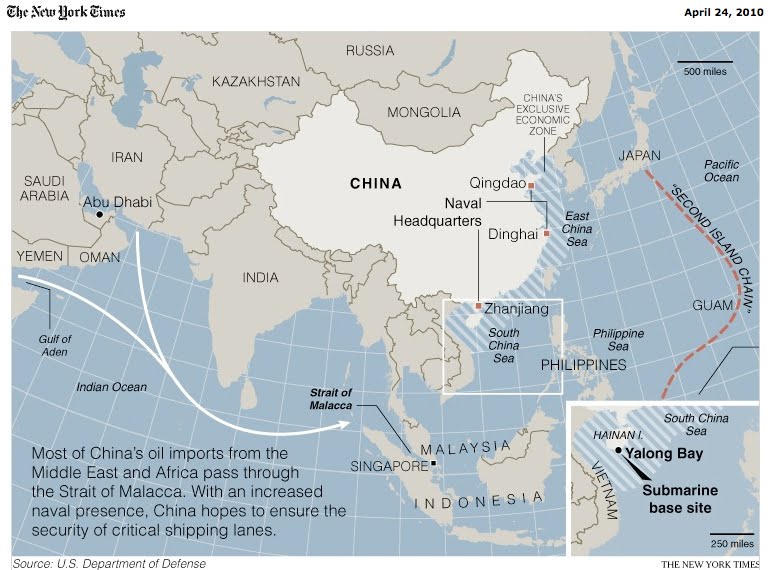
YALONG BAY, China — The Chinese military is seeking to project naval power well beyond the Chinese coast, from the oil ports of the Middle East to the shipping lanes of the Pacific, where the United States Navy has long reigned as the dominant force, military officials and analysts say.
China calls the new strategy “far sea defense,” and the speed with which it is building long-range capabilities has surprised foreign military officials.
The strategy is a sharp break from the traditional, narrower doctrine of preparing for war over the self-governing island of Taiwan or defending the Chinese coast. Now, Chinese admirals say they want warships to escort commercial vessels that are crucial to the country’s economy, from as far as the Persian Gulf to the Strait of Malacca, in Southeast Asia, and to help secure Chinese interests in the resource-rich South and East China Seas.
In late March, two Chinese warships docked in Abu Dhabi, the first time the modern Chinese Navy made a port visit in the Middle East.
The overall plan reflects China’s growing sense of self-confidence and increasing willingness to assert its interests abroad. China’s naval ambitions are being felt, too, in recent muscle flexing with the United States: in March, Chinese officials told senior American officials privately that China would brook no foreign interference in its territorial issues in the South China Sea, said a senior American official involved in China policy.
The naval expansion will not make China a serious rival to American naval hegemony in the near future, and there are few indications that China has aggressive intentions toward the United States or other countries.
But China, now the world’s leading exporter and a giant buyer of oil and other natural resources, is also no longer content to trust the security of sea lanes to the Americans, and its definition of its own core interests has expanded along with its economic clout.
In late March, Adm. Robert F. Willard, the leader of the United States Pacific Command, said in Congressional testimony that recent Chinese military developments were “pretty dramatic.” China has tested long-range ballistic missiles that could be used against aircraft carriers, he said. After years of denials, Chinese officials have confirmed that they intend to deploy an aircraft carrier group within a few years.
China is also developing a sophisticated submarine fleet that could try to prevent foreign naval vessels from entering its strategic waters if a conflict erupted in the region, said Admiral Willard and military analysts.
“Of particular concern is that elements of China’s military modernization appear designed to challenge our freedom of action in the region,” the admiral said.
Yalong Bay, on the southern coast of Hainan island in the South China Sea, is the site of five-star beach resorts just west of a new underground submarine base. The base allows submarines to reach deep water within 20 minutes and roam the South China Sea, which has some of the world’s busiest shipping lanes and areas rich in oil and natural gas that are the focus of territorial disputes between China and other Asian nations.
That has caused concern not only among American commanders, but also among officials in Southeast Asian nations, which have been quietly acquiring more submarines, missiles and other weapons. “Regional officials have been surprised,” said Huang Jing, a scholar of the Chinese military at the National University of Singapore. “We were in a blinded situation. We thought the Chinese military was 20 years behind us, but we suddenly realized China is catching up.”
China is also pressing the United States to heed its claims in the region. In March, Chinese officials told two visiting senior Obama administration officials, Jeffrey A. Bader and James B. Steinberg, that China would not tolerate any interference in the South China Sea, now part of China’s “core interest” of sovereignty, said an American official involved in China policy. It was the first time the Chinese labeled the South China Sea a core interest, on par with Taiwan and Tibet, the official said.
Another element of the Chinese Navy’s new strategy is to extend its operational reach beyond the South China Sea and the Philippines to what is known as the “second island chain” — rocks and atolls out in the Pacific, the official said. That zone significantly overlaps the United States Navy’s area of supremacy.
Japan is anxious, too. Its defense minister, Toshimi Kitazawa, said in mid-April that two Chinese submarines and eight destroyers were spotted on April 10 heading between two Japanese islands en route to the Pacific, the first time such a large Chinese flotilla had been seen so close to Japan. When two Japanese destroyers began following the Chinese ships, a Chinese helicopter flew within 300 feet of one of the destroyers, the Japanese Defense Ministry said.
Since December 2008, China has maintained three ships in the Gulf of Aden to contribute to international antipiracy patrols, the first deployment of the Chinese Navy beyond the Pacific. The mission allows China to improve its navy’s long-range capabilities, analysts say.
A 2009 Pentagon report estimated Chinese naval forces at 260 vessels, including 75 “principal combatants” — major warships — and more than 60 submarines. The report noted the building of an aircraft carrier, and said China “continues to show interest” in acquiring carrier-borne jet fighters from Russia. The United States Navy has 286 battle-force ships and 3,700 naval aircraft, though ship for ship the American Navy is considered qualitatively superior to the Chinese Navy.
The Pentagon does not classify China as an enemy force. But partly in reaction to China’s growth, the United States has recently transferred submarines from the Atlantic to the Pacific so that most of its nuclear-powered attack submarines are now in the Pacific, said Bernard D. Cole, a former American naval officer and a professor at the National War College in Washington.
The United States has also begun rotating three to four submarines on deployments out of Guam, reviving a practice that had ended with the cold war, Mr. Cole said.
American vessels now frequently survey the submarine base at Hainan island, and that activity leads to occasional friction with Chinese ships. A survey mission last year by an American naval ship, the Impeccable, resulted in what Pentagon officials said was harassment by Chinese fishing vessels; the Chinese government said it had the right to block surveillance in those waters because they are an “exclusive economic zone” of China.
The United States and China have clashing definitions of such zones, defined by a United Nations convention as waters within 200 nautical miles of a coast. The United States says international law allows a coastal country to retain only special commercial rights in the zones, while China contends the country can control virtually any activity within them.
Military leaders here maintain that the Chinese Navy is purely a self-defense force. But the definition of self-defense has expanded to encompass broad maritime and economic interests, two Chinese admirals contended in March.
“With our naval strategy changing now, we are going from coastal defense to far sea defense,” Rear Adm. Zhang Huachen, deputy commander of the East Sea Fleet, said in an interview with Xinhua, the state news agency.
“With the expansion of the country’s economic interests, the navy wants to better protect the country’s transportation routes and the safety of our major sea lanes,” he added. “In order to achieve this, the Chinese Navy needs to develop along the lines of bigger vessels and with more comprehensive capabilities.”
The navy gets more than one-third of the overall Chinese military budget, “reflecting the priority Beijing currently places on the navy as an instrument of national security,” Mr. Cole said. China’s official military budget for 2010 is $78 billion, but the Pentagon says China spends much more than that amount. Last year, the Pentagon estimated total Chinese military spending at $105 billion to $150 billion, still much less than what the United States spends on defense. For comparison, the Obama administration proposed $548.9 billion as the Pentagon’s base operating budget for next year.
The Chinese Navy’s most impressive growth has been in its submarine fleet, said Mr. Huang, the scholar in Singapore. It recently built at least two Jin-class submarines, the first regularly active ones in the fleet with ballistic missile capabilities, and two more are under construction. Two Shang-class nuclear-powered attack submarines recently entered service.
Countries in the region have responded with their own acquisitions, said Carlyle A. Thayer, a professor at the Australian Defense Force Academy. In December, Vietnam signed an arms deal with Russia that included six Kilo-class submarines, which would give Vietnam the most formidable submarine fleet in Southeast Asia. Last year, Malaysia took delivery of its first submarine, one of two ordered from France, and Singapore began operating one of two Archer-class submarines bought from Sweden.
Last fall, during a speech in Washington, Lee Kuan Yew, the former Singaporean leader, reflected widespread anxieties when he noted China’s naval rise and urged the United States to maintain its regional presence. “U.S. core interest requires that it remains the superior power on the Pacific,” he said. “To give up this position would diminish America’s role throughout the world.”


Beijing learning about soft power
By James Holmes Wednesday, Jan 27, 2010, Page 8Call it disaster-relief judo.
China pulled off a nifty feat of diplomatic one-upsmanship following the Haitian earthquake, rushing 6 cargo plane loaded with relief supplies to the stricken country before US Navy vessels (or USAF plane) could reach the scene.
 Bragged the official People’s Daily: “It was the Chinese rescuers, not the Americans, who were among the first relief personnel to arrive in the Caribbean country, even though China is farther away from Haiti than the US.” Not so fast. In the contest for first impressions, China emerged the clear victor. However, unless Beijing follows up with a serious humanitarian campaign, history will remember its post-earthquake relief flight as a publicity stunt, if at all.
 “Soft power,” a concept much in vogue in Asia and the West, helps explain why. Harvard University professor Joseph Nye, who coined the term, says soft power represents the “ability to entice and attract.” It is a byproduct of an appealing culture, policies or other attributes. Nye says a nation rich in soft power improves its chances of success in world politics “because other countries want to follow it, admiring its values, emulating its example, aspiring to its level of prosperity and openness.”
As my colleague Toshi Yoshihara puts it, soft power is like a “pheromone” inherent to attractive nations. A nation so gifted can apply it as “perfume,” enhancing its ability to persuade. However, a nation’s good name requires careful tending. Claimants to soft power must profess altruistic ideals and back them up with deeds consistently over time, setting a pattern of benign behavior. Soft-power diplomacy involves more than atmospherics, boastfulness or isolated acts of mercy.
These subtleties appear lost on Beijing. The US enjoys major reserves of soft power owing to its openness and to liberal traditions embodied in founding documents like the Declaration of Independence and the US Constitution. India benefits from its history of nonviolence and nonalignment. As the historic center of a Sinocentric order in Asia, China too might seem awash in soft power, but by Nye’s definition, the outlook is more mixed.
China — or, more specifically, the Chinese Communist Party (CCP) regime — must earn a reputation for benevolence.
 True, China’s beguiling history and Confucian heritage exert a power of attraction, throughout Asia and beyond. However, not so long ago, the CCP regime went to extravagant lengths to dissociate itself from — and indeed destroy — much of that culture. That gives fellow Asians pause. In a sense, consequently, Beijing is starting anew in its quest for soft power. Rendering assistance after natural disasters represents one opportune way for Beijing to establish a good name.
China got off to a slow start refurbishing its reputation. It stood idle from 2004 to 2005, after a massive tsunami swept across South Asia. Twenty-one nations — including minor powers like Switzerland, with a fraction of China’s resources — rushed a combined 102 ships and 196 aircraft to the afflicted region. The size of the Chinese contingent? Zero. Despite Beijing’s claim to leadership in Asia, the People’s Liberation Army (PLA) found itself a spectator, unable to stage naval forces beyond China’s immediate environs.
Nor was Beijing especially generous by other measures. The People’s Daily was reduced to arguing lamely that the miserly US$90 million donated by China constituted a “tangible” contribution to tsunami relief. The leadership’s puzzling indifference, coupled with the PLA’s shortfall in capacity, left the US military, the Japan Self-Defense Forces and other expeditionary forces to reap the goodwill that repays acts viewed as selfless.
China, in short, found itself upstaged by prospective rivals in Southeast and South Asia, regions of real and growing Chinese interest. Its leadership in effect vowed “never again” to miss out on major humanitarian undertakings.
By rushing supplies and personnel to the Caribbean, Beijing wants to burnish an image tarnished through past inaction, expiating memories of the tsunami debacle. As a bonus, it hopes to outshine the US military in its own backyard.
That last goal is whimsical. Belated or not, US relief efforts will dwarf any effort China can mount in the Caribbean, but that doesn’t really matter.
Soft power is not a zero-sum game, in which one player gains only at another’s expense. Lending a hand so far from Chinese shores represents an admirable act on Beijing’s part — an act that will energize Chinese soft power, provided it’s part of a sustained errand of mercy. James Holmes is an associate professor at the US Naval War College. The views voiced here are his alone.
 result of its large-scale military buildup that threatens U.S. access and freedom of navigation in East Asia, according to a forthcoming congressional report.