Showing posts with label Varyag. Show all posts

Monday, November 29, 2010

Shi Lang (Varyag) Nearly Complete

 
Background:
China Building A Pair of Aircraft Carrier
 Chinese Military Seeks to Extend Its Naval Power 

The People’s Republic of China’s PLAN in the Indian and Pacific Oceans: The Game is Changing and the US is Now on the Defensive
 
Chinese missile could shift Pacific power balance

First Chinese Carrier Aviators

Ukraine wants to become the international capital of carrier aviation training

Admiral Kuznetzov Sukhoi Su-33 footage...
 

Work is picking up on what appears to be China's first aircraft carrier, the Shi Lang. For eight years now, China has been tinkering with a half finished Russian aircraft carrier. 
Two years ago, this ex-Russian aircraft carrier, Varyag, was renamed the Shi Lang (after the Chinese general who took possession of Taiwan in 1681, the first time China ever paid any attention to the island) and given the pennant number 83.
Until last year, progress was slow. But there has been a lot of work lately. Early in 2009, China moved the Shi Lang into dry dock, where work is now obviously underway to install engines and other heavy equipment. 

A year ago, the radar mast was completed, and now there is a Chinese radar system being installed. Officially, the Chinese say nothing. But the dockyard workers keep at it, and it's possible to take photos from a distance. It appears that the Shi Lang is a year or so from going to sea.
For a long time, no one was sure exactly what plans the Chinese had for the Shi Lang, although work had been going on for years. It's long been believed that the carrier will eventually be used to train the first generation of Chinese carrier aviators and sailors. Or maybe not. No one who really knows anything about the plans for the Shi Lang, is speaking up. All is observation (from a distance, but good pix are numerous) and speculation.

The Varyag has been in a Chinese shipyard at Dailan since 2002. For a long time, few visible signs of work were visible; like a new paint job (in the gray shade used by the Chinese navy) and ongoing work on the superstructure (particularly the tall island on the flight deck.) Many workers could be seen on the ship, and material was seen going into (new stuff) and out of (old stuff) of the ship. Shipyard workers report ever tighter security on the carrier, and stern instructions to not report details of what is happening on the ship.

The Varyag is one of the Kuznetsov class carriers that Russia began building in the 1980s. 

Originally the Kuznetsovs were to be 90,000 ton, nuclear powered ships, similar to American carriers (complete with steam catapults). 

Instead, because of the high cost, and the complexity of modern (American style) carriers, the Russians were forced to scale back their plans, and ended up with the 65,000 ton (full load ) ships that lacked steam catapults, and used a ski jump type flight deck instead. Nuclear power was dropped, but the Kuznetsov class was still a formidable design. The 323 meter (thousand foot) long ship normally carries a dozen navalized Su-27s (called Su-33s), 14 Ka-27PL anti-submarine helicopters, two electronic warfare helicopters and two search and rescue helicopters

But the ship can carry up to 36 Su-33s and sixteen helicopters. 

The ship carries 2,500 tons of aviation fuel, allowing it to generate 500-1,000 aircraft and helicopter sorties. Crew size is 2,500 (or 3,000 with a full aircraft load.) 
Only two ships of this class exist; the original Kuznetsov, which is in Russian service, and the Varyag.
The Chinese have been in touch with Russian naval construction firms, and may have purchased plans and technology for equipment installed in the Kuznetsov. 

Some Chinese leaders have quipped about having a carrier by 2010 (this would have to be a refurbished Varyag), but now 2012 is more likely. Even that may be too soon, as the Chinese have been burned before when they tried to build new military technology in a hurry. The Chinese appear intent on getting it right the first time.

Two years ago, China announced that its first class of carrier aviators had begun training at the Dalian Naval Academy. The naval officers are undergoing a four year course of instruction to turn them into fighter pilots capable of operating off a carrier. 


China already has an airfield, in the shape of a carrier deck, built at an inland facility. The Russians have warned China that it may take them a decade or more to develop the knowledge and skills needed to efficiently run an aircraft carrier. The Chinese are game, and are slogging forward.

Saturday, April 24, 2010

Chinese Military Seeks to Extend Its Naval Power

The strategy reflects China’s growing sense of self-confidence and increasing willingness to assert its interests abroad.

Chinese Military Seeks to Extend Its Naval Power
By EDWARD WONG Published: April 23, 2010

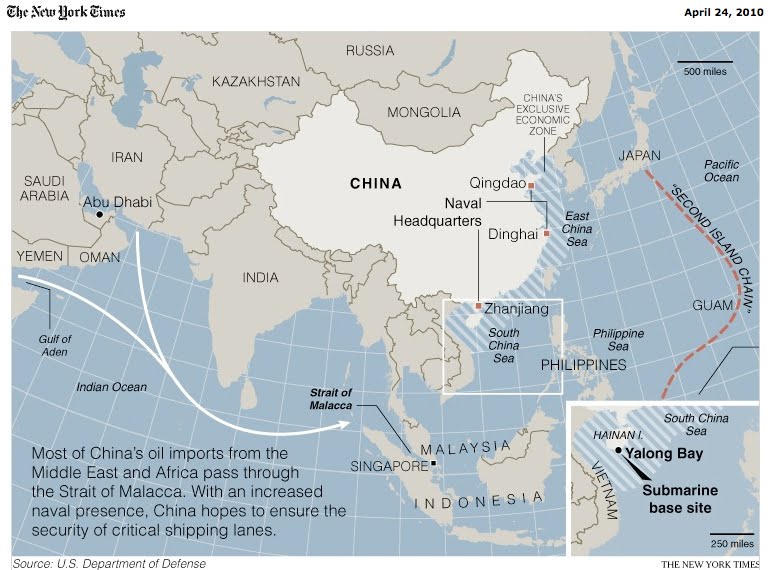
YALONG BAY, China — The Chinese military is seeking to project naval power well beyond the Chinese coast, from the oil ports of the Middle East to the shipping lanes of the Pacific, where the United States Navy has long reigned as the dominant force, military officials and analysts say.

China calls the new strategy “far sea defense,” and the speed with which it is building long-range capabilities has surprised foreign military officials.

The strategy is a sharp break from the traditional, narrower doctrine of preparing for war over the self-governing island of Taiwan or defending the Chinese coast. Now, Chinese admirals say they want warships to escort commercial vessels that are crucial to the country’s economy, from as far as the Persian Gulf to the Strait of Malacca, in Southeast Asia, and to help secure Chinese interests in the resource-rich South and East China Seas.

In late March, two Chinese warships docked in Abu Dhabi, the first time the modern Chinese Navy made a port visit in the Middle East.

The overall plan reflects China’s growing sense of self-confidence and increasing willingness to assert its interests abroad. China’s naval ambitions are being felt, too, in recent muscle flexing with the United States: in March, Chinese officials told senior American officials privately that China would brook no foreign interference in its territorial issues in the South China Sea, said a senior American official involved in China policy.

The naval expansion will not make China a serious rival to American naval hegemony in the near future, and there are few indications that China has aggressive intentions toward the United States or other countries.

But China, now the world’s leading exporter and a giant buyer of oil and other natural resources, is also no longer content to trust the security of sea lanes to the Americans, and its definition of its own core interests has expanded along with its economic clout.

In late March, Adm. Robert F. Willard, the leader of the United States Pacific Command, said in Congressional testimony that recent Chinese military developments were “pretty dramatic.” China has tested long-range ballistic missiles that could be used against aircraft carriers, he said. After years of denials, Chinese officials have confirmed that they intend to deploy an aircraft carrier group within a few years.

China is also developing a sophisticated submarine fleet that could try to prevent foreign naval vessels from entering its strategic waters if a conflict erupted in the region, said Admiral Willard and military analysts.

“Of particular concern is that elements of China’s military modernization appear designed to challenge our freedom of action in the region,” the admiral said.

Yalong Bay, on the southern coast of Hainan island in the South China Sea, is the site of five-star beach resorts just west of a new underground submarine base. The base allows submarines to reach deep water within 20 minutes and roam the South China Sea, which has some of the world’s busiest shipping lanes and areas rich in oil and natural gas that are the focus of territorial disputes between China and other Asian nations.

That has caused concern not only among American commanders, but also among officials in Southeast Asian nations, which have been quietly acquiring more submarines, missiles and other weapons. “Regional officials have been surprised,” said Huang Jing, a scholar of the Chinese military at the National University of Singapore. “We were in a blinded situation. We thought the Chinese military was 20 years behind us, but we suddenly realized China is catching up.”

China is also pressing the United States to heed its claims in the region. In March, Chinese officials told two visiting senior Obama administration officials, Jeffrey A. Bader and James B. Steinberg, that China would not tolerate any interference in the South China Sea, now part of China’s “core interest” of sovereignty, said an American official involved in China policy. It was the first time the Chinese labeled the South China Sea a core interest, on par with Taiwan and Tibet, the official said.

Another element of the Chinese Navy’s new strategy is to extend its operational reach beyond the South China Sea and the Philippines to what is known as the “second island chain” — rocks and atolls out in the Pacific, the official said. That zone significantly overlaps the United States Navy’s area of supremacy.

Japan is anxious, too. Its defense minister, Toshimi Kitazawa, said in mid-April that two Chinese submarines and eight destroyers were spotted on April 10 heading between two Japanese islands en route to the Pacific, the first time such a large Chinese flotilla had been seen so close to Japan. When two Japanese destroyers began following the Chinese ships, a Chinese helicopter flew within 300 feet of one of the destroyers, the Japanese Defense Ministry said.

Since December 2008, China has maintained three ships in the Gulf of Aden to contribute to international antipiracy patrols, the first deployment of the Chinese Navy beyond the Pacific. The mission allows China to improve its navy’s long-range capabilities, analysts say.
A 2009 Pentagon report estimated Chinese naval forces at 260 vessels, including 75 “principal combatants” — major warships — and more than 60 submarines. The report noted the building of an aircraft carrier, and said China “continues to show interest” in acquiring carrier-borne jet fighters from Russia. The United States Navy has 286 battle-force ships and 3,700 naval aircraft, though ship for ship the American Navy is considered qualitatively superior to the Chinese Navy.
The Pentagon does not classify China as an enemy force. But partly in reaction to China’s growth, the United States has recently transferred submarines from the Atlantic to the Pacific so that most of its nuclear-powered attack submarines are now in the Pacific, said Bernard D. Cole, a former American naval officer and a professor at the National War College in Washington.

The United States has also begun rotating three to four submarines on deployments out of Guam, reviving a practice that had ended with the cold war, Mr. Cole said.

American vessels now frequently survey the submarine base at Hainan island, and that activity leads to occasional friction with Chinese ships. A survey mission last year by an American naval ship, the Impeccable, resulted in what Pentagon officials said was harassment by Chinese fishing vessels; the Chinese government said it had the right to block surveillance in those waters because they are an “exclusive economic zone” of China.

The United States and China have clashing definitions of such zones, defined by a United Nations convention as waters within 200 nautical miles of a coast. The United States says international law allows a coastal country to retain only special commercial rights in the zones, while China contends the country can control virtually any activity within them.

Military leaders here maintain that the Chinese Navy is purely a self-defense force. But the definition of self-defense has expanded to encompass broad maritime and economic interests, two Chinese admirals contended in March.

“With our naval strategy changing now, we are going from coastal defense to far sea defense,” Rear Adm. Zhang Huachen, deputy commander of the East Sea Fleet, said in an interview with Xinhua, the state news agency.

“With the expansion of the country’s economic interests, the navy wants to better protect the country’s transportation routes and the safety of our major sea lanes,” he added. “In order to achieve this, the Chinese Navy needs to develop along the lines of bigger vessels and with more comprehensive capabilities.”

The navy gets more than one-third of the overall Chinese military budget, “reflecting the priority Beijing currently places on the navy as an instrument of national security,” Mr. Cole said. China’s official military budget for 2010 is $78 billion, but the Pentagon says China spends much more than that amount. Last year, the Pentagon estimated total Chinese military spending at $105 billion to $150 billion, still much less than what the United States spends on defense. For comparison, the Obama administration proposed $548.9 billion as the Pentagon’s base operating budget for next year.

The Chinese Navy’s most impressive growth has been in its submarine fleet, said Mr. Huang, the scholar in Singapore. It recently built at least two Jin-class submarines, the first regularly active ones in the fleet with ballistic missile capabilities, and two more are under construction. Two Shang-class nuclear-powered attack submarines recently entered service.

Countries in the region have responded with their own acquisitions, said Carlyle A. Thayer, a professor at the Australian Defense Force Academy. In December, Vietnam signed an arms deal with Russia that included six Kilo-class submarines, which would give Vietnam the most formidable submarine fleet in Southeast Asia. Last year, Malaysia took delivery of its first submarine, one of two ordered from France, and Singapore began operating one of two Archer-class submarines bought from Sweden.

Last fall, during a speech in Washington, Lee Kuan Yew, the former Singaporean leader, reflected widespread anxieties when he noted China’s naval rise and urged the United States to maintain its regional presence. “U.S. core interest requires that it remains the superior power on the Pacific,” he said. “To give up this position would diminish America’s role throughout the world.”


Sunday, January 4, 2009

China Building A Pair of Aircraft Carrier

In Shanghai, China, shipyard employees report that the Chinese Navy has ordered two 60,000 ton aircraft carriers, and preparations are under way to begin construction this year, with completion scheduled for 2015.

Fifty Russian Su-33 jet fighters would be imported to serve on the new carriers. Chinese naval aviators would use the former Russian carrier Varyag as a training ship, to learn how to operate the Su-33s off carriers.

Recently, Chinese officials visited Ukraine and inspected the naval aviation training facilities that were built there before the Soviet Union dissolved. Ukraine wants to use those facilities to establish an international center for training carrier aviators.

Chinese admirals have said they need carriers to assure Chinese access to raw materials, especially oil, that comes by sea. China hopes to get key components for the carrier from Russian manufacturers. If that is possible, completion of the carriers might be speeded up by a year or two.

Three months ago, China announced that its first class of carrier aviators had begun training at the Dalian Naval Academy. The naval officers will undergo a four year course of instruction to turn them into fighter pilots capable of operating off a carrier. China already has an airfield, in the shape of a carrier deck, built at an inland facility. The Russians have warned China that it may take them a decade or more to develop the knowledge and skills needed to efficiently run an aircraft carrier. The Chinese are game, and are slogging forward.

A year ago, the Russian aircraft carrier Varyag was renamed
the Shi Lang (after the Chinese general who took possession of Taiwan in 1681, the first time China ever paid any attention to the island) and given the pennant number 83.

The Chinese have been refurbishing the Varyag, one of the Kuznetsov class that Russia began building in the 1980s, for several years now. It is expected to be ready for sea trials any day now.

Originally the Kuznetsovs were conceived of as 90,000 ton, nuclear powered ships, similar to American carriers (complete with steam catapults). Instead, because of the cost, and the complexity of modern (American style) carriers, the Russians were forced to scale back their goals, and ended up with the 65,000 ton (full load ) ships that lacked steam catapults, and used a ski jump type flight deck instead. Nuclear power was dropped, but the Kuznetsov class was still a formidable design.

The thousand foot long carrier normally carries a dozen navalized Su-27s (called Su-33s), 14 Ka-27PL anti-submarine helicopters, two electronic warfare helicopters and two search and rescue helicopters. But the ship can carry up to 36 Su-33s and sixteen helicopters. The ship carries 2,500 tons of aviation fuel, allowing it to generate 500-1,000 aircraft and helicopter sorties. Crew size is 2,500 (or 3,000 with a full aircraft load.) Only two ships of this class exist; the original Kuznetsov, which is in Russian service, and the Varyag.

The Chinese have been in touch with Russian naval construction firms, and may have purchased plans and technology for equipment installed in the Kuznetsov.

Some Chinese leaders have quipped about having a carrier by 2010 (this would have to be a refurbished Varyag). Even that would be an ambitious schedule, and the Chinese have been burned before when they tried to build new military technology in a hurry.

Tuesday, December 9, 2008

Ukraine wants to become the international capital of carrier aviation training

Decades ago, the Soviet Union built its aircraft carrier pilot training facilities at Nitka, outside Odessa, a city that is, since the dissolution of the Soviet Union in 1991, in the independent country of Ukraine.

Ukraine is now trying to attract China and India as customers for these facilities. China has signed up, and is buying aircraft carrier equipment made in Ukraine.

China is expanding its own carrier aviation training center, and is buying consulting and technical services from Ukraine to assist in that project.

One interesting item to come out of the visits by Chinese naval aviation personnel to Ukraine, is that the Varyag, a former Soviet carrier that China bought from Russia six years ago, is being restored for use as a training carrier. This explains the spotty restoration work that has been done on the Varyag. However, the Chinese indicated that the Varyag could still be turned into an operational combat carrier, either before or after it enters service as a training ship.

The Nitka base was used by the Soviets to train MiG-29K and Su-33 pilots for service on their carriers. India is buying MiG-29Ks for their carriers, and China is apparently building, with Ukrainian help, a carrier version of the Su-30 (which is what the Su-33 was).

Friday, September 19, 2008

First Chinese Carrier Aviators

China announced that its first class of carrier aviators had begun training at the Dalian Naval Academy.

The naval officers will undergo a four year course of instruction to turn them into fighter pilots capable of operating off a carrier.

China already has an airfield, in the shape of a carrier deck, built at an inland facility. The Russians have warned China that it may take them a decade or more to develop the knowledge and skills needed to efficiently run an aircraft carrier. The Chinese are game, and are slogging forward.

Earlier this year, the Russian aircraft carrier Varyag was renamed the Shi Lang (after the Chinese general who took possession of Taiwan in 1681, the first time China ever paid any attention to the island) and given the pennant number 83. The Chinese have been refurbishing the Varyag, one of the Kuznetsov class that Russia began building in the 1980s, for several years now. It is expected to be ready for sea trials by the end of the year.
The Varyag has been tied up in a Chinese shipyard at Dailan since 2002. While the ship is under guard, it can be seen from a nearby highway. From that vantage point, local military and naval buffs have noted that some kind of work is being done on the ship. The only visible signs of this work are a new paint job (in the gray shade used by the Chinese navy) and ongoing work on the superstructure (particularly the tall island on the flight deck.)
Many workers can be seen on the ship, and material is seen going into (new stuff) and out of (old stuff) the ship. The new contracts are believed to be for more equipment for the Varyag, in addition to the non-custom stuff already going into the ship.

Originally the Kuznetsovs were conceived of as 90,000 ton, nuclear powered ships, similar to American carriers (complete with steam catapults). Instead, because of the cost, and the complexity of modern (American style) carriers, the Russians were forced to scale back their goals, and ended up with the 65,000 ton (full load ) ships that lacked steam catapults, and used a ski jump type flight deck instead. Nuclear power was dropped, but the Kuznetsov class was still a formidable design.

The thousand foot long carrier normally carries a dozen navalized Su-27s (called Su-33s), 14 Ka-27PL anti-submarine helicopters, two electronic warfare helicopters and two search and rescue helicopters. But the ship can carry up to 36 Su-33s and sixteen helicopters. The ship carries 2,500 tons of aviation fuel, allowing it to generate 500-1,000 aircraft and helicopter sorties. Crew size is 2,500 (or 3,000 with a full aircraft load.) Only two ships of this class exist; the original Kuznetsov, which is in Russian service, and the Varyag. Currently, the Kuznetsov is operating in the Mediterranean.

The Chinese have been in touch with Russian naval construction firms, and may have purchased plans and technology for equipment installed in the Kuznetsov. Some Chinese leaders have quipped about having a carrier by 2010 (this would have to be a refurbished Varyag). Even that would be an ambitious schedule, and the Chinese have been burned before when they tried to build new military technology in a hurry.