Showing posts with label Hainan island. Show all posts

Monday, November 15, 2010

Chinese missiles can ravage U.S. bases - Report cites 5 sites in Asia


China's military can destroy five out of six U.S. bases in Asia with waves of missile strikes as the result of its large-scale military buildup that threatens U.S. access and freedom of navigation in East Asia, according to a forthcoming congressional report.

"The main implication of China's improved air and conventional missile capabilities is a dramatic increase in the [People's Liberation Army's] ability to inhibit U.S. military operations in the region," a late draft of the report by the U.S.-China Economic and Security Review Commission concludes.

The U.S. government has growing concerns over what the report says are "China's improving capabilities to challenge the U.S. military's freedom of access in East Asia."

The draft report - the final version is set for release Wednesday - has been disclosed as tensions in Asia intensify over growing assertiveness by the Chinese military in the Yellow Sea, the East China Sea and the South China Sea.


President Obama, during his recent visit to Asia, frequently mentioned growing U.S. concerns about "maritime security" and the need for stronger alliances against regional threats.

In Japan on Saturday, Prime Minister Naoto Kan thanked Mr. Obama for U.S. support during Tokyo's recent dispute with China over Chinese fishing near Japan's Senkaku Islands.

"For the peace and security of the countries in the region, the presence of the United States and the presence of the U.S. military, I believe, is becoming only increasingly important," Mr. Kan said.
 

Defense Secretary Robert M. Gates said last month during theJapan-China dispute that the Senkakus are covered by the U.S.-Japanese defense treaty, a signal to China that the U.S. military is prepared to defend the islands from Chinese encroachment.

The United States also could face a Chinese missile strike on its bases and ships in a future conflict with China over Taiwan, according to the China commission report.

In addition to missiles, the Chinese military buildup includes major deployments and upgrades of Chinese jet fighters that have increased ranges and better weapons, as well as greatly improved air defenses, the report says.


The report says that in the event of a conflict, China missiles alone would be enough to attack and shut down five of the six major U.S. military bases in the region. Guam is the exception because it is 1,800 miles from China.

China's growing long-range bomber arsenal, however, means the "PLA Air Force's bomber fleet soon could allow it to target
Guam, where the sixth U.S. Air Force base is located," the report says.

Guam is the site of a major U.S. military buildup in Asia, with the addition of new submarines and bombers and spy aircraft.

U.S. bases vulnerable to Chinese missile attack include two in South Korea, namely Osan and Kunsan air bases, the report says. Each could be destroyed with attacks by 480 short- and medium-range ballistic missiles and 350 ground-launched cruise missiles for each base. The bases are some 240 to 400 miles from China.

In Japan, U.S. bases at Kadena, Misawa and Yokota could be knocked out with 80 medium- and short-range ballistic missiles and 350 ground-launched cruise missiles, the report says. Those bases are between 525 miles and 680 miles from China.

"Not only would U.S. bases be threatened in the event of a conflict with China but so too would U.S. deployed aircraft," the report says.

For the past 20 years, China's missile and naval forces have been transformed from an outdated military to "one with modern aircraft and air defenses and a large, growing arsenal of conventional ballistic and land-attack cruise missiles," the report says.

Since 2000, for example, Chinese short-range missile forces alone increased from a brigade of up to 36 launchers to as many as 252 today, the report states.

Additionally, China now has up to 500 DH-10 land-attack cruise missiles with ranges of up to 932 miles. A second, new cruise missile, the YJ-63 also is deployed and has a range of more than 125 miles.

"In addition to increasing the number of missiles, China is also extending their range, improving their accuracy, and increasing their payload," the report says.


Thursday, August 5, 2010

Chinese missile could shift Pacific power balance

Nothing projects U.S. global air and sea power more vividly than supercarriers. That can reach deep into even landlocked trouble zones, America's virtually invincible carrier fleet has long enforced its dominance of the high seas.

China may soon put an end to that.
U.S. naval planners are scrambling to deal with what analysts say is a game-changing weapon being developed by China — an unprecedented carrier-killing missile called the Dong Feng 21D that could be launched from land with enough accuracy to penetrate the defenses of even the most advanced moving aircraft carrier at a distance of more than 3,000 km (1,900 mi).
Analysts say final testing of the missile could come as soon as the end of this year, though questions remain about how fast China will be able to perfect its accuracy to the level needed to threaten a moving carrier at sea.

The weapon, a version of which was displayed last year in a Chinese military parade, could revolutionize China's role in the Pacific balance of power, seriously weakening Washington's ability to intervene in any potential conflict over Taiwan or North Korea.

It could also deny U.S. ships safe access to international waters near China's 11,200-mile (18,000-kilometer) -long coastline. While a nuclear bomb could theoretically sink a carrier, assuming its user was willing to raise the stakes to that levels, the conventionally armed Dong Feng 21D's uniqueness is in its ability to hit a powerfully defended moving target with pin-point precision.
Funded by annual double-digit increases in the defense budget for almost every year of the past two decades, the Chinese navy has become Asia's largest and has expanded beyond its traditional mission of retaking Taiwan to push its sphere of influence deeper into the Pacific and protect vital maritime trade routes.
"The Navy has long had to fear carrier-killing capabilities," said Patrick Cronin, senior director of the Asia-Pacific Security Program at the nonpartisan, Washington-based Center for a New American Security.

"The emerging Chinese antiship missile capability, and in particular the DF 21D, represents the first post-Cold War capability that is both potentially capable of stopping our naval power projection and deliberately designed for that purpose."

Background - Chinese Military Seeks to Extend Its Naval Power

Backgroung - Beijing learning about soft power

Background - China Mech

Background - U.S. Says Settling South China Sea Disputes ‘Pivotal’

Setting the stage for a possible conflict, Beijing has grown increasingly vocal in its demands for the U.S. to stay away from the wide swaths of ocean — covering much of the Yellow, East and South China seas — where it claims exclusivity.

It strongly opposed plans to hold U.S.-South Korean war games in the Yellow Sea off the northeastern Chinese coast, saying the participation of the USS George Washington supercarrier, with its 1,092-foot (333-meter) flight deck and 6,250 personnel, would be a provocation because it put Beijing within striking range of U.S. F-18 warplanes.

Background - China Deploys Bomber Coverage Of Korea And Taiwan From Shandong Peninsula


The carrier instead took part in maneuvers held farther away in the Sea of Japan.


U.S. officials deny Chinese pressure kept it away, and say they will not be told by Beijing where they can operate. "We reserve the right to exercise in international waters anywhere in the world,"

Rear Adm. Daniel Cloyd, who headed the U.S. side of the exercises, said aboard the carrier during the maneuvers, which ended last week.
But the new missile could undermine that policy.

"China can reach out and hit the U.S. well before the U.S. can get close enough to the mainland to hit back," said Toshi Yoshihara, an associate professor at the U.S. Naval War College. He said U.S. ships have only twice been that vulnerable — against Japan in World War II and against Soviet bombers in the Cold War.

Carrier-killing missiles "could have an enduring psychological effect on U.S. policymakers, It underscores more broadly that the U.S. Navy no longer rules the waves as it has since the end of World War II. The stark reality is that sea control cannot be taken for granted anymore."

Yoshihara said the weapon is causing considerable consternation in Washington, though — with attention focused on land wars in Afghanistan and Iraq — its implications haven't been widely discussed in public. Analysts note that while much has been made of China's efforts to ready a carrier fleet of its own, it would likely take decades to catch U.S. carrier crews' level of expertise, training and experience.
But Beijing does not need to match the U.S. carrier for carrier. The Dong Feng 21D, smarter, and vastly cheaper, could successfully attack a U.S. carrier, or at least deter it from getting too close.
Background - China Building A Pair of Aircraft Carrier

U.S. Defense Secretary Robert Gates warned of the threat in a speech last September at the Air Force Association Convention.
..
"When considering the military-modernization programs of countries like China, we should be concerned less with their potential ability to challenge the U.S. symmetrically — fighter to fighter or ship to ship — and more with their ability to disrupt our freedom of movement and narrow our strategic options."
Gates said China's investments in cyber and anti-satellite warfare, anti-air and anti-ship weaponry, along with ballistic missiles, "could threaten America's primary way to project power" through its forward air bases and carrier strike groups.

Background - Congress warned of Chinese cyber, space threats


Background - Cyberattack Gets Worse


Background - China’s Cyber-Militia

The Pentagon has been worried for years about China getting an anti-ship ballistic missile. The Pentagon considers such a missile an "anti-access," weapon, meaning that it could deny others access to certain areas.


The Air Force's top surveillance and intelligence officer, Lt. Gen. David Deptula, told reporters this week that China's effort to increase anti-access capability is part of a worrisome trend.

He did not single out the DF 21D, but said: "While we might not fight the Chinese, we may end up in situations where we'll certainly be opposing the equipment that they build and sell around the world."

Questions remain over when — and if — China will perfect the technology; hitting a moving carrier is no mean feat, requiring state-of-the-art guidance systems, and some experts believe it will take China a decade or so to field a reliable threat. Others, however, say final tests of the missile could come in the next year or two.
Former Navy commander James Kraska, a professor of international law and sea power at the U.S. Naval War College, recently wrote a controversial article in the magazine Orbis outlining a hypothetical scenario set just five years from now in which a Deng Feng 21D missile with a penetrator warhead sinks the USS George Washington.
That would usher in a "new epoch of international order in which Beijing emerges to displace the United States." While China's Defense Ministry never comments on new weapons before they become operational, the DF 21D — which would travel at 10 times the speed of sound and carry conventional payloads.
A pseudonymous article posted on Xinhuanet, website of China's official news agency, imagines the U.S. dispatching the George Washington to aid Taiwan against a Chinese attack.

The Chinese would respond with three salvos of DF 21D, the first of which would pierce the hull, start fires and shut down flight operations, the article says. The second would knock out its engines and be accompanied by air attacks. The third wave, the article says, would "send the George Washington to the bottom of the ocean."

(Dong-Feng) DF-21D (CSS-5 Mod-4(NATO))
Anti-ship ballistic missile

Dong-Feng means "East Wind"

Originally developed for strategic purposes, the DF-21's later variants were designed for both nuclear and conventional missions. As well as a nuclear warhead of around 300kt, it is thought that high explosive, submunition and chemical warheads are also available.

The latest DF-21D was said to be the world's first and only anti-ship ballistic missile (ASBM). The DF-21 has also been developed into space launcher and anti-satellite/anti-missile weapon carrier.

The US Department of Defense has stated that China is developing a conventionally-armed high hypersonic land-based anti-ship ballistic missile (ASBM) based on the DF-21, with a range of up to 3,000 km (1,900 mi).
This would be the world's first and only ASBM and the world's first weapons system capable of targeting a moving aircraft carrier strike group from long-range, land-based mobile launchers.
These would combine manoeuvrable reentry vehicles (MaRVs) with some kind of terminal guidance system. Such a missile may have been tested in 2005-6, and the launch of the Jianbing-5/YaoGan-1 and Jianbing-6/YaoGan-2 satellites would give the Chinese targeting information from SAR and visual imaging respectively.
The upgrades would greatly enhance China's ability to conduct sea-denial operations to prevent US carriers from intervention in the Taiwan Strait.
China has recently launched a series of satellites to support its ASBM efforts

Yaogan-VII electro-optical satellite - 9 December 2009

Yaogan-VIII synthetic aperture radar satellite - 14 December 2009

Yaogan-IX Naval Ocean Surveillance System (NOSS) constellation (3 satellites in formation) - 5 March 2010.

Saturday, April 24, 2010

Chinese Military Seeks to Extend Its Naval Power

The strategy reflects China’s growing sense of self-confidence and increasing willingness to assert its interests abroad.

Chinese Military Seeks to Extend Its Naval Power
By EDWARD WONG Published: April 23, 2010

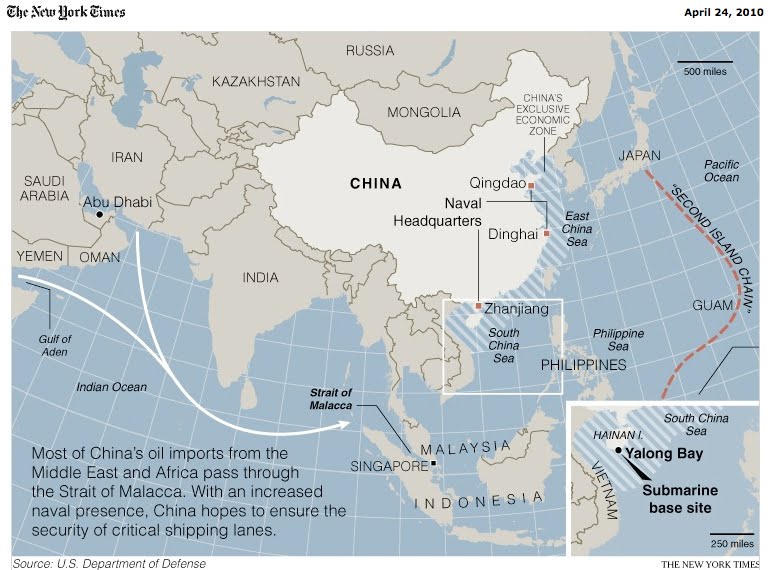
YALONG BAY, China — The Chinese military is seeking to project naval power well beyond the Chinese coast, from the oil ports of the Middle East to the shipping lanes of the Pacific, where the United States Navy has long reigned as the dominant force, military officials and analysts say.

China calls the new strategy “far sea defense,” and the speed with which it is building long-range capabilities has surprised foreign military officials.

The strategy is a sharp break from the traditional, narrower doctrine of preparing for war over the self-governing island of Taiwan or defending the Chinese coast. Now, Chinese admirals say they want warships to escort commercial vessels that are crucial to the country’s economy, from as far as the Persian Gulf to the Strait of Malacca, in Southeast Asia, and to help secure Chinese interests in the resource-rich South and East China Seas.

In late March, two Chinese warships docked in Abu Dhabi, the first time the modern Chinese Navy made a port visit in the Middle East.

The overall plan reflects China’s growing sense of self-confidence and increasing willingness to assert its interests abroad. China’s naval ambitions are being felt, too, in recent muscle flexing with the United States: in March, Chinese officials told senior American officials privately that China would brook no foreign interference in its territorial issues in the South China Sea, said a senior American official involved in China policy.

The naval expansion will not make China a serious rival to American naval hegemony in the near future, and there are few indications that China has aggressive intentions toward the United States or other countries.

But China, now the world’s leading exporter and a giant buyer of oil and other natural resources, is also no longer content to trust the security of sea lanes to the Americans, and its definition of its own core interests has expanded along with its economic clout.

In late March, Adm. Robert F. Willard, the leader of the United States Pacific Command, said in Congressional testimony that recent Chinese military developments were “pretty dramatic.” China has tested long-range ballistic missiles that could be used against aircraft carriers, he said. After years of denials, Chinese officials have confirmed that they intend to deploy an aircraft carrier group within a few years.

China is also developing a sophisticated submarine fleet that could try to prevent foreign naval vessels from entering its strategic waters if a conflict erupted in the region, said Admiral Willard and military analysts.

“Of particular concern is that elements of China’s military modernization appear designed to challenge our freedom of action in the region,” the admiral said.

Yalong Bay, on the southern coast of Hainan island in the South China Sea, is the site of five-star beach resorts just west of a new underground submarine base. The base allows submarines to reach deep water within 20 minutes and roam the South China Sea, which has some of the world’s busiest shipping lanes and areas rich in oil and natural gas that are the focus of territorial disputes between China and other Asian nations.

That has caused concern not only among American commanders, but also among officials in Southeast Asian nations, which have been quietly acquiring more submarines, missiles and other weapons. “Regional officials have been surprised,” said Huang Jing, a scholar of the Chinese military at the National University of Singapore. “We were in a blinded situation. We thought the Chinese military was 20 years behind us, but we suddenly realized China is catching up.”

China is also pressing the United States to heed its claims in the region. In March, Chinese officials told two visiting senior Obama administration officials, Jeffrey A. Bader and James B. Steinberg, that China would not tolerate any interference in the South China Sea, now part of China’s “core interest” of sovereignty, said an American official involved in China policy. It was the first time the Chinese labeled the South China Sea a core interest, on par with Taiwan and Tibet, the official said.

Another element of the Chinese Navy’s new strategy is to extend its operational reach beyond the South China Sea and the Philippines to what is known as the “second island chain” — rocks and atolls out in the Pacific, the official said. That zone significantly overlaps the United States Navy’s area of supremacy.

Japan is anxious, too. Its defense minister, Toshimi Kitazawa, said in mid-April that two Chinese submarines and eight destroyers were spotted on April 10 heading between two Japanese islands en route to the Pacific, the first time such a large Chinese flotilla had been seen so close to Japan. When two Japanese destroyers began following the Chinese ships, a Chinese helicopter flew within 300 feet of one of the destroyers, the Japanese Defense Ministry said.

Since December 2008, China has maintained three ships in the Gulf of Aden to contribute to international antipiracy patrols, the first deployment of the Chinese Navy beyond the Pacific. The mission allows China to improve its navy’s long-range capabilities, analysts say.
A 2009 Pentagon report estimated Chinese naval forces at 260 vessels, including 75 “principal combatants” — major warships — and more than 60 submarines. The report noted the building of an aircraft carrier, and said China “continues to show interest” in acquiring carrier-borne jet fighters from Russia. The United States Navy has 286 battle-force ships and 3,700 naval aircraft, though ship for ship the American Navy is considered qualitatively superior to the Chinese Navy.
The Pentagon does not classify China as an enemy force. But partly in reaction to China’s growth, the United States has recently transferred submarines from the Atlantic to the Pacific so that most of its nuclear-powered attack submarines are now in the Pacific, said Bernard D. Cole, a former American naval officer and a professor at the National War College in Washington.

The United States has also begun rotating three to four submarines on deployments out of Guam, reviving a practice that had ended with the cold war, Mr. Cole said.

American vessels now frequently survey the submarine base at Hainan island, and that activity leads to occasional friction with Chinese ships. A survey mission last year by an American naval ship, the Impeccable, resulted in what Pentagon officials said was harassment by Chinese fishing vessels; the Chinese government said it had the right to block surveillance in those waters because they are an “exclusive economic zone” of China.

The United States and China have clashing definitions of such zones, defined by a United Nations convention as waters within 200 nautical miles of a coast. The United States says international law allows a coastal country to retain only special commercial rights in the zones, while China contends the country can control virtually any activity within them.

Military leaders here maintain that the Chinese Navy is purely a self-defense force. But the definition of self-defense has expanded to encompass broad maritime and economic interests, two Chinese admirals contended in March.

“With our naval strategy changing now, we are going from coastal defense to far sea defense,” Rear Adm. Zhang Huachen, deputy commander of the East Sea Fleet, said in an interview with Xinhua, the state news agency.

“With the expansion of the country’s economic interests, the navy wants to better protect the country’s transportation routes and the safety of our major sea lanes,” he added. “In order to achieve this, the Chinese Navy needs to develop along the lines of bigger vessels and with more comprehensive capabilities.”

The navy gets more than one-third of the overall Chinese military budget, “reflecting the priority Beijing currently places on the navy as an instrument of national security,” Mr. Cole said. China’s official military budget for 2010 is $78 billion, but the Pentagon says China spends much more than that amount. Last year, the Pentagon estimated total Chinese military spending at $105 billion to $150 billion, still much less than what the United States spends on defense. For comparison, the Obama administration proposed $548.9 billion as the Pentagon’s base operating budget for next year.

The Chinese Navy’s most impressive growth has been in its submarine fleet, said Mr. Huang, the scholar in Singapore. It recently built at least two Jin-class submarines, the first regularly active ones in the fleet with ballistic missile capabilities, and two more are under construction. Two Shang-class nuclear-powered attack submarines recently entered service.

Countries in the region have responded with their own acquisitions, said Carlyle A. Thayer, a professor at the Australian Defense Force Academy. In December, Vietnam signed an arms deal with Russia that included six Kilo-class submarines, which would give Vietnam the most formidable submarine fleet in Southeast Asia. Last year, Malaysia took delivery of its first submarine, one of two ordered from France, and Singapore began operating one of two Archer-class submarines bought from Sweden.

Last fall, during a speech in Washington, Lee Kuan Yew, the former Singaporean leader, reflected widespread anxieties when he noted China’s naval rise and urged the United States to maintain its regional presence. “U.S. core interest requires that it remains the superior power on the Pacific,” he said. “To give up this position would diminish America’s role throughout the world.”