Showing posts with label China. Show all posts

Friday, December 23, 2011

WTF: Patriot found in Finland on ship going to China?


:Finnish authorities have impounded an Isle of Man-flagged ship bound for China with undeclared missiles and explosives, officials say.
Police are questioning the crew of the MS Thor Liberty after what were described as 69 Patriot anti-missile missiles were found aboard.
Interior Minister Paivi Rasanen said the missiles were marked "fireworks".


The M/S Thor Liberty sailed from the north German port of Emden on Dec. 13 and two days later docked in Kotka, southern Finland, to pick up a cargo of anchor chains, Finnish Customs spokesman Petri Lounatmaa said.


"The patriot missiles are being transported from the ship to a more secure location under the protection of the Finnish military," says Rikosylikomisario Timo Virtanen, Detective Chief Superintendent in Finland's Nation Bureau of Investigation. "The explosives onboard the ship are not being confiscated... the problem with the explosives is that they are supposed to be inside containers, but they are legal."
He confirmed that the Finns are investigating two crimes; that the shippers did not ask for permission to transit the missiles and explosives via Finland, and the explosives being inappropriately loaded.
Virtanen said dock workers found the explosives — picric acid — badly stored on open pallets instead of in closed containers. They alerted inspectors who found the missiles in containers marked as holding fireworks.
Interior Minister Rasanen said she had not heard of a similar case.
"Of course, there are legal transports of weapons or defence material [through Finland] but in this case the cargo was marked as containing fireworks," she told Finnish media. "That is quite unusual."
Mr Lounatmaa said customs officials and police had launched a joint investigation into a possible breach of Finnish export and weapons trading laws.
He said that the crew of about 32 were being questioned.

The managing director of the ship's owner, Thorco Shipping, expressed surprise. Thomas Mikkelsen told AFP news agency from Denmark that he was unaware of the matter.
Another company official, speaking on condition of anonymity, confirmed the ship had been detained in Finland and said the missiles could have been loaded on to the vessel by mistake.
Police did not confirm Finnish media reports that the ship had also been scheduled to stop in North Korea, Reuters news agency reports.


Raytheon MIM-104 Patriot


The MIM-104 Patriot is the most advanced medium/long-range surface-to-air missile in current operational U.S. Army inventory. The Patriot system, complemented by the newPAC-3 missile, will remain the Army's main tactical air-defense system for some time in the future.
Studies for an advanced surface-to-air missile to supplement and eventually replace the MIM-23 Hawk already began in 1961 under the FABMDS (Field Army Ballistic Missile Defense System) program. The name was later changed to AADS-70 (Army Air-Defense System - 1970), and finally in 1964 to SAM-D (Surface-to-Air Missile - Development). Specifications were vague and changed frequently, but always included not only the ability to counter aircraft threats of all types, but also an anti-TBM (Theater Ballistic Missiles, a.k.a. short-range ballistic missiles) capability. In May 1967, Raytheon was selected as prime contractor for SAM-D development, and firing trials of SAM-D test missiles began in November 1969. The engineering development phase began in 1973, but in January 1974, a major change in the requirements occurred. It was directed that SAM-D should use Track-Via-Missile (TVM) guidance, i.e. target tracking information is not received by the ground radar directly, but by the missile which transmits it to the ground control station. Because the missile is always nearer to the target than the ground radar, this method significantly enhances accuracy and the ability to discriminate decoys from the real threat. This new requirement of course significantly delayed the development, and full-scale development didn't start until January 1976, after TVM had been demonstrated in tests in 1975. Around that time, the official designation XMIM-104A was assigned, and in May 1976, SAM-D was named Patriot. Testing of the missile and the Patriot ground equipment continued through the late 1970s, and in October 1980, the first production contract for the MIM-104A Patriot missile was issued. In 1984, the Patriot finally reached Initial Operation Capability with its first U.S. Army units.
Photo: U.S. Army
MIM-104A/B (exact model unknown)


The MIM-104A is powered by a single Thiokol TX-486-1 solid-fueled rocket motor, and armed with a high-explosive blast-fragmentation warhead. The missile is launched from canisters, four of which make up the M901 launching station transported on an M860 semi-trailer. The Patriot missile is inertially guided with command updates, using TVM for high terminal accuracy. The main item of the ground equipment is the AN/MPQ-53 G-band pulse-doppler phased-array multipurpose radar, which is controlled by the AN/MSQ-104 ECS (Engagement Control Station). The ECS is the central control agency for all missiles of a Patriot unit, and automatically coordinates the assignment of missiles to identified targets, and the launches of the individual missiles. The AN/MPQ-53 is used for tracking, IFF, and target-illumination purposes, and also includes the command uplink and TVM downlink channels. The TVM guidance method is particularly efficient in long-range and/or low-altitude engagements, when the ground radar can "see" much less of the energy reflected from the target than the MIM-104's monopulse seeker. Then the "radar image" in the missile's seeker can be used, together with the high computing power of the ECS, to discriminate decoys and calculate the interception path. At the interception point, the missile's warhead is detonated by a radar-proximity fuze.
The MIM-104B, fielded in the late 1980s, is also known as the SOJC (Standoff Jammer Countermeasures) missile and uses a modified guidance and navigation hardware. The MIM-104B adds a surface-to-surface capability against ground-based radar jamming sources to the Patriot system. The missile can fly an optimized (lofted) trajectory towards the jammer, and use its seeker to select the strongest emitter for terminal homing. The anti-aircraft/anti-missile capability is the same as for the MIM-104A.
Photo: U.S. Army
MIM-104A/B (exact model unknown)


The most important changes to the Patriot system were made by the PAC (Patriot Advanced Capability, originally Patriot Anti-TBM Capability) program. The interim PAC-1 modification, first flight tested against an MGM-52 Lance target missile in September 1986, incorporated only software changes to the search and track algorithms and the phased-array radar (the maximum elevation angle of the latter was increased from 45° to almost 90°). Because the Patriot missile itself was unchanged, no new MIM-104 designation was allocated. The first PAC-1 systems were fielded in July 1988.
The PAC-2 upgrade includes further software changes, and an improved MIM-104C missile. The MIM-104C has a blast-fragmentation warhead with larger fragments (45 g compared to 2 g for the MIM-104A/B warhead) to increase lethality against ballistic missile warheads. It also has a new pulse-doppler proximity fuze with two beams, a narrow one for missiles, and a broader one for slower aircraft targets. The first test firing of an MIM-104C (against another Patriot missile!) occurred in November 1987, and the first PAC-2 systems were delivered to the field in late 1990. During Operation Desert Storm (ODS) in 1991, PAC-1 and PAC-2 systems were used against Iraqi "Al-Hussein" (modified SS-1 Scud) SRBMs. In most of the ODS engagements, two missiles were automatically fired at an incoming target. The success rate was not bad, but not as overwhelmingly good as the first reports suggested. Furthermore, the "Al-Hussein" was far from the state-of-the-art in missile and countermeasures technology.
Photo: U.S. Army
MIM-104C


The MIM-104D, also known as PAC-2/GEM (Guidance Enhanced Missile), is a further improved MIM-104C. It has a seeker with better performance against low-RCS targets, and an improved fuze against high-speed ballistic missiles. The MIM-104D entered production in 1994.
The designation MIM-104E has been allocated to the new GEM+ version, and many existing PAC-2 rounds (MIM-104C/D) will be upgraded to MIM-104E standard by replacement of the missile forebody. The upgrade consists of a new low-noise front end to increase seeker sensitivity (improving acquisition and tracking of small RCS targets) and a modernized fuzing system for better performance against ballistic missile targets. Reliability of the GEM+ missile is also improved by replacement of older components with new technology. The first MIM-104Es were delivered to the U.S. Army in November 2002.
The PAC-3 system incorporates many changes to the ground equipment and the missile, and is fielded in incremental steps, called Configuration 1, 2, and 3. PAC-3/Conf.1 was first fielded in 1995, and incorporates changes to the ECS, a new pulse-doppler radar processor, and the MIM-104D missile. PAC-3/Conf.2, introduced in 1996, includes Link 16 JTIDS (Joint Tactical Information Distribution System) compatibility and further radar improvements against low-RCS targets and anti-radiation missiles.
The ultimate PAC-3/Conf.3 includes upgrades to the radar (now designated AN/MPQ-65) to increase detection in high-clutter environments, and to improve discrimination of closely spaced objects (better decoy recognition). The most important feature of this new Patriot system, however, will be a completely new missile, a variant of the Lockheed Martin ERINT (Extended Range Interceptor). It is commonly called PAC-3 (q.v. for further details), which is a bit confusing because the interim PAC-3 systems don't use this missile.
More than 12000 MIM-104 Patriot missiles have been built so far by Raytheon.

Specifications

Note: Data given by several sources show slight variations. Figures given below may therefore be inaccurate!
Data for MIM-104A/B (except where noted):
Length5.31 m (17 ft 5 in)
Finspan84 cm (33 in)
Diameter41 cm (16 in)
Weight900 kg (2000 lb)
SpeedMach 5
Ceiling24000 m (80000 ft)
Range70 km (43 miles)
PropulsionThiokol TX-486-1 solid-fueled rocket
WarheadM248 91 kg (200 lb) blast-fragmentation
MIM-104C/D: 84 kg (185 lb) blast-fragmentation

Main Sources

[1] Bill Gunston: "The Illustrated Encyclopedia of Rockets and Missiles", Salamander Books Ltd, 1979
[2] Hajime Ozu: "Missile 2000 - Reference Guide to World Missile Systems", Shinkigensha, 2000
[3] Bernard Blake (ed.): "Jane's Weapon Systems 1987-88", Jane's, 1988
[4] Redstone Arsenal Historical Information Website
[5] Raytheon Website
[6] HAWK Site Denmark (originally at http://www.hawk.dk/, now dead link (31 March 2004))


Tuesday, November 30, 2010

Wikileaks reveals plans for North Korean collapse


China knows less about and has less influence over its close ally North Korea than is usually presumed and is likely to eventually accept a reunified peninsula under South Korean rule, according to U.S. diplomatic files leaked to the WikiLeaks website.

The Cables, though they were mostly encrypted e-mails - paint a picture of three countries struggling to understand an isolated, hard-line regime in the face of a dearth of information and indicate American and South Korean diplomats' reliance on China's analysis and interpretation.

The release of the documents, which included discussions of contingency plans for the regime's collapse and speculation about when that might come, follows new tensions in the region. 

North Korea unleashed a fiery artillery barrage on a South Korean island that killed four people a week ago and has since warned that joint U.S.-South Korean naval drills this week are pushing the peninsula to the "brink of war."

The shelling comes on the heels of a slew of other provocative acts: An illegal nuclear test and several missile tests, the torpedoing of a South Korean warship and, most recently, an announcement that in addition to its plutonium program, it may also be pursuing the uranium path to a nuclear bomb.
The memos give a window into a period prior to the latest tensions, but they paint a picture of three countries struggling to understand isolated and unpredictable North Korea.
In the cables, China sometimes seems unaware of or uncertain about issues ranging from who will succeed North Korean leader Kim Jong Il to the regime's uranium enrichment plans and its nuclear test, suggesting that the North plays its cards close to its chest even with its most important ally.

Questioned about the enriched uranium program in June last year, Chinese officials said they believed that was program was "only in an initial phase" - a characterization that now appears to have been a gross underestimate.
China is Pyongyang's closest ally - Beijing fought on the northern side of the Korean War and its aid props up the current regime - and its actions have often served to insulate North Korea from foreign pressure. It has repeatedly opposed harsh economic sanctions and responded to the latest crises by repeating calls for a return to long-stalled, six-nation denuclearization talks that the North has rejected.
But China would appear to have little ability to stop a collapse and less influence over the authorities in Pyongyang than is widely believed, South Korea's then-vice foreign minister, Chun Yung-woo, is quoted telling American Ambassador Kathleen Stephens in February.

China lacks the will to push Pyongyang to change its behavior, according to Chun, but Beijing will not necessarily oppose the U.S. and South Korea in the case of a North Korean collapse.

China "would be comfortable with a reunified Korea controlled by Seoul and anchored to the US in a 'benign alliance' as long as Korea was not hostile towards China," Chun said.

Economic opportunities in a reunified Korea could further induce Chinese acquiescence, he said.
The diplomatic cables warn, however, that China would not accept the presence of U.S. troops north of the demilitarized zone that currently forms the North-South border.
Chinese Foreign Ministry spokesman Hong Lei said China would not comment specifically on the cables.

"China consistently supports dialogue between the North and South sides of the Korean peninsula to improve their relations," Hong said at a regularly scheduled news conference.

In the leaked cable, Chun predicts the government in Pyongyang would last no more than three years following the death of ailing leader Kim Jong Il, who is seeking to transfer power to his youngest son Kim Jong Un, a political ingenue in his 20s.

Chun also dismisses the possibility of Chinese military intervention if North Korea descended into chaos.
Despite that, China is preparing to handle any outbreaks of unrest along the border that could follow a collapse of the regime. Chinese officials say they could deal with up to 300,000 refugees, but might have to seal the border to maintain order, the memos say, citing an unidentified representative of an international aid group.
Chinese officials are also quoted using mocking language in reference to North Korea, pointing to tensions between the two neighbors in contrast to official statements underscoring strong historical ties.

Then-Deputy Foreign Minister He Yafei is quoted as telling a U.S. official in April 2009 that Pyongyang was acting like a "spoiled child" by staging a missile test in an attempt to achieve its demand of bilateral talks with Washington.

Monday, November 29, 2010

Shi Lang (Varyag) Nearly Complete

 
Background:
China Building A Pair of Aircraft Carrier
 Chinese Military Seeks to Extend Its Naval Power 

The People’s Republic of China’s PLAN in the Indian and Pacific Oceans: The Game is Changing and the US is Now on the Defensive
 
Chinese missile could shift Pacific power balance

First Chinese Carrier Aviators

Ukraine wants to become the international capital of carrier aviation training

Admiral Kuznetzov Sukhoi Su-33 footage...
 

Work is picking up on what appears to be China's first aircraft carrier, the Shi Lang. For eight years now, China has been tinkering with a half finished Russian aircraft carrier. 
Two years ago, this ex-Russian aircraft carrier, Varyag, was renamed the Shi Lang (after the Chinese general who took possession of Taiwan in 1681, the first time China ever paid any attention to the island) and given the pennant number 83.
Until last year, progress was slow. But there has been a lot of work lately. Early in 2009, China moved the Shi Lang into dry dock, where work is now obviously underway to install engines and other heavy equipment. 

A year ago, the radar mast was completed, and now there is a Chinese radar system being installed. Officially, the Chinese say nothing. But the dockyard workers keep at it, and it's possible to take photos from a distance. It appears that the Shi Lang is a year or so from going to sea.
For a long time, no one was sure exactly what plans the Chinese had for the Shi Lang, although work had been going on for years. It's long been believed that the carrier will eventually be used to train the first generation of Chinese carrier aviators and sailors. Or maybe not. No one who really knows anything about the plans for the Shi Lang, is speaking up. All is observation (from a distance, but good pix are numerous) and speculation.

The Varyag has been in a Chinese shipyard at Dailan since 2002. For a long time, few visible signs of work were visible; like a new paint job (in the gray shade used by the Chinese navy) and ongoing work on the superstructure (particularly the tall island on the flight deck.) Many workers could be seen on the ship, and material was seen going into (new stuff) and out of (old stuff) of the ship. Shipyard workers report ever tighter security on the carrier, and stern instructions to not report details of what is happening on the ship.

The Varyag is one of the Kuznetsov class carriers that Russia began building in the 1980s. 

Originally the Kuznetsovs were to be 90,000 ton, nuclear powered ships, similar to American carriers (complete with steam catapults). 

Instead, because of the high cost, and the complexity of modern (American style) carriers, the Russians were forced to scale back their plans, and ended up with the 65,000 ton (full load ) ships that lacked steam catapults, and used a ski jump type flight deck instead. Nuclear power was dropped, but the Kuznetsov class was still a formidable design. The 323 meter (thousand foot) long ship normally carries a dozen navalized Su-27s (called Su-33s), 14 Ka-27PL anti-submarine helicopters, two electronic warfare helicopters and two search and rescue helicopters. 

But the ship can carry up to 36 Su-33s and sixteen helicopters. 

The ship carries 2,500 tons of aviation fuel, allowing it to generate 500-1,000 aircraft and helicopter sorties. Crew size is 2,500 (or 3,000 with a full aircraft load.) 
Only two ships of this class exist; the original Kuznetsov, which is in Russian service, and the Varyag.
The Chinese have been in touch with Russian naval construction firms, and may have purchased plans and technology for equipment installed in the Kuznetsov. 

Some Chinese leaders have quipped about having a carrier by 2010 (this would have to be a refurbished Varyag), but now 2012 is more likely. Even that may be too soon, as the Chinese have been burned before when they tried to build new military technology in a hurry. The Chinese appear intent on getting it right the first time.

Two years ago, China announced that its first class of carrier aviators had begun training at the Dalian Naval Academy. The naval officers are undergoing a four year course of instruction to turn them into fighter pilots capable of operating off a carrier. 


China already has an airfield, in the shape of a carrier deck, built at an inland facility. The Russians have warned China that it may take them a decade or more to develop the knowledge and skills needed to efficiently run an aircraft carrier. The Chinese are game, and are slogging forward.

Sunday, November 28, 2010

U.S. and South Korea live-fire drills in Yellow Sea

 
Background:
Its Tuesday: North Korean Artillery Attack a South Korean Island


 Large-scale joint naval drills between South Korea and the United States off the Korean Peninsula's west coast went into their second day Monday, stepping up their warning against any further provocations by North Korea which has bristled over the maneuvers.

Led by the USS George Washington, the allies started the four-day drills Sunday in the wake of the North's deadly artillery attack on an inhabited South Korean island that killed four South Koreans, including two marines.


North Korea alleges that South Korea incited the attacks when shells from a South Korean drill landed in North Korean waters during their annual Hoguk military drill. North Korea’s official Korean Central News Agency has verbally condemned South Korea and the United States for rousing this predicament. 

China may be criticizing North Korea privately for its November 23rd artillery attack on a South Korean town (Yeonpyeong Island), but it is publically chastising South Korea and the U.S. for conducting naval training exercises off the west coast of Korea, in international waters.

This sort of thing has been a favorite communist diplomatic ploy for over half a century.

It goes like this, the communists concentrate on building up their military forces, but keep details secret and insist they are all for peace. But at the same time, democracies, which have a free media, are criticized for the size and disposition of their armed forces, and for holding training exercises (which the communist nations cannot afford as many of).

If the democracies make the same accusations, the communist states deny everything and insist that it's none of your business. As absurd as this sounds, it's what's been going on for decades. This drill has become part of the media landscape and isn't really noticed. But occasionally it gets violent.

In the 1950s and 60s, Russia and North Korea would attack American intelligence ships and aircraft outside their air space or coastal waters (as recognized by international law) for "spying." As recently as 2001, a U.S. Navy recon aircraft was hit, and damaged, over international waters, by a Chinese fighter. China has more recently ordered state owned fishing vessels to deliberately get in the way of American and Japanese warships who were getting too close to China, despite being in international waters. It's the old "what's mine is mine and what's yours is negotiable" ploy taken to a deadly extreme.

What the North Koreans are saying to South Korea is "give us more food and oil or we will keep attacking you in the name of self-defense". North Korea is starving again, and the leadership (representing about ten percent of the population that are well fed) need help and don't want to risk their control of North Korea to get it. Meanwhile, South Korea and Japan are fed up with over a decade of North Korean extortion and are no longer willing to provide free food to North Korea unless the nuclear weapons program is shut down. North Korea refuses to consider this, and has come up with a new tactic; fatal warning shots. Over half of South Korea's population (and more than a third of its GDP) is within range of thousands of North Korean 170mm guns (range of 50 kilometers) and 240 mm multiple rocket launchers (range of 45 kilometers).

Actually, North Korea has hundreds of ballistic missiles capable of hitting anywhere in South Korea. What if North Korea demands that free food and oil shipments resume, or more South Korea towns (or neighborhoods in cities) will be hit? What's South Korea going to do, when North Korea threatens to launch a major offensive if the south fights back and tries to destroy North Korea guns, rockets and ballistic missiles?

Because North Korea has the ability to do major damage to the southern capital (where half the population and a quarter of the GDP are), the South Koreans have more to lose than the northerners. Sprawling Seoul is 40-50 kilometers from the North Korea border. The city alone is 600 square kilometers, and the suburbs even larger. There are over 17,000 people per square kilometer (45,000 per square mile) in the city. The southerners know the north has nothing to lose, are desperate and heavily armed. What do you do?

Last March, a North Korean submarine torpedoed and sank a South Korean corvette (killing 46 sailors), in South Korean waters. North Korea denied that it was responsible (although the attacks was played in the north as very much a North Korean military operation). The north noted that the south did not retaliate.

Many South Koreans are now demanding a military response, but the majority of southerners will do almost anything to avoid a major war. Over the last decade, southerners have become less tolerant of northern extortion tactics, and have cut off most aid. So the north has done what any criminal gang would do, it has sent a message. The question is, do you call in the cops, or give in?

In this case, it's uncertain if the "cops" (U.S. and South Korea armed forces) can do anything that will work. Military commanders point out that the North Korean military is not invincible, and is vulnerable. Nearly two decades of food shortages, and economic collapse up north have had an effect on the military. North Korean troops, who grew up during the first rounds of famine in the 1990s, are noticeably shorter than the previous generation. There's not enough money to train, or maintain the vast North Korea arsenal of vehicles, weapons and other equipment. There's lots of evidence of this, from satellite photos, electronic chatter, and the thousands of North Korean refugees who have made it to South Korea in the last few years (and many more who made it to China, and can be reached by journalists, and intelligence agencies.)

But the North Korean leadership knows this as well. Without massive aid, the northern military will continue to rot, and the North Korean people will become more unruly. Already, anti-government graffiti is showing up in the north. This was unheard of until recently. The security agencies up there are becoming corrupt, as a result of the shortages, and the creation of a limited market economy to try and prevent more widespread starvation and privation. Many in the north, especially in the ruling Kim family, would rather go out with a bang, rather than a whimper (or a firing squad). The U.S. says it will not reward bad behavior, but South Korea and Japan, being within range of North Korean weapons, are not so sure of that approach.

The South Korean military has a third fewer troops in uniform than the north, but they are better armed and trained. However, North Korea has not been at war since 1953, and South Korea since the late 1960s (when they had troops in Vietnam). Armed forces tend to get stiff and inefficient in peacetime. But both nations have most of their troops lined up along the mountainous border (the DMZ, or demilitarized zone). There are plenty of fortifications, and plans for the south to keep the northerners out.

The basic drill has always been that the north would try to invade again (as it did in 1950), with the southerners and their American allies defending. Based on historical experience, the north could do a lot of damage, but not win. The north has chemical weapons, and it is feared they would use them. The north also, technically, has nuclear weapons. But based on two tests of their nukes, it is not believed they have a weapon that could be delivered. The north could make the big push, but the southerners and their American allies would eventually prevail. The invasion is a threat, not a solution.

Artillery firing was again heard on Yeonpyeong Island today, but this time, no shells or rockets fell on the island. North Korean artillery was practicing again, within its own territory. You'll be hearing a lot more North Korean artillery practice, because they have large stocks of aging munitions that must either be fired or disposed of because the stuff is too dangerous to use.

After a few decades, the chemical components of rockets and artillery shells decompose and become unreliable. But North Korea can't fire all this stuff, since each time you fire a shell it damages the barrel, which must be replaced, in some cases, after only a few hundred shells are fired. It's similar for rocket launchers, with heat of the rockets causing some damage to the launch tubes and the launcher (or launch vehicle) in general. The north cannot afford replacements. North Korea's poverty since 1991 has meant it could not afford to replace its older munitions like it used to in the past, and there's a lot more old stuff to worry about. Fuel shortages mean that the old munitions can't even be trucked to coast and dumped at sea, or buried on land (to provide a hazard for over a century). So a lot of these increasingly unstable ammo just rots in storage bunkers.


Sunday, October 24, 2010

China Respect King of the Battlefield

Although, on paper, Russia and North Korea have larger quantities of artillery, it is China that probably has the largest, combat ready, artillery force on the planet. 

This force includes towed and self-propelled guns, as well as multiple rocket launchers. Meanwhile, many Russian systems are unmanned, and the North Korean artillery is older and often in poor repair. China's stuff has trained crews available, and is of more recent manufacture. 

China has over fifty different models, amounting to over 17,000 guns, howitzers, mortars and rocket launchers. Most of these are mortars used by the infantry. Many Chinese artillery weapons are copies of Russian models, although for the last decades China has been developing its own.

For example, China has developed some interesting new systems, including GPS guided 406mm rockets, carried in self-propelled rocket launchers. The WS-2 system consists of an 8x8 truck mounting six canisters, each holding a 1.3 ton, 406mm WS-2 rocket. The WS-2 has a max range of 200 kilometers. 

Warheads can be as large as 200 kilograms (440 pounds), for the 70 kilometers range version. At 200 kilometers, the warhead is about half that size. The warheads use cluster bomb munitions. The WS-3 version has GPS guidance, a smaller warhead and a longer range (over 300 kilometers). 

While the original WS-2 rocket was unguided, and could land within 600 meters of the aiming point at maximum range, the WS-3, using GPS or inertial navigation, as well as terminal homing guidance, can take out very small targets. The WS-2 is similar to the U.S. 610mm, 1.8 ton ATACMS rocket, which has GPS guidance and a range of 300 kilometers. Each ATACMS rocket costs about a million dollars. 

The WS-2 rocket probably goes for less than $100,000 each, although the WS-3 probably costs several times that.
 
China is one of a handful of nations that still maintains artillery divisions. Russia and North Korea are the other two major users of these units. 

Artillery divisions were first organized during World War I, as a means of more effectively organizing huge (hundreds of cannon) barrages in support of major attacks. 

Only the Russians carried over the use of artillery divisions to World War II, and kept using them throughout the Cold War. Other communist countries followed suit. China still has six of them, but has adapted to new technologies.

Chinese artillery divisions exist mainly to keep specialist artillery, often called "non-divisional" in the West (because more common types of artillery are assigned to each combat division) together. The artillery division can supervise training and maintenance of the cannon, rocket and missile units, along looking after lots of ammunition. In wartime, the artillery division has plans in place to assign its weapons with units that will require.

The Chinese 1st Artillery Division, which is stationed near the coast, opposite Taiwan, is one of the best equipped, and ready-for-combat units in the army. It's five regiments contain 152mm howitzers (both towed and self-propelled), 130mm guns, 100mm assault guns, 300mm rockets and ATGMs (anti-tank guided missile). 


The 152mm howitzers can fire the Chinese copy of the Russian Krasnopol laser guided shell. The division also has units for detecting the location of enemy artillery (using specialized radars and computers) along with other computers for planning elaborate attacks using different types of cannon and rockets. 

This is similar to the one artillery division (the 7th) the German army did maintain during World War II. Their 7th Artillery Division was a response to the American use of highly coordinated fire from a large number of widely dispersed cannon.

The U.S. had developed techniques for rapid and highly coordinated artillery use during the 1930s, and it changed the way modern artillery was used. 

The Germans were surprised when they first encountered it, but never had enough artillery, radios and ammunition to make it all work like the Americans did. So they formed an Artillery Division to try and make it work for them.

Smart shells and rockets have once more changed the game. Large scale use of artillery is no longer beneficial if you have the GPS guided weapons. 


China is building these weapons, and working hard to figure out how to make the most of them. But they are not likely to disband their artillery divisions anytime soon. 

Their 1st Artillery Division, which recently celebrated its 50th anniversary, may not last another half century, but for the time being, it will remain a convenient way to administer the large number of non-divisional artillery units the Chinese have.

China and Turkey

NATO is not happy with Turkey hosting Chinese Su-27s and MiG-29s last month, for joint air exercises. NATO, especially the U.S., felt that this event allowed China to familiarize themselves with NATO air tactics and operations. 

Previously, these yearly Anatolian Eagle exercises involved Turkish, American and Israeli aircraft. But Turkey is cozying up to China, and other Islamic states, and pulling away from Israel and the West. 

For the last decade, a reform government, with Islamic roots, has ruled the country. While the corruption certainly needed attention, turning towards Islamic nations and away from Israel was not popular with Turkey's Western allies, or many Turks for that matter.

China has pledged to quickly increase trade between the two
countries from the current $17 billion a year, to $50 billion. Despite this economic incentive from China.

But Turkey has said it would increase military cooperation with China. Turkey has also held joint training exercises with neighboring Syria, a sworn enemy of Israel.

Retired Senior Government Officials speaking out in China

While China prominently proclaims the peaceful intentions behind its growing military buildup, within the military the rhetoric is far more aggressive. 

The United States is the main foe among officers, and they continue to churn out books and articles about how America can be defeated. Lesser foes include Taiwan, Japan, Vietnam and South Korea. But it's understood, among Chinese officers, that if the mighty Americans can be brought to heel, all other local powers will become much easier to handle.
 

Meanwhile, the winds of political change can be detected within China. A group of 23 retired senior government officials and academics openly called for more democracy in China, and authoritarian rule. These old guys can get away with this kind of open talk because they are old, retired, and still have many friends within the government. The real target of the letter was the hard-liners in the government who pay more attention to maintaining the communist police state, than to improving the well-being of the average Chinese. The hard-liners used to include a lot of officials who still believed in communism, but there are few of those left, and not enough of them for anyone to bother with anymore. 
The hard-liners tend to ally themselves with corrupt officials (nearly everyone in the ruling elite is at least a little dirty) to maintain the police state. But many senior officials actually back more democracy, and accountability to the people.
The United States sees China as having a natural interest in protecting its access to the sea (for importing raw materials and exporting manufactured goods). This justifies the large amounts of money the Chinese are pouring into building up their fleet. This is very new for China, which has not been a major naval power for over 600 years. What alarms the Americans is how the U.S. is being demonized by the Chinese military leadership. 
 Chinese politicians speak in more friendly terms, while tolerating the bellicose attitudes of their generals and admirals. The politicians refrain from reining in the aggressive attitudes of their military commanders. China experts counsel that the rants from the military are mainly to build morale within the ranks, and make it easier for the politicians to reduce corruption in the armed forces. This corruption is an old, old problem in China. 

It's been reduced in the last two decades, but is still there, in a big way. By whipping up this fervor for dealing with a major war, it becomes unpatriotic (for many, but not all, officers) to steal and connive. But to outsiders, it looks like the Chinese are preparing for something ominous. This is reinforced by the increasingly aggressive Chinese attitudes towards disputes with its neighbors over uninhabited islands (often just rock outcroppings only visible at low tide). Outright possession of these islets gives the owner possession of nearby oil or natural gas deposits. Something worth fighting for, and that's what worries neighbors when it comes to China's growing naval strength.

South Korean and Australian military officials believe China has recently made a major effort to steal secret data from them via the Internet. The hacking attacks try hard to hide their origins, but better forensic tools make it easier to find and follow tracks. The Chinese Internet based espionage efforts have been growing more frequent and aggressive over the last decade. As the evidence piles up, China is having a more difficult time trying to hide behind blanket denials.

China is aggressively offering inexpensive weapons and military training services to African nations. This would give China more influence within African armed forces, and better knowledge of what makes them tick. This can be useful when there are embarrassing incidents. Recently, in Zambia, two Chinese mine officials opened fire with assault rifles, when confronted by workers angry about the way they were mistreated. Two workers were wounded and the rest dispersed. The Zambian government wants to prosecute the two Chinese gunmen, while China wants to avoid any damage to Chinese economic interests in Zambia and Africa. China has also been approaching Western nations for greater military cooperation. The latest targets were Poland and Italy.

Not wanting to incur the wrath of China, Vietnam made it clear that it will not lease Cam Rahn Bay to Russia, or any other foreigners. From 1979-2002, Russia did lease access, but left in a dispute over how much they should pay. Russia recently offered to return, and China was not pleased. Despite centuries of tension, China is currently a major trading partner with neighboring Vietnam. While Vietnam has been deferential to China, most other neighbors of China (including India) are increasingly cooperating in efforts to form a de facto military and political alliance against China. If this ever becomes a formal alliance (an eastern NATO, against the eastern superpower), China will not be pleased.

China now has military alliances that allow it to fly combat aircraft all the way to Europe. A joint air force training exercise in Turkey last month had Chinese jet fighters flying through the air space of two allies, Pakistan and Iran, to new ally Turkey.

The U.S. has approached China about negotiating who would be allowed to do what in North Korea once the current North Korean government collapsed. Everyone in the region agrees that it's not a matter of if, but when, the North Korean dictatorship will collapse. South Korea considers it their responsibility to move in and clean up the mess. China has openly discussed other ideas, not involving South Korea. The proposed U.S. talks would seek to work out an arrangement that would not risk another major war in the area.

The government made a major effort to keep the recent news of imprisoned 1989 demonstration leader Liu Xiaobo winning the Nobel Peace Prize. Censors worked overtime to keep the news off all forms of media (especially cell phones and the Internet). It got through anyway, and the extent of the censorship effort made the government look weak and afraid of what the 1989 pro-democracy demonstrations represented.

In the northwest, China continues to have problems with its Moslem minority. As mainstream (Han) Chinese continue to move into these remote areas, the locals, who are often Moslem, increasingly respond with violence. Last month, for example, over a thousand northwestern Moslems (not Turkic Uighurs, but Hui, a catchall term for dozens of Moslem ethnic groups in the area) rioted and tried to destroy a newly built (by Han, largely for Han) nightclub. The locals objected to the booze and prostitution such places featured.

Friday, July 23, 2010

U.S. Says Settling South China Sea Disputes ‘Pivotal’

Secretary of State Hillary Clinton said resolving territorial disputes off China’s southern coast is “a leading diplomatic priority,” signaling her intention to intercede in a region claimed in full by the Chinese government.

Ending disagreements in the South China Sea “is pivotal to regional stability” and ensuring “unimpeded commerce,” Clinton told the 27-member Asean Regional Forum in Hanoi today, according to a State Department transcript. She later met with Chinese Foreign Minister Yang Jiechi.

Asean Secretary-General Surin Pitsuwan said there were “very, very open, sometimes heated discussion” during the forum on issues including the South China Sea and the Korean peninsula.

The Chinese government considers the entire South China Sea as its own, dismissing rival claims to islands such as the Spratlys, and is building a blue-water fleet to project power beyond its own borders.
“China’s assertiveness has caused anxieties in the region,” said Carlyle A. Thayer, professor of politics at the Australian Defense Force Academy in Canberra. Countries around Asia “are quite happy the U.S. is doing the heavy lifting.”
‘Core Interest’ Status
Raising the South China Sea to the level of a “core interest” would put it on the same standing as Taiwan, which China views as a breakaway province to be reunited by force, if necessary. China cut military links with the U.S. in January in protest at arms sales to Taiwan, a move Defense Secretary Robert Gates said “makes little sense” and threatens regional stability.

China doesn’t see U.S. arms sales to Taiwan as “normal,” General Ma Xiaotian, deputy chief of general staff of the People’s Liberation Army, said in Singapore last month.

China has also protested at military exercises by the U.S. off the coast of Korea that Gates said are aimed at deterring further acts of aggression by North Korea after the sinking of a South Korean warship in March.
In a show of the U.S.’ strategic commitment to the region, Clinton and Gates, together with Admiral Mike Mullen, the chairman of the Joint Chiefs of Staff and other senior defense officials met in Seoul on June 21 on the 60th anniversary of the outbreak of the Korean War.

U.S. Naval Force

The 97,000-ton USS George Washington and three destroyers arrived in the country the same day, ahead of military exercises due next week that will involve F-22 stealth fighter-bombers and hundreds of other aircraft, ships and thousands of U.S. and Korean personnel.

The U.S. drills mask a hidden aim to “pressurize and contain other big powers by force of arms in the region,” the state-run Korea Central News Agency said July 21. North Korea denies any involvement in the sinking and today accused the U.S. of “gunboat diplomacy” in sending the Washington to the region.

“There will be physical response against the steps imposed by the United States militarily,” Ri Tong Il, an official with North Korea’s delegation to the Asean Security Forum, told reporters in Hanoi today.

China, North Korea’s main ally and source of economic support, is “firmly opposed” to any threatening foreign military activities in waters off its shores, the foreign ministry said in a statement posted on its website. It has so far refused to join international condemnation of North Korea for the ship sinking.

Claims Disputed

The Chinese government formally disputed the claims of Vietnam and Malaysia to part of the South China Sea’s Spratly Islands when it submitted a map to the United Nations last year asserting ownership over most of the sea. Brunei, the Philippines and Taiwan also lay claim to all or part of the island chain, which may contain oil and gas reserves.

China has beefed up its military over the past decade, enhancing the capability to deter U.S. ships and enforce territorial claims off its shores. Last year, Chinese fishing boats harassed two U.S. naval vessels in the South China Sea, where American forces have patrolled since World War II.

Chinese officials told U.S. counterparts in March they consider the sea a “core interest” on par with Taiwan, Tibet and Xinjiang, Kyodo News reported on July 3, citing unidentified officials.

U.S.-Vietnam Cooperation

Clinton yesterday discussed military cooperation with Vietnam and Defense Secretary Robert Gates restored ties with special forces in Indonesia. The two countries border the South China Sea, which contains sea corridors vital to world trade.

“The United States supports a collaborative diplomatic process by all claimants for resolving the various territorial disputes without coercion,” Clinton said. “We oppose the use or threat of force by any claimant.”

Asean foreign ministers are negotiating an agreement with China on a code of conduct in the sea to build on a 2002 accord that called for disputes to be resolved peacefully. Ministers hope the deal can be concluded by year’s end, Asean’s Surin said yesterday. Open shipping lanes in the sea are “really the lifeline of our commerce, of our transport for all of us,” Surin told reporters in Hanoi. China, Japan and South Korea “recognize that 85 to 90 percent of their energy source comes either from or through Southeast Asia,” he said.

Saturday, April 24, 2010

Chinese Military Seeks to Extend Its Naval Power

The strategy reflects China’s growing sense of self-confidence and increasing willingness to assert its interests abroad.

Chinese Military Seeks to Extend Its Naval Power
By EDWARD WONG Published: April 23, 2010

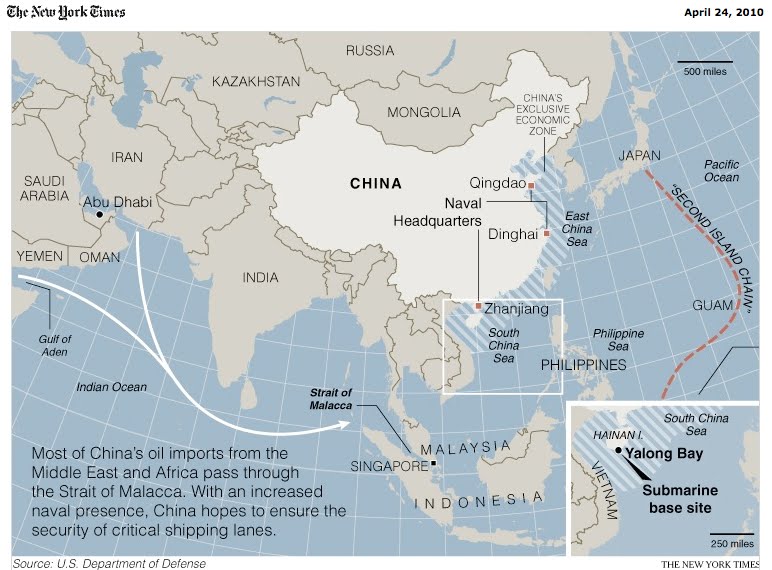
YALONG BAY, China — The Chinese military is seeking to project naval power well beyond the Chinese coast, from the oil ports of the Middle East to the shipping lanes of the Pacific, where the United States Navy has long reigned as the dominant force, military officials and analysts say.

China calls the new strategy “far sea defense,” and the speed with which it is building long-range capabilities has surprised foreign military officials.

The strategy is a sharp break from the traditional, narrower doctrine of preparing for war over the self-governing island of Taiwan or defending the Chinese coast. Now, Chinese admirals say they want warships to escort commercial vessels that are crucial to the country’s economy, from as far as the Persian Gulf to the Strait of Malacca, in Southeast Asia, and to help secure Chinese interests in the resource-rich South and East China Seas.

In late March, two Chinese warships docked in Abu Dhabi, the first time the modern Chinese Navy made a port visit in the Middle East.

The overall plan reflects China’s growing sense of self-confidence and increasing willingness to assert its interests abroad. China’s naval ambitions are being felt, too, in recent muscle flexing with the United States: in March, Chinese officials told senior American officials privately that China would brook no foreign interference in its territorial issues in the South China Sea, said a senior American official involved in China policy.

The naval expansion will not make China a serious rival to American naval hegemony in the near future, and there are few indications that China has aggressive intentions toward the United States or other countries.

But China, now the world’s leading exporter and a giant buyer of oil and other natural resources, is also no longer content to trust the security of sea lanes to the Americans, and its definition of its own core interests has expanded along with its economic clout.

In late March, Adm. Robert F. Willard, the leader of the United States Pacific Command, said in Congressional testimony that recent Chinese military developments were “pretty dramatic.” China has tested long-range ballistic missiles that could be used against aircraft carriers, he said. After years of denials, Chinese officials have confirmed that they intend to deploy an aircraft carrier group within a few years.

China is also developing a sophisticated submarine fleet that could try to prevent foreign naval vessels from entering its strategic waters if a conflict erupted in the region, said Admiral Willard and military analysts.

“Of particular concern is that elements of China’s military modernization appear designed to challenge our freedom of action in the region,” the admiral said.

Yalong Bay, on the southern coast of Hainan island in the South China Sea, is the site of five-star beach resorts just west of a new underground submarine base. The base allows submarines to reach deep water within 20 minutes and roam the South China Sea, which has some of the world’s busiest shipping lanes and areas rich in oil and natural gas that are the focus of territorial disputes between China and other Asian nations.

That has caused concern not only among American commanders, but also among officials in Southeast Asian nations, which have been quietly acquiring more submarines, missiles and other weapons. “Regional officials have been surprised,” said Huang Jing, a scholar of the Chinese military at the National University of Singapore. “We were in a blinded situation. We thought the Chinese military was 20 years behind us, but we suddenly realized China is catching up.”

China is also pressing the United States to heed its claims in the region. In March, Chinese officials told two visiting senior Obama administration officials, Jeffrey A. Bader and James B. Steinberg, that China would not tolerate any interference in the South China Sea, now part of China’s “core interest” of sovereignty, said an American official involved in China policy. It was the first time the Chinese labeled the South China Sea a core interest, on par with Taiwan and Tibet, the official said.

Another element of the Chinese Navy’s new strategy is to extend its operational reach beyond the South China Sea and the Philippines to what is known as the “second island chain” — rocks and atolls out in the Pacific, the official said. That zone significantly overlaps the United States Navy’s area of supremacy.

Japan is anxious, too. Its defense minister, Toshimi Kitazawa, said in mid-April that two Chinese submarines and eight destroyers were spotted on April 10 heading between two Japanese islands en route to the Pacific, the first time such a large Chinese flotilla had been seen so close to Japan. When two Japanese destroyers began following the Chinese ships, a Chinese helicopter flew within 300 feet of one of the destroyers, the Japanese Defense Ministry said.

Since December 2008, China has maintained three ships in the Gulf of Aden to contribute to international antipiracy patrols, the first deployment of the Chinese Navy beyond the Pacific. The mission allows China to improve its navy’s long-range capabilities, analysts say.
A 2009 Pentagon report estimated Chinese naval forces at 260 vessels, including 75 “principal combatants” — major warships — and more than 60 submarines. The report noted the building of an aircraft carrier, and said China “continues to show interest” in acquiring carrier-borne jet fighters from Russia. The United States Navy has 286 battle-force ships and 3,700 naval aircraft, though ship for ship the American Navy is considered qualitatively superior to the Chinese Navy.
The Pentagon does not classify China as an enemy force. But partly in reaction to China’s growth, the United States has recently transferred submarines from the Atlantic to the Pacific so that most of its nuclear-powered attack submarines are now in the Pacific, said Bernard D. Cole, a former American naval officer and a professor at the National War College in Washington.

The United States has also begun rotating three to four submarines on deployments out of Guam, reviving a practice that had ended with the cold war, Mr. Cole said.

American vessels now frequently survey the submarine base at Hainan island, and that activity leads to occasional friction with Chinese ships. A survey mission last year by an American naval ship, the Impeccable, resulted in what Pentagon officials said was harassment by Chinese fishing vessels; the Chinese government said it had the right to block surveillance in those waters because they are an “exclusive economic zone” of China.

The United States and China have clashing definitions of such zones, defined by a United Nations convention as waters within 200 nautical miles of a coast. The United States says international law allows a coastal country to retain only special commercial rights in the zones, while China contends the country can control virtually any activity within them.

Military leaders here maintain that the Chinese Navy is purely a self-defense force. But the definition of self-defense has expanded to encompass broad maritime and economic interests, two Chinese admirals contended in March.

“With our naval strategy changing now, we are going from coastal defense to far sea defense,” Rear Adm. Zhang Huachen, deputy commander of the East Sea Fleet, said in an interview with Xinhua, the state news agency.

“With the expansion of the country’s economic interests, the navy wants to better protect the country’s transportation routes and the safety of our major sea lanes,” he added. “In order to achieve this, the Chinese Navy needs to develop along the lines of bigger vessels and with more comprehensive capabilities.”

The navy gets more than one-third of the overall Chinese military budget, “reflecting the priority Beijing currently places on the navy as an instrument of national security,” Mr. Cole said. China’s official military budget for 2010 is $78 billion, but the Pentagon says China spends much more than that amount. Last year, the Pentagon estimated total Chinese military spending at $105 billion to $150 billion, still much less than what the United States spends on defense. For comparison, the Obama administration proposed $548.9 billion as the Pentagon’s base operating budget for next year.

The Chinese Navy’s most impressive growth has been in its submarine fleet, said Mr. Huang, the scholar in Singapore. It recently built at least two Jin-class submarines, the first regularly active ones in the fleet with ballistic missile capabilities, and two more are under construction. Two Shang-class nuclear-powered attack submarines recently entered service.

Countries in the region have responded with their own acquisitions, said Carlyle A. Thayer, a professor at the Australian Defense Force Academy. In December, Vietnam signed an arms deal with Russia that included six Kilo-class submarines, which would give Vietnam the most formidable submarine fleet in Southeast Asia. Last year, Malaysia took delivery of its first submarine, one of two ordered from France, and Singapore began operating one of two Archer-class submarines bought from Sweden.

Last fall, during a speech in Washington, Lee Kuan Yew, the former Singaporean leader, reflected widespread anxieties when he noted China’s naval rise and urged the United States to maintain its regional presence. “U.S. core interest requires that it remains the superior power on the Pacific,” he said. “To give up this position would diminish America’s role throughout the world.”