A Okie look at all thing Politics, eCampaign, New Media and Warfare - - - I must study politics and war that my sons may have liberty to study mathematics and philosophy. - John Adams
Work is picking up on what appears to be China's first aircraft carrier, the Shi Lang. For eight years now, China has been tinkering with a half finished Russian aircraft carrier.
Two years ago, this ex-Russian aircraft carrier, Varyag, was renamed the Shi Lang (after the Chinese general who took possession of Taiwan in 1681, the first time China ever paid any attention to the island) and given the pennant number 83.
Until last year, progress was slow. But there has been a lot of work lately. Early in 2009, China moved the Shi Lang into dry dock, where work is now obviously underway to install engines and other heavy equipment.
A year ago, the radar mast was completed, and now there is a Chinese radar system being installed. Officially, the Chinese say nothing. But the dockyard workers keep at it, and it's possible to take photos from a distance. It appears that the Shi Lang is a year or so from going to sea. For a long time, no one was sure exactly what plans the Chinese had for the Shi Lang, although work had been going on for years. It's long been believed that the carrier will eventually be used to train the first generation of Chinese carrier aviators and sailors. Or maybe not. No one who really knows anything about the plans for the Shi Lang, is speaking up. All is observation (from a distance, but good pix are numerous) and speculation.
The Varyag has been in a Chinese shipyard at Dailan since 2002. For a long time, few visible signs of work were visible; like a new paint job (in the gray shade used by the Chinese navy) and ongoing work on the superstructure (particularly the tall island on the flight deck.) Many workers could be seen on the ship, and material was seen going into (new stuff) and out of (old stuff) of the ship. Shipyard workers report ever tighter security on the carrier, and stern instructions to not report details of what is happening on the ship.
The Varyag is one of the Kuznetsov class carriers that Russia began building in the 1980s.
Originally the Kuznetsovs were to be 90,000 ton, nuclear powered ships, similar to American carriers (complete with steam catapults).
Instead, because of the high cost, and the complexity of modern (American style) carriers, the Russians were forced to scale back their plans, and ended up with the 65,000 ton (full load ) ships that lacked steam catapults, and used a ski jump type flight deck instead. Nuclear power was dropped, but the Kuznetsov class was still a formidable design. The 323 meter (thousand foot) long ship normally carries a dozen navalized Su-27s (called Su-33s), 14 Ka-27PL anti-submarine helicopters, two electronic warfare helicopters and two search and rescue helicopters.
But the ship can carry up to 36 Su-33s and sixteen helicopters.
The ship carries 2,500 tons of aviation fuel, allowing it to generate 500-1,000 aircraft and helicopter sorties. Crew size is 2,500 (or 3,000 with a full aircraft load.)
Only two ships of this class exist; the original Kuznetsov, which is in Russian service, and the Varyag.
The Chinese have been in touch with Russian naval construction firms, and may have purchased plans and technology for equipment installed in the Kuznetsov.
Some Chinese leaders have quipped about having a carrier by 2010 (this would have to be a refurbished Varyag), but now 2012 is more likely. Even that may be too soon, as the Chinese have been burned before when they tried to build new military technology in a hurry. The Chinese appear intent on getting it right the first time.
Two years ago, China announced that its first class of carrier aviators had begun training at the Dalian Naval Academy. The naval officers are undergoing a four year course of instruction to turn them into fighter pilots capable of operating off a carrier.
China already has an airfield, in the shape of a carrier deck, built at an inland facility. The Russians have warned China that it may take them a decade or more to develop the knowledge and skills needed to efficiently run an aircraft carrier. The Chinese are game, and are slogging forward.
China's military can destroy five out of six U.S. bases in Asia with waves of missile strikes as the result of its large-scale military buildup that threatens U.S. access and freedom of navigation in East Asia, according to a forthcoming congressional report.
"The main implication of China's improved air and conventional missile capabilities is a dramatic increase in the [People's Liberation Army's] ability to inhibit U.S. military operations in the region," a late draft of the report by the U.S.-China Economic and Security Review Commission concludes.
The U.S. government has growing concerns over what the report says are "China's improving capabilities to challenge the U.S. military's freedom of access in East Asia."
The draft report - the final version is set for release Wednesday - has been disclosed as tensions in Asia intensify over growing assertiveness by the Chinese military in the Yellow Sea, the East China Sea and the South China Sea. President Obama, during his recent visit to Asia, frequently mentioned growing U.S. concerns about "maritime security" and the need for stronger alliances against regional threats.
In Japan on Saturday, Prime Minister Naoto Kan thanked Mr. Obama for U.S. support during Tokyo's recent dispute with China over Chinese fishing near Japan's Senkaku Islands.
"For the peace and security of the countries in the region, the presence of the United States and the presence of the U.S. military, I believe, is becoming only increasingly important," Mr. Kan said. Defense Secretary Robert M. Gates said last month during theJapan-China dispute that the Senkakus are covered by the U.S.-Japanese defense treaty, a signal to China that the U.S. military is prepared to defend the islands from Chinese encroachment.
The United States also could face a Chinese missile strike on its bases and ships in a future conflict with China over Taiwan, according to the China commission report.
In addition to missiles, the Chinese military buildup includes major deployments and upgrades of Chinese jet fighters that have increased ranges and better weapons, as well as greatly improved air defenses, the report says.
The report says that in the event of a conflict, China missiles alone would be enough to attack and shut down five of the six major U.S. military bases in the region. Guam is the exception because it is 1,800 miles from China.
China's growing long-range bomber arsenal, however, means the "PLA Air Force's bomber fleet soon could allow it to target Guam, where the sixth U.S. Air Force base is located," the report says.
Guam is the site of a major U.S. military buildup in Asia, with the addition of new submarines and bombers and spy aircraft.
U.S. bases vulnerable to Chinese missile attack include two in South Korea, namely Osan and Kunsan air bases, the report says. Each could be destroyed with attacks by 480 short- and medium-range ballistic missiles and 350 ground-launched cruise missiles for each base. The bases are some 240 to 400 miles from China.
In Japan, U.S. bases at Kadena, Misawa and Yokota could be knocked out with 80 medium- and short-range ballistic missiles and 350 ground-launched cruise missiles, the report says. Those bases are between 525 miles and 680 miles from China.
"Not only would U.S. bases be threatened in the event of a conflict with China but so too would U.S. deployed aircraft," the report says.
For the past 20 years, China's missile and naval forces have been transformed from an outdated military to "one with modern aircraft and air defenses and a large, growing arsenal of conventional ballistic and land-attack cruise missiles," the report says.
Since 2000, for example, Chinese short-range missile forces alone increased from a brigade of up to 36 launchers to as many as 252 today, the report states.
Additionally, China now has up to 500 DH-10 land-attack cruise missiles with ranges of up to 932 miles. A second, new cruise missile, the YJ-63 also is deployed and has a range of more than 125 miles.
"In addition to increasing the number of missiles, China is also extending their range, improving their accuracy, and increasing their payload," the report says.
While China prominently proclaims the peaceful intentions behind its growing military buildup, within the military the rhetoric is far more aggressive.
The United States is the main foe among officers, and they continue to churn out books and articles about how America can be defeated. Lesser foes include Taiwan, Japan, Vietnam and South Korea. But it's understood, among Chinese officers, that if the mighty Americans can be brought to heel, all other local powers will become much easier to handle.
Meanwhile, the winds of political change can be detected within China. A group of 23 retired senior government officials and academics openly called for more democracy in China, and authoritarian rule. These old guys can get away with this kind of open talk because they are old, retired, and still have many friends within the government. The real target of the letter was the hard-liners in the government who pay more attention to maintaining the communist police state, than to improving the well-being of the average Chinese. The hard-liners used to include a lot of officials who still believed in communism, but there are few of those left, and not enough of them for anyone to bother with anymore.
The hard-liners tend to ally themselves with corrupt officials (nearly everyone in the ruling elite is at least a little dirty) to maintain the police state. But many senior officials actually back more democracy, and accountability to the people.
The United States sees China as having a natural interest in protecting its access to the sea (for importing raw materials and exporting manufactured goods). This justifies the large amounts of money the Chinese are pouring into building up their fleet. This is very new for China, which has not been a major naval power for over 600 years. What alarms the Americans is how the U.S. is being demonized by the Chinese military leadership.
Chinese politicians speak in more friendly terms, while tolerating the bellicose attitudes of their generals and admirals. The politicians refrain from reining in the aggressive attitudes of their military commanders. China experts counsel that the rants from the military are mainly to build morale within the ranks, and make it easier for the politicians to reduce corruption in the armed forces. This corruption is an old, old problem in China.
It's been reduced in the last two decades, but is still there, in a big way. By whipping up this fervor for dealing with a major war, it becomes unpatriotic (for many, but not all, officers) to steal and connive. But to outsiders, it looks like the Chinese are preparing for something ominous. This is reinforced by the increasingly aggressive Chinese attitudes towards disputes with its neighbors over uninhabited islands (often just rock outcroppings only visible at low tide). Outright possession of these islets gives the owner possession of nearby oil or natural gas deposits. Something worth fighting for, and that's what worries neighbors when it comes to China's growing naval strength.
South Korean and Australian military officials believe China has recently made a major effort to steal secret data from them via the Internet. The hacking attacks try hard to hide their origins, but better forensic tools make it easier to find and follow tracks. The Chinese Internet based espionage efforts have been growing more frequent and aggressive over the last decade. As the evidence piles up, China is having a more difficult time trying to hide behind blanket denials.
China is aggressively offering inexpensive weapons and military training services to African nations. This would give China more influence within African armed forces, and better knowledge of what makes them tick. This can be useful when there are embarrassing incidents. Recently, in Zambia, two Chinese mine officials opened fire with assault rifles, when confronted by workers angry about the way they were mistreated. Two workers were wounded and the rest dispersed. The Zambian government wants to prosecute the two Chinese gunmen, while China wants to avoid any damage to Chinese economic interests in Zambia and Africa. China has also been approaching Western nations for greater military cooperation. The latest targets were Poland and Italy.
Not wanting to incur the wrath of China, Vietnam made it clear that it will not lease Cam Rahn Bay to Russia, or any other foreigners. From 1979-2002, Russia did lease access, but left in a dispute over how much they should pay. Russia recently offered to return, and China was not pleased. Despite centuries of tension, China is currently a major trading partner with neighboring Vietnam. While Vietnam has been deferential to China, most other neighbors of China (including India) are increasingly cooperating in efforts to form a de facto military and political alliance against China. If this ever becomes a formal alliance (an eastern NATO, against the eastern superpower), China will not be pleased.
The U.S. has approached China about negotiating who would be allowed to do what in North Korea once the current North Korean government collapsed. Everyone in the region agrees that it's not a matter of if, but when, the North Korean dictatorship will collapse. South Korea considers it their responsibility to move in and clean up the mess. China has openly discussed other ideas, not involving South Korea. The proposed U.S. talks would seek to work out an arrangement that would not risk another major war in the area.
The government made a major effort to keep the recent news of imprisoned 1989 demonstration leader Liu Xiaobo winning the Nobel Peace Prize. Censors worked overtime to keep the news off all forms of media (especially cell phones and the Internet). It got through anyway, and the extent of the censorship effort made the government look weak and afraid of what the 1989 pro-democracy demonstrations represented.
In the northwest, China continues to have problems with its Moslem minority. As mainstream (Han) Chinese continue to move into these remote areas, the locals, who are often Moslem, increasingly respond with violence. Last month, for example, over a thousand northwestern Moslems (not Turkic Uighurs, but Hui, a catchall term for dozens of Moslem ethnic groups in the area) rioted and tried to destroy a newly built (by Han, largely for Han) nightclub. The locals objected to the booze and prostitution such places featured.
Two warships of the People’s Republic of China (PRC) People’s Liberation Army-Navy (PLAN) docked at a port in Myanmar on August 29, 2010, in the first publicized PLAN ship visit — but not the first actual PLAN visit — to Myanmar.
It was a move designed to help pre-position the PRC in its relations with Myanmar in the lead up to that country’s upcoming national elections.
The move also ended two decades of discreet PRC approaches to its naval presence in the Indian Ocean. It also follows the open PLAN task force presence in anti-piracy operations off the Horn of Africa, and the now open commitment to use of the Pakistani Baluchistan port of Gwadar, at the entrance to the Persian Gulf. Significantly, although the PRC maintains itself as both a heartland and maritime power, it is aware that the great challenge to break out from US global strategic dominance is essentially a maritime matter. Given economic and other realities, the US will be forced to rely increasingly on the US Navy — and particularly the Seventh Fleet in the Pacific and Indian Oceans — to project US influence.
But Washington is also working to bolster its strategic relations with the Republic of Korea, the ASEAN states as a whole, and India. The crunch for the US will be in finding the economic resources to boost the US Navy’s power projection advantages, particularly in the Pacific and Indian Oceans.
An Australian analyst, Dr Joel Rathus, of Adelaide University and Japan’s Meiji University, has noted (in the East Asia Forum, August 28, 1010): “A re-alignment is steadily underway in East Asia. Increasingly, ASEAN (and Korea) are moving closer to the geographically distant US, while China is becoming more distant from its neighbors.”
He also said: “China has seen the US and ASEAN draw closer on issues of major interest, such as the territorial disputes in the South China Sea. Clinton’s identification of this issue as a ‘pivot’ of regional security brings the United States back as a player after more than a decade of diplomatic passivity (to China’s notable discomfort).”
Building, or re-building, the US Navy in the Pacific and Indian Ocean to its earlier pre-eminence will not be easy for the US, despite the apparent numerical dominance which the USN has in the regions in terms of air and naval striking power.
To begin with, the PLAN has already deployed assets which severely inhibit the US Seventh Fleet: the Kilo- and Improved Kilo-class submarines, and other modern submarines, which can readily penetrate USN anti-submarine warfare (ASW) pickets around carrier battle groups; and the shipborne SS-N-22 Sunburn (P-270 Moskit or 3M-80/-80E) supersonic anti-ship missiles, against which there is as yet no adequate defense.
Now, Adm. Robert Willard, commander of the US Pacific Command, has confirmed during August 2010 discussions in Tokyo, that the PLA was “close to becoming operational” with its anti-ship ballistic missile (ASBM), based on a variant of the CSS-5 medium-range (1,500 to 2,000 km) ballistic missile (also known as the DF-21). The DF-21s have maneuverable warheads (MARVs: Maneuverable Re-Entry Vehicles), and the type has undergone testing. The yet-to-be-deployed DF-21D would, most US sources agree, be a game-changer in the Pacific, giving the PRC, not the US, control of the anti-access/area denial (A2/AD) high ground. The PRC is highly conscious of the fact that control of the seas is foreseeably being removed from the US.
All of this potentially makes the US-Republic of China (ROC: Taiwan) strategic relationship of greatly renewed importance, but the US has gone out of its way in recent years to downplay this, even to the point of supporting the ROC Army’s internal political lobbying to retain control of the ROC defense equation.
Right now, some 80 percent of the ROC’s defense spending goes to the Army, which reflects the original “continental army” approach which the ROC had when it left the mainland and was positioning itself to return. That situation no longer prevails: the ROC is now an island, maritime power, which relies on sea transport for some 99 percent of its raw materials.
Despite this, the US — and even the US Naval War College analysts — have gone out of their way to promote a so-called “porcupine strategy” for the ROC, by which it would rely on the Army to repel a PRC invasion. Now, however, the US needs the ROC to develop its maritime and air power resources, which have long been neglected.
Mark Helprin, writing in The Wall Street Journal on August 15, 2010, noted that “If present military trends continue, the correlation of forces will shift much more to Beijing's advantage within the next decade.” He continued:
“Lurking about the presidency in the guise of secretary of state, America's chief diplomat has embarked upon a mistake that someday may rival Dean Acheson's exclusion of Korea from the Pacific defense area, or April Glaspie's muddled words to Saddam Hussein.
At a regional meeting in Hanoi in late July, Hillary Clinton unveiled an initiative the effect of which is an attempt to forge a defensive alliance along the maritime perimeter, with nations such as Vietnam and the Philippines. Like her predecessor Acheson, Mrs. Clinton seems averse or blind to military analysis. Her inevitably stillborn South China Sea initiative is showy diplomacy that may lead either to a military clash with China or, more likely, a ratification of China's aims as the United States lets its implied guarantees die on the vine.
China's assertions in regard to the potentially oil rich and strategically important South China Sea are consistent, clear, and patently absurd. Based upon the questionable ownership of uninhabited rocks and shoals, some which do not rise above water and others roughly the size of a Volkswagen, it claims an area almost as large as the Caribbean Basin and as far as 1,800 miles from its nearest shoreline.
In linking America's national interests to those of the coastal states thus insulted, Mrs. Clinton's recent comments are commendable but insufficiently backed. China above all is sensitive to "paper-tigerism" and ready to challenge it, especially in regard to its essential interests and where the balance of applicable power is swinging in its favor. A naval battle in which China has the upper hand? Do we not have the most powerful military in the world?
We do, but strategic appraisal must not be one-dimensional. Although decisive to some, that this country spends more on defense than the next 14 countries combined is irrelevant to things such as the scope of its commitments, personnel costs, the willingness or reticence of allies, purchasing power parity, force structure, asymmetrical advantage and disadvantage, domestic politics, strategical genius, its absence, and many other factors including not least geography.
China fought us to a draw in Korea more than half a century ago. In Vietnam we stayed our hand for fear of drawing it into the battle, when its primitive navy was not even a tenth the size of ours, it had no nuclear weapons that could threaten us, and the Western Pacific was an American lake with a necklace of massive military installations now largely abandoned and an alliance structure we are at present trying to rebuild with words.
Whittled down by successive administrations, the big stick now turns on the Obama lathe as it is pressed against the Gates knife. If present trends merely continue, in five or 10 years, when the U.S. will have to decide whether to challenge China's claims or acquiesce, the correlation of forces will have shifted much more to China's advantage. “
The PRC’s anti-fleet capabilities are not the only concern which the US must face in the region. The Indo-Russian BrahMos supersonic cruise missile is already deployed with the Indian fleet and the new BrahMos Block II — which is capable of more complex trajectory and maneuver — has now (as of September 5, 2010) been successfully tested. These various missiles, deployed by the PRC and India, have yet to see successful countermeasures deployed by the US Navy.
At present, the US has pursued an aggressive strategic campaign to provide strategic partnership to India, but in reality India cannot afford to abandon its relationship with Russia, even though New Delhi is aware that it must move its relationship with Russia to a new parity, abandoning the old Cold War paternalism with which Moscow treated India.
Moreover, India, while seeing accord with the US Chinese Military, Chinese Navy, Chinese Power, Peoples Liberaton dealing with the PRC, has its own strategic agenda to follow in the Indian Ocean, and this, too, is not necessarily in total accord with the objectives of Washington.
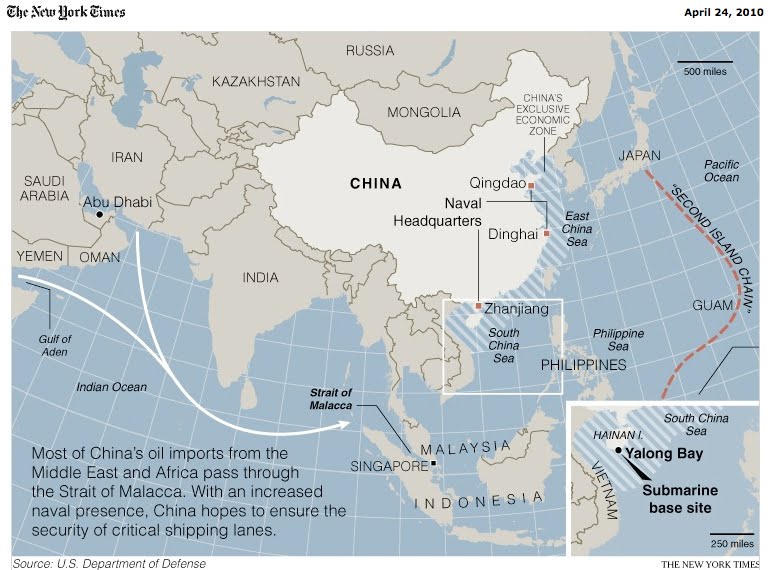
YALONG BAY, China — The Chinese military is seeking to project naval power well beyond the Chinese coast, from the oil ports of the Middle East to the shipping lanes of the Pacific, where the United States Navy has long reigned as the dominant force, military officials and analysts say.
China calls the new strategy “far sea defense,” and the speed with which it is building long-range capabilities has surprised foreign military officials.
The strategy is a sharp break from the traditional, narrower doctrine of preparing for war over the self-governing island of Taiwan or defending the Chinese coast. Now, Chinese admirals say they want warships to escort commercial vessels that are crucial to the country’s economy, from as far as the Persian Gulf to the Strait of Malacca, in Southeast Asia, and to help secure Chinese interests in the resource-rich South and East China Seas.
In late March, two Chinese warships docked in Abu Dhabi, the first time the modern Chinese Navy made a port visit in the Middle East.
The overall plan reflects China’s growing sense of self-confidence and increasing willingness to assert its interests abroad. China’s naval ambitions are being felt, too, in recent muscle flexing with the United States: in March, Chinese officials told senior American officials privately that China would brook no foreign interference in its territorial issues in the South China Sea, said a senior American official involved in China policy.
The naval expansion will not make China a serious rival to American naval hegemony in the near future, and there are few indications that China has aggressive intentions toward the United States or other countries.
But China, now the world’s leading exporter and a giant buyer of oil and other natural resources, is also no longer content to trust the security of sea lanes to the Americans, and its definition of its own core interests has expanded along with its economic clout.
In late March, Adm. Robert F. Willard, the leader of the United States Pacific Command, said in Congressional testimony that recent Chinese military developments were “pretty dramatic.” China has tested long-range ballistic missiles that could be used against aircraft carriers, he said. After years of denials, Chinese officials have confirmed that they intend to deploy an aircraft carrier group within a few years.
China is also developing a sophisticated submarine fleet that could try to prevent foreign naval vessels from entering its strategic waters if a conflict erupted in the region, said Admiral Willard and military analysts.
“Of particular concern is that elements of China’s military modernization appear designed to challenge our freedom of action in the region,” the admiral said.
Yalong Bay, on the southern coast of Hainan island in the South China Sea, is the site of five-star beach resorts just west of a new underground submarine base. The base allows submarines to reach deep water within 20 minutes and roam the South China Sea, which has some of the world’s busiest shipping lanes and areas rich in oil and natural gas that are the focus of territorial disputes between China and other Asian nations.
That has caused concern not only among American commanders, but also among officials in Southeast Asian nations, which have been quietly acquiring more submarines, missiles and other weapons. “Regional officials have been surprised,” said Huang Jing, a scholar of the Chinese military at the National University of Singapore. “We were in a blinded situation. We thought the Chinese military was 20 years behind us, but we suddenly realized China is catching up.”
China is also pressing the United States to heed its claims in the region. In March, Chinese officials told two visiting senior Obama administration officials, Jeffrey A. Bader and James B. Steinberg, that China would not tolerate any interference in the South China Sea, now part of China’s “core interest” of sovereignty, said an American official involved in China policy. It was the first time the Chinese labeled the South China Sea a core interest, on par with Taiwan and Tibet, the official said.
Another element of the Chinese Navy’s new strategy is to extend its operational reach beyond the South China Sea and the Philippines to what is known as the “second island chain” — rocks and atolls out in the Pacific, the official said. That zone significantly overlaps the United States Navy’s area of supremacy.
Japan is anxious, too. Its defense minister, Toshimi Kitazawa, said in mid-April that two Chinese submarines and eight destroyers were spotted on April 10 heading between two Japanese islands en route to the Pacific, the first time such a large Chinese flotilla had been seen so close to Japan. When two Japanese destroyers began following the Chinese ships, a Chinese helicopter flew within 300 feet of one of the destroyers, the Japanese Defense Ministry said.
Since December 2008, China has maintained three ships in the Gulf of Aden to contribute to international antipiracy patrols, the first deployment of the Chinese Navy beyond the Pacific. The mission allows China to improve its navy’s long-range capabilities, analysts say.
A 2009 Pentagon report estimated Chinese naval forces at 260 vessels, including 75 “principal combatants” — major warships — and more than 60 submarines. The report noted the building of an aircraft carrier, and said China “continues to show interest” in acquiring carrier-borne jet fighters from Russia. The United States Navy has 286 battle-force ships and 3,700 naval aircraft, though ship for ship the American Navy is considered qualitatively superior to the Chinese Navy.
The Pentagon does not classify China as an enemy force. But partly in reaction to China’s growth, the United States has recently transferred submarines from the Atlantic to the Pacific so that most of its nuclear-powered attack submarines are now in the Pacific, said Bernard D. Cole, a former American naval officer and a professor at the National War College in Washington.
The United States has also begun rotating three to four submarines on deployments out of Guam, reviving a practice that had ended with the cold war, Mr. Cole said.
American vessels now frequently survey the submarine base at Hainan island, and that activity leads to occasional friction with Chinese ships. A survey mission last year by an American naval ship, the Impeccable, resulted in what Pentagon officials said was harassment by Chinese fishing vessels; the Chinese government said it had the right to block surveillance in those waters because they are an “exclusive economic zone” of China.
The United States and China have clashing definitions of such zones, defined by a United Nations convention as waters within 200 nautical miles of a coast. The United States says international law allows a coastal country to retain only special commercial rights in the zones, while China contends the country can control virtually any activity within them.
Military leaders here maintain that the Chinese Navy is purely a self-defense force. But the definition of self-defense has expanded to encompass broad maritime and economic interests, two Chinese admirals contended in March.
“With our naval strategy changing now, we are going from coastal defense to far sea defense,” Rear Adm. Zhang Huachen, deputy commander of the East Sea Fleet, said in an interview with Xinhua, the state news agency.
“With the expansion of the country’s economic interests, the navy wants to better protect the country’s transportation routes and the safety of our major sea lanes,” he added. “In order to achieve this, the Chinese Navy needs to develop along the lines of bigger vessels and with more comprehensive capabilities.”
The navy gets more than one-third of the overall Chinese military budget, “reflecting the priority Beijing currently places on the navy as an instrument of national security,” Mr. Cole said. China’s official military budget for 2010 is $78 billion, but the Pentagon says China spends much more than that amount. Last year, the Pentagon estimated total Chinese military spending at $105 billion to $150 billion, still much less than what the United States spends on defense. For comparison, the Obama administration proposed $548.9 billion as the Pentagon’s base operating budget for next year.
The Chinese Navy’s most impressive growth has been in its submarine fleet, said Mr. Huang, the scholar in Singapore. It recently built at least two Jin-class submarines, the first regularly active ones in the fleet with ballistic missile capabilities, and two more are under construction. Two Shang-class nuclear-powered attack submarines recently entered service.
Countries in the region have responded with their own acquisitions, said Carlyle A. Thayer, a professor at the Australian Defense Force Academy. In December, Vietnam signed an arms deal with Russia that included six Kilo-class submarines, which would give Vietnam the most formidable submarine fleet in Southeast Asia. Last year, Malaysia took delivery of its first submarine, one of two ordered from France, and Singapore began operating one of two Archer-class submarines bought from Sweden.
Last fall, during a speech in Washington, Lee Kuan Yew, the former Singaporean leader, reflected widespread anxieties when he noted China’s naval rise and urged the United States to maintain its regional presence. “U.S. core interest requires that it remains the superior power on the Pacific,” he said. “To give up this position would diminish America’s role throughout the world.”
China suspended military exchanges with the United States, threatened unprecedented sanctions against American defense companies and warned Saturday that cooperation would suffer after Washington announced $6.4 billion in planned arms sales to Taiwan.
The response to Friday's U.S. announcement, while not entirely unexpected, was swift and indicated that China plans to put up a greater challenge than usual as it deals with the most sensitive topic in U.S.-China relations.
"This is the strongest reaction we've seen so far in recent years," said Stephanie T. Kleine-Ahlbrandt, northeast Asia project director for the International Crisis Group. "China is really looking to see what kind of reaction it's going to receive from Obama on this."
China's Defense Ministry said the arms sales to self-governing Taiwan, which the mainland claims as its own, cause "severe harm" to overall U.S.-China cooperation, the state-run Xinhua News Agency reported. Vice ministerial-level talks on arms control and strategic security were postponed.
The warning comes as the U.S. seeks Beijing's help on issues including the global financial crisis and nuclear standoffs in North Korea and Iran. Tensions were already high after recent U.S. comments on Internet freedom and a dispute between Google and China, as well as President Barack Obama's plan to meet with Tibetan spiritual leader the Dalai Lama this year.
China's Vice Foreign Minister He Yafei told U.S. Ambassador Jon Huntsman that the sales of Black Hawk helicopters, Patriot Advanced Capability-3 missiles and other weapons to Taiwan would "cause consequences that both sides are unwilling to see," a ministry statement said.
The Foreign Ministry also threatened sanctions against U.S. companies involved in the arms sales, which hasn't happened in past sales to Taiwan.
"Our action regarding Taiwan reinforces our commitment to stability in the region," U.S. State Department spokesman P.J. Crowley said Saturday. "We know China has a different view. Given our broad relationship with China, we will manage this issue as we have in the past."
The United States is Taiwan's most important ally and largest arms supplier, and it's bound by law to ensure the island is able to respond to Chinese threats.
China responds angrily to any proposed arms sales, however, and it also cut off military ties with the U.S. in 2008 after the former Bush administration announced a multibillion-dollar arms sale to Taiwan.
A similar cutoff of military ties was expected this time, but it comes as Washington and Beijing wanted to improve normally frosty relations between their armed forces. The U.S. has tried to use military visits to build trust with Beijing and learn more about the aims of its massive military buildup.
"In the past, these kinds of suspensions have lasted for three to six months, with some parts of the military-to-military relationship suspended beyond that," said Phillip Saunders, a distinguished research fellow at the National Defense University in Washington. "I expect something similar this time."
It's not known whether the arms sale will affect President Hu Jintao's expected visit to the U.S. this year or a summit on nuclear safety in the U.S. this spring.
Experts on China warned Beijing could take further steps to punish the United States to show its newfound power and confidence in world affairs.
Jin Canrong, a professor of international studies at China's Renmin University, said the sale would give Beijing a "fair and proper reason" to accelerate weapons testing. China test-fired rockets in recent weeks for an anti-missile defense system in what security experts said was a display of anger at the pending arms sale.
"The U.S. will pay a price for this. Starting now, China will make some substantial retaliation, such as reducing cooperation on the North Korea and Iran nuclear issues and anti-terrorism work," Jin added.
The latest suspension of military ties should affect planned visits to China by U.S. Secretary of Defense Robert Gates and Admiral Michael Mullen, chairman of the U.S. Joint Chiefs of Staff. A visit to the U.S. by the Chinese military's chief of the general staff, Gen. Chen Bingde, could also be called off.
The U.S. Congress has 30 days to comment on the newest arms sales before the plan goes forward. Lawmakers traditionally have supported such sales.
Though Taiwan's ties with China have warmed considerably since Taiwanese President Ma Ying-jeou took office 20 months ago, Beijing has threatened to invade if the island ever formalizes its de facto independence. China has more than 1,000 ballistic missiles aimed at Taiwan.
China often argues that arms sales to Taiwan hurt their relations, but Saunders said that despite the latest announcement and the one in 2008, "cross-Strait relations have never been better."
The arms package announced Friday dodged a thorny issue: The more advanced F-16 fighter jets that Taiwan covets are not included.
The Pentagon's decision not to include the fighters and a design plan for diesel submarines - two items Taiwan wants most - "shows that the Obama administration is deeply concerned about China's response," said Wang Kao-cheng, a defense expert at Taipei's Tamkang University.
Taiwan's Ma told reporters Saturday that the deal should not anger the mainland because the weapons are defensive, not offensive.
Beijing learning about soft power By James Holmes Wednesday, Jan 27, 2010, Page 8
Call it disaster-relief judo.
China pulled off a nifty feat of diplomatic one-upsmanship following the Haitian earthquake, rushing 6 cargo plane loaded with relief supplies to the stricken country before US Navy vessels (or USAF plane) could reach the scene. Bragged the official People’s Daily: “It was the Chinese rescuers, not the Americans, who were among the first relief personnel to arrive in the Caribbean country, even though China is farther away from Haiti than the US.”Not so fast. In the contest for first impressions, China emerged the clear victor. However, unless Beijing follows up with a serious humanitarian campaign, history will remember its post-earthquake relief flight as a publicity stunt, if at all.
“Soft power,” a concept much in vogue in Asia and the West, helps explain why. Harvard University professor Joseph Nye, who coined the term, says soft power represents the “ability to entice and attract.” It is a byproduct of an appealing culture, policies or other attributes. Nye says a nation rich in soft power improves its chances of success in world politics “because other countries want to follow it, admiring its values, emulating its example, aspiring to its level of prosperity and openness.”
As my colleague Toshi Yoshihara puts it, soft power is like a “pheromone” inherent to attractive nations. A nation so gifted can apply it as “perfume,” enhancing its ability to persuade. However, a nation’s good name requires careful tending. Claimants to soft power must profess altruistic ideals and back them up with deeds consistently over time, setting a pattern of benign behavior. Soft-power diplomacy involves more than atmospherics, boastfulness or isolated acts of mercy.
These subtleties appear lost on Beijing. The US enjoys major reserves of soft power owing to its openness and to liberal traditions embodied in founding documents like the Declaration of Independence and the US Constitution. India benefits from its history of nonviolence and nonalignment. As the historic center of a Sinocentric order in Asia, China too might seem awash in soft power, but by Nye’s definition, the outlook is more mixed.
China — or, more specifically, the Chinese Communist Party (CCP) regime — must earn a reputation for benevolence. True, China’s beguiling history and Confucian heritage exert a power of attraction, throughout Asia and beyond. However, not so long ago, the CCP regime went to extravagant lengths to dissociate itself from — and indeed destroy — much of that culture. That gives fellow Asians pause. In a sense, consequently, Beijing is starting anew in its quest for soft power. Rendering assistance after natural disasters represents one opportune way for Beijing to establish a good name.
China got off to a slow start refurbishing its reputation. It stood idle from 2004 to 2005, after a massive tsunami swept across South Asia. Twenty-one nations — including minor powers like Switzerland, with a fraction of China’s resources — rushed a combined 102 ships and 196 aircraft to the afflicted region. The size of the Chinese contingent? Zero. Despite Beijing’s claim to leadership in Asia, the People’s Liberation Army (PLA) found itself a spectator, unable to stage naval forces beyond China’s immediate environs.
Nor was Beijing especially generous by other measures. The People’s Daily was reduced to arguing lamely that the miserly US$90 million donated by China constituted a “tangible” contribution to tsunami relief. The leadership’s puzzling indifference, coupled with the PLA’s shortfall in capacity, left the US military, the Japan Self-Defense Forces and other expeditionary forces to reap the goodwill that repays acts viewed as selfless.
China, in short, found itself upstaged by prospective rivals in Southeast and South Asia, regions of real and growing Chinese interest. Its leadership in effect vowed “never again” to miss out on major humanitarian undertakings.
By rushing supplies and personnel to the Caribbean, Beijing wants to burnish an image tarnished through past inaction, expiating memories of the tsunami debacle. As a bonus, it hopes to outshine the US military in its own backyard.
That last goal is whimsical. Belated or not, US relief efforts will dwarf any effort China can mount in the Caribbean, but that doesn’t really matter.
Soft power is not a zero-sum game, in which one player gains only at another’s expense. Lending a hand so far from Chinese shores represents an admirable act on Beijing’s part — an act that will energize Chinese soft power, provided it’s part of a sustained errand of mercy.James Holmes is an associate professor at the US Naval War College. The views voiced here are his alone.
The Chinese South Sea Fleet recently conducted an anti-terrorism drill in which commandos flew to a merchant ship and then assaulted it by rappelling down from the helicopter and "cleared" the vessel of pirates and "rescued" the crew.
Earlier this month, a Chinese cargo ship, the "Delight", and its 25 man crew, was taken by Somali pirates. About the same time, a Chinese fishing boat, with a crew of 24, was also taken by Somali pirates off the coast of Kenya. China has said it will contribute forces to help deal with the Somali pirates.
The JH-7A fighter-bombers of China's No. 5 Attacker Division deployed on the Shandong Peninsula theoretically could cover all the U.S. military bases in Korea and the Taiwan Strait.
They also could receive aerial support from the J-11 fighters deployed at the No. 19 Fighter Division at Jining in southwestern Shandong. Jining has the best military airport on the peninsula, where huge underground aircraft hangars and first-line maintenance and support facilities have been completed.
By contrast, the No. 12 Fighter Division, armed with J-8II fighters, has been somewhat neglected both in terms of construction at its airport and upgrading of its equipment. In terms of combat missions assigned to the two fighter divisions in this region, the No. 12 Division probably would be responsible for territorial air defense, while the No. 19 Division would be engaged in out-line operations along with the No. 5 Attacker Division.
In line with this trend of development, as well as the experiences of the No. 2 and No. 3 Fighter Divisions, the No. 19 Fighter Division may very likely receive more advanced combat aircraft in the future.
The Navy Aviation Force No. 5 Division also has been strengthened. This division is now equipped with new-generation J-8F fighters. The electronic reconnaissance and intelligence collection capabilities of the Navy Aviation Units under the People's Liberation Army's navy North Fleet have been fully enhanced over the years.
In recent years, there have been quite a number of occasions on which U.S. or Japanese fighters have intercepted Y-8 serial high-tech electronic reconnaissance and maritime patrol aircraft in the airspace above the East China Sea. The key base of the Y-8 serial reconnaissance aircraft is Laiyang, in the middle of the peninsula, the home base of the Independent Reconnaissance Regiment of the North Sea Fleet.
By extensively reinforcing the air force units stationed in Shandong, the PLA has naturally upgraded its air defense posture. The Shandong Peninsula has become another key area for the deployment of S-300 or HQ-9 surface-to-air missiles. So far, two S-300 or HQ-9 SAM positions have been located, currently under construction in Shandong. One is at a location close to Qingdao, which obviously is intended to provide protection for the headquarters of the North Sea Fleet and the No. 1 Nuclear Submarine Flotilla.
The other SAM position is located at Penglai, in northeastern Shandong. It is likely that the purpose of deploying S-300s or HQ-9s in this region is to provide protection for the nuclear power stations that are now in the planning stages. Shandong is planning to construct three nuclear power stations along 120 kilometers (about 75 miles) of coastline connecting three major cities -- Qindao, Yantai and Weihai.
Of course, reinforcing air defense on the Shandong Peninsula will also enhance Beijing's air defense posture. Some of the U.S. Air Force units stationed in Korea and Japan would have to cross the Shandong Peninsula in order to attack Beijing. The above two S-300 or HQ-9 SAM positions, both currently under construction, very likely will be put into use after receiving S-300PMU2 air defense systems.
Reinforcing Shandong's air defense naturally will give nearby Henan province an effective air defense shield as well. Henan is the key strategic base of the PLA Second Artillery Force, with the mission of exerting strategic nuclear deterrence against the United States.
Also, an unconfirmed source says that a DF-31 long-range strategic missile (ICBM) brigade of the No. 52 Group Army is based at Laiwu in central Shandong province. China's immense efforts to reinforce Shandong's long-range air defense system seem to have special significance.
Computer hackers in China, including those working on behalf of the Chinese government and military, have penetrated deeply into the information systems of U.S. companies and government agencies, stolen proprietary information from American executives in advance of their business meetings in China, and, in a few cases, gained access to electric power plants in the United States, possibly triggering two recent and widespread blackouts in Florida and the Northeast, according to U.S. government officials and computer-security experts.
One prominent expert told National Journal he believes that China’s People’s Liberation Army played a role in the power outages. Tim Bennett, the former president of the Cyber Security Industry Alliance, a leading trade group, said that U.S. intelligence officials have told him that the PLA in 2003 gained access to a network that controlled electric power systems serving the northeastern United States. The intelligence officials said that forensic analysis had confirmed the source, Bennett said. “They said that, with confidence, it had been traced back to the PLA.” These officials believe that the intrusion may have precipitated the largest blackout in North American history, which occurred in August of that year. A 9,300-square-mile area, touching Michigan, Ohio, New York, and parts of Canada, lost power; an estimated 50 million people were affected.
Officially, the blackout was attributed to a variety of factors, none of which involved foreign intervention. Investigators blamed “overgrown trees” that came into contact with strained high-voltage lines near facilities in Ohio owned by FirstEnergy Corp. More than 100 power plants were shut down during the cascading failure. A computer virus, then in wide circulation, disrupted the communications lines that utility companies use to manage the power grid, and this exacerbated the problem. The blackout prompted President Bush to address the nation the day it happened. Power was mostly restored within 24 hours.
There has never been an official U.S. government assertion of Chinese involvement in the outage, but intelligence and other government officials contacted for this story did not explicitly rule out a Chinese role. One security analyst in the private sector with close ties to the intelligence community said that some senior intelligence officials believe that China played a role in the 2003 blackout that is still not fully understood.
Bennett, whose former trade association includes some of the nation’s largest computer-security companies and who has testified before Congress on the vulnerability of information networks, also said that a blackout in February, which affected 3 million customers in South Florida, was precipitated by a cyber-hacker. That outage cut off electricity along Florida’s east coast, from Daytona Beach to Monroe County, and affected eight power-generating stations. Bennett said that the chief executive officer of a security firm that belonged to Bennett’s trade group told him that federal officials had hired the CEO’s company to investigate the blackout for evidence of a network intrusion, and to “reverse engineer” the incident to see if China had played a role.
Bennett, who now works as a private consultant, said he decided to speak publicly about these incidents to point out that security for the nation’s critical electronic infrastructures remains intolerably weak and to emphasize that government and company officials haven’t sufficiently acknowledged these vulnerabilities.
The Florida Blackout
A second information-security expert independently corroborated Bennett’s account of the Florida blackout. According to this individual, who cited sources with direct knowledge of the investigation, a Chinese PLA hacker attempting to map Florida Power & Light’s computer infrastructure apparently made a mistake. “The hacker was probably supposed to be mapping the system for his bosses and just got carried away and had a ‘what happens if I pull on this’ moment.” The hacker triggered a cascade effect, shutting down large portions of the Florida power grid, the security expert said. “I suspect, as the system went down, the PLA hacker said something like, ‘Oops, my bad,’ in Chinese.”
The power company has blamed “human error” for the incident, specifically an engineer who improperly disabled safety backups while working on a faulty switch. But federal officials are still investigating the matter and have not issued a final report, a spokeswoman for the Federal Energy Regulatory Commission said. The industry source, who conducts security research for government and corporate clients, said that hackers in China have devoted considerable time and resources to mapping the technology infrastructure of other U.S. companies. That assertion has been backed up by the current vice chairman of the Joint Chiefs of Staff, who said last year that Chinese sources are probing U.S. government and commercial networks.
Asked whether Washington knew of hacker involvement in the two blackouts, Joel Brenner, the government’s senior counterintelligence official, told National Journal, “I can’t comment on that.” But he added, “It’s certainly possible that sort of thing could happen. The kinds of network exploitation one does to explore a network and map it and learn one’s way around it has to be done whether you are going to … steal information, bring [the network] down, or corrupt it.… The possible consequences of this behavior are profound.”
Brenner, who works for Director of National Intelligence Mike McConnell, looks for vulnerabilities in the government’s information networks. He pointed to China as a source of attacks against U.S. interests. “Some [attacks], we have high confidence, are coming from government-sponsored sites,” Brenner said. “The Chinese operate both through government agencies, as we do, but they also operate through sponsoring other organizations that are engaging in this kind of international hacking, whether or not under specific direction. It’s a kind of cyber-militia.… It’s coming in volumes that are just staggering.”
The Central Intelligence Agency’s chief cyber-security officer, Tom Donahue, said that hackers had breached the computer systems of utility companies outside the United States and that they had even demanded ransom. Donahue spoke at a January gathering in New Orleans of security executives from government agencies and some of the nation’s largest utility and energy companies. He said he suspected that some of the hackers had inside knowledge of the utility systems and that in at least one case, an intrusion caused a power outage that affected multiple cities. The CIA didn’t know who launched the attacks or why, Donahue said, “but all involved intrusions through the Internet.”
Donahue’s public remarks, which were unprecedented at the time, prompted questions about whether power plants in the United States had been hacked. Many computer-security experts, including Bennett, believe that his admission about foreign incidents was intended to warn American companies that if intrusions hadn’t already happened stateside, they certainly could. A CIA spokesman at the time said that Donahue’s comments were “designed to highlight to the audience the challenges posed by potential cyber intrusions.” The CIA declined National Journal’s request to interview Donahue.
Cyber-Espionage
In addition to disruptive attacks on networks, officials are worried about the Chinese using long-established computer-hacking techniques to steal sensitive information from government agencies and U.S. corporations.
Brenner, the U.S. counterintelligence chief, said he knows of “a large American company” whose strategic information was obtained by its Chinese counterparts in advance of a business negotiation. As Brenner recounted the story, “The delegation gets to China and realizes, ‘These guys on the other side of the table know every bottom line on every significant negotiating point.’ They had to have got this by hacking into [the company’s] systems.”
Bennett told a similar story about a large, well-known American company. (Both he and Brenner declined to provide the names of the companies.) According to Bennett, the Chinese based their starting points for negotiation on the Americans’ end points.
Two sources also alleged that the hacking extends to high-level administration officials.
During a trip to Beijing in December 2007, spyware programs designed to clandestinely remove information from personal computers and other electronic equipment were discovered on devices used by Commerce Secretary Carlos Gutierrez and possibly other members of a U.S. trade delegation, according to a computer-security expert with firsthand knowledge of the spyware used. Gutierrez was in China with the Joint Commission on Commerce and Trade, a high-level delegation that includes the U.S. trade representative and that meets with Chinese officials to discuss such matters as intellectual-property rights, market access, and consumer product safety. According to the computer-security expert, the spyware programs were designed to open communications channels to an outside system, and to download the contents of the infected devices at regular intervals. The source said that the computer codes were identical to those found in the laptop computers and other devices of several senior executives of U.S. corporations who also had their electronics “slurped” while on business in China. The source said he believes, based on conversations with U.S. officials, that the Gutierrez compromise was a source of considerable concern in the Bush administration. Another source with knowledge of the incident corroborated the computer-security expert’s account.
National Journal had a series of conversations with Rich Mills, a Commerce Department spokesman. Asked whether spyware or other malicious software code was found on any electronic devices used by Gutierrez or people traveling with him in China in December 2007, Mills said he “could not confirm or deny” the computer-security expert’s allegations. “I cannot comment on specific [information-technology] issues, but the Department of Commerce is actively working to safeguard sensitive information.” Mills added that the source had provided some inaccurate information, but he did not address the veracity of the source’s claim that the delegation was electronically compromised.
“China is indeed a counterintelligence threat, and specifically a cyber-counterintelligence threat,” said Brenner, who served for four years as inspector general of the National Security Agency, the intelligence organization that electronically steals other countries’ secrets. Brenner said that the American company’s experience “is an example of how hard the Chinese will work at this, and how much more seriously the American corporate sector has to take the information-security issue.” He called economic espionage a national security risk and said that it makes little difference to a foreign power whether it steals sensitive information from a government-operated computer or from one owned by a contractor. “If you travel abroad and are the director of research or the chief executive of a large company, you’re a target,” he said.
“Cyber-networks are the new frontier of counterintelligence,” Brenner emphasized. “If you can steal information or disrupt an organization by attacking its networks remotely, why go to the trouble of running a spy?”
Stephen Spoonamore, CEO of Cybrinth, a cyber-security firm that works for government and corporate clients, said that Chinese hackers attempt to map the IT networks of his clients on a daily basis. He said that executives from three Fortune 500 companies, all clients, had document-stealing code planted in their computers while traveling in China, the same fate that befell Gutierrez.
Spoonamore challenged U.S. officials to be more forthcoming about the breaches that have occurred on their systems. “By not talking openly about this, they are making a truly dangerous national security problem worse,” Spoonamore said. “Secrecy in this matter benefits no one. Our nation’s intellectual capital, industrial secrets, and economic security are under daily and withering attack. The oceans that surround us are no protection from sophisticated hackers, working at the speed of light on behalf of nation-states and mafias. We must cease denying the scope, scale, and risks of the issue. I, and a growing number of my peers believe our nation is in grave and growing danger.”
A Growing Threat
Brenner said that Chinese hackers are “very good and getting better all the time.… What makes the Chinese stand out is the pervasive and relentless nature of the attacks that are coming from China.”
The issue has caught Congress’s attention. Rep. Jim Langevin, D-R.I., who chairs the Homeland Security panel’s Subcommittee on Emerging Threats, Cybersecurity, and Science and Technology, said that his staff has examined a range of hacker networks, from criminal syndicates to nationally supported groups. “China has been a primary concern,” he said. The deepest penetrations into U.S. systems have been traced back to sources within China, Langevin noted.
(At a hearing last week, Langevin said that the private sector, which owns the vast majority of U.S. information networks, including those that operate power plants, dams, and other critical infrastructure, had taken a “halfhearted approach” to improving security. He cited a new report by the Government Accountability Office, which found that the Tennessee Valley Authority, the nation’s largest power generator, “has not fully implemented appropriate security practices to secure the control systems and networks used to operate its critical infrastructures.” Langevin said that the TVA “risks a disruption of its operations as the result of a cyber-incident, which could impact its customers,” and he expressed “little confidence that industry is taking the appropriate actions.”)
The Chinese make little distinction between hackers who work for the government and those who undertake cyber-adventures on its behalf. “There’s a huge pool of Chinese individuals, students, academics, unemployed, whatever it may be, who are, at minimum, not discouraged from trying this out,” said Rodger Baker, a senior China analyst for Stratfor, a private intelligence firm. So-called patriotic-hacker groups have launched attacks from inside China, usually aimed at people they think have offended the country or pose a threat to its strategic interests. At a minimum the Chinese government has done little to shut down these groups, which are typically composed of technologically skilled and highly nationalistic young men. Officially, Chinese military and diplomatic officials say they have no policy of attacking other governments’ systems.
“This has been a growing wave in recent years,” Brenner said, attributing China’s cyber-tactics to its global economic and political ambitions. “The Chinese are out to develop a modern economy and society in one generation.… There is much about their determination that is admirable. But they’re also willing to steal a lot of proprietary information to do it, and that’s not admirable. And we’ve got to stop it as best we can.”
High-profile penetrations of government systems have been occurring for several years. In 2007, an unidentified hacker broke into the e-mail system for Defense Secretary Robert Gates’s office, and the Pentagon shut down about 1,500 computers in response. But officials said that the intrusion caused no harm. In 2006, a State Department employee opened an e-mail containing a Trojan horse, a program designed to install itself on a host machine to give a hacker covert access. As a result, officials cut off Internet access to the department’s East Asia and Pacific region, but the department suffered no long-term problems.
The Homeland Security Department, which is responsible for protecting civilian computer systems, suffered nearly 850 attacks over a two-year period beginning in 2005, officials have said. In one instance, they found that a program designed to steal passwords had been installed on two of the department’s network servers. In these and other incidents, there is considerable debate about whether the intruders stole truly valuable information that could compromise U.S. strategy or ongoing operations.
“The penetrations we’ve seen are on unclassified systems, which are obviously less protected than classified systems,” Brenner said.
Private Sector Foot-Dragging
There is little indication that cyber-intrusions, however menacing, have severely impaired government operations for very long. So why are so many officials increasingly sounding the alarm about network attacks, Chinese hacking and espionage, and the advent of cyberwar?
Part of the answer lies in officials’ most recent appraisals of the cyber-threat. They cite evidence that attacks are increasing in volume and appear engineered more to cause real harm than sporadic inconvenience. Without naming China, Robert Jamison, the top cyber-security official at DHS, told reporters at a March briefing, “We’re concerned that the intrusions are more frequent, and they’re more targeted, and they’re more sophisticated.”
“In terms of breaches within government systems, it’s something that has happened quite a bit over the last six, seven years,” says Shannon Kellogg, the director of information-security policy for EMC Corp., which owns RSA, a top cyber-security research firm. “But the scale of these types of breaches and attacks seems to have increased substantially.”
Government officials are more concerned now than in recent years about the private sector’s inability, or unwillingness, to stop these pervasive attacks. When Donahue, the CIA cyber-security officer, warned the gathering in New Orleans about foreign hackings of power plants, some saw it as a direct challenge to American companies.
“Donahue wouldn’t have said it publicly if he didn’t think the threat was very large and that companies needed to fix things right now,” Alan Paller, the highly regarded director of research at the SANS Institute, told The Washington Post at the time. (SANS, a cyber-security research and education group, sponsored the January meeting in New Orleans.) Another security expert noted that in the previous 18 months, there had been “a huge increase in focused attacks on our national infrastructure networks … and they have been coming from outside the United States.”
In comments posted on Wired magazine’s Danger Room blog, which is trafficked by many techno-elites who are skeptical of the administration’s more boisterous public warnings, Donahue’s remarks about power plants drew support. Michael Tanji, a former intelligence officer with the Defense Intelligence Agency, said that the comments weren’t part of a government plot to hype the threat. “Having worked with [Donahue] on these and related issues in the past, I regret to inform conspiracy theorists that he is virulently allergic to hyperbole,” Tanji said. “I’ve long been a skeptic of claims about being able to shut down the world from the Net.… But after today, I’m starting to come around to the idea that the ignorance or intransigence of utility system owners just might merit a more robust response than has been undertaken to date.”
Tanji’s remarks pointed to one of the most nettlesome realities of cyber-security policy. Because most of the infrastructure in the United States is privately owned, the government finds it exceptionally difficult to compel utility operators to better monitor their systems. The FBI and DHS have established formal groups where business operators can disclose their known vulnerabilities privately. (Companies fear that public exposure will decrease shareholder confidence or incite more hackings.) But membership in these organizations isn’t compulsory. Furthermore, many of the systems that utility operators use were designed by others. Intelligence officials now worry that software developed overseas poses another layer of risk because malicious codes or backdoors can be embedded in the software at its creation. U.S. officials have singled out software manufacturers in emerging markets such as, not surprisingly, China.
Military Response
The intelligence community’s and private sector’s vocal warnings and dire suspicions of Chinese hackers join a chorus of concern emanating from the Defense Department in recent months. In the most recent annual report on China’s military power, the Defense Department declared publicly for the first time that attacks against government and commercial computer networks in 2007 appear to have emanated from China. “Numerous computer networks around the world, including those owned by the U.S. government, were subject to intrusions that appear to have originated within” the People’s Republic of China. Although not claiming that the attacks were conducted by the Chinese government, or officially endorsed, the declaration built upon the previous year’s warning that the People’s Liberation Army is “building capabilities for information warfare” for possible use in “pre-emptive attacks.”
The military is not waiting for China, or any other nation or hacker group, to strike a lethal cyber-blow. In March, Air Force Gen. Kevin Chilton, the chief of U.S. Strategic Command, said that the Pentagon has its own cyberwar plans. “Our challenge is to define, shape, develop, deliver, and sustain a cyber-force second to none,” Chilton told the Senate Armed Services Committee. He asked appropriators for an “increased emphasis” on the Defense Department’s cyber-capabilities to help train personnel to “conduct network warfare.”
The Air Force is in the process of setting up a Cyberspace Command, headed by a two-star general and comprising about 160 individuals assigned to a handful of bases. As Wired noted in a recent profile, Cyberspace Command “is dedicated to the proposition that the next war will be fought in the electromagnetic spectrum and that computers are military weapons.” The Air Force has launched a TV ad campaign to drum up support for the new command, and to call attention to cyberwar. “You used to need an army to wage a war,” a narrator in the TV spot declares. “Now all you need is an Internet connection.”
Defense and intelligence officials have been surprised by China’s cyber-advances, according to the U.S-China Economic and Security Review Commission. In November, the commission reported that “Chinese military strategists have embraced … cyberattacks” as a weapon in their military arsenal. Gen. James Cartwright, the former head of U.S. Strategic Command and now the vice chairman of the Joint Chiefs, told the commission that China was engaged in cyber-reconnaissance, probing computer networks of U.S. agencies and corporations. He was particularly concerned about China’s ability to conduct “denial-of-service” attacks, which overwhelm a computer system with massive amounts of automatically generated message traffic. Cartwright provocatively asserted that the consequences of a cyberattack “could, in fact, be in the magnitude of a weapon of mass destruction.”
A former CIA official cast the cyber-threat in a similarly dire terms. “We are currently in a cyberwar, and war is going on today,” Andrew Palowitch, who’s now a consultant to U.S. Strategic Command, told an audience at Georgetown University in November. STRATCOM, headquartered at Offutt Air Force Base in Nebraska, oversees the Defense Department’s Joint Task Force-Global Network Operations, which defends military systems against cyber-attack. Palowitch cited statistics, provided by Cartwright, that 37,000 reported breaches of government and private systems occured in fiscal 2007. The Defense Department experienced almost 80,000 computer attacks, he said. Some of these assaults “reduced” the military’s “operational capabilities,” Palowitch noted.
Presidential Attention
President Bush has personally devoted more high-level attention to the cyberattack issue in the last year or so than he did in the first six years of his tenure combined. Many security experts are surprised that the administration is only now moving to take dramatic measures to improve the security of government networks, because some Cabinet-level and White House officials have been warning about the threat for years to just about anyone who will listen.
Until McConnell, the national intelligence director, personally drove the point home to Bush in an Oval Office meeting in 2006, there was little top-level support for a comprehensive government cyber-security plan. “They ignored it,” one former senior administration official said flatly. “McConnell has the president’s ear.”
McConnell, a former director of the National Security Agency, whose main job is to intercept foreign communications intelligence but which is also responsible for protecting U.S. classified information and systems, takes the computer-security issue as seriously as his counter-terrorism mission. After McConnell left the NSA, in 1996, he took over the intelligence practice at Booz Allen Hamilton, where he again turned to security problems, particularly within the nation’s financial infrastructure. Working with officials from the New York Stock Exchange, McConnell developed a report for the government on network vulnerabilities; he has said that it was so revealing, the administration decided to classify it.
Lawrence Wright of The New Yorker reported earlier this year that McConnell told Bush during the 2006 Oval Office meeting, “If the 9/11 perpetrators had focused on a single U.S. bank through cyberattack and it had been successful, it would have had an order-of-magnitude greater impact on the U.S. economy.” According to Wright, the president was disturbed, and then asked Treasury Secretary Henry Paulson Jr., who was at the meeting, if McConnell was correct; Paulson assured the president that he was.
Brenner confirmed Wright’s account as “a true story.” And separately, a former senior administration official told National Journal of another dimension. In that meeting, McConnell also told the president that White House communications systems could be targeted for attack just as other U.S. government systems had been targeted. The intelligence chief was telling the president, “If the capability to exploit a communications device exists, we have to assume that our enemies either have it, or are trying to develop it,” the former official said.
This meeting compelled the White House to craft an executive order laying out a broad and ambitious plan to shore up government-network defenses. Known internally as “the cyber-initiative,” it was formally issued in January. The details remain classified, but it has been reported that the order authorizes the National Security Agency to monitor federal computer networks. It also requires that the government dramatically scale back the number of points at which federal networks connect to the public Internet. The Office of Management and Budget has directed agencies to limit the total number of Internet “points of presence” to 50 by June.
Limiting connection points is analogous to pulling up drawbridges in order to defend the government’s cyber-infrastructure. Security experts interviewed for this story said that it shows how little the government can do, at least for now, to ward off intrusions if the first line of defense is to “unplug.”
Mixed Reactions
Under the president’s cyber-initiative, the Homeland Security Department will be responsible for monitoring government agencies apart from the Defense Department. In March, Homeland Security Secretary Michael Chertoff told National Journal that the first step is “to survey all the points” of presence. “We have no final number yet.”
“The agencies’ networks have grown very haphazardly. No one really knows where [the connections to the Internet] are,” said Bruce McConnell, who was the chief of information technology and policy in the Office of Management and Budget. He left government in 2000. “Trying to catalogue where things are so you could turn them off is a daunting task in and of itself,” said McConnell, who is not related to the intelligence chief.
Bush’s cyber-initiative has received mixed reviews. Generally, cyber-experts favor a comprehensive approach, and they are relieved that the issue finally has the president’s full attention. But some question how the program is being implemented—under a cloak of secrecy and with a heavy reliance on the intelligence community.
The sharpest criticisms are directed at the NSA, an intelligence agency whose traditional mandate is to collect information coming from outside the United States; it has no customary role monitoring networks inside the country, although this has changed in the years following the 9/11 attacks. It’s not clear just how far the government’s monitoring of computer networks will extend into the private sector and precisely what role the NSA will play tracking networks inside the United States, but lawmakers have already raised concerns that the cyber-initiative will creep into domestic intelligence-gathering. The same kinds of technologies that are used to monitor networks for viruses and other malicious threats could be used to track domestic communications. On May 2, DHS’s top overseers sent a letter to Chertoff questioning “the secrecy of the project.” Sens. Joe Lieberman, ID-Conn., and Susan Collins, R-Maine, the chairman and ranking member of the Homeland Security and Governmental Affairs Committee, respectively, noted that the department had requested an additional $83 million for its National Cyber Security Division; DHS had already been allocated $115 million for the cyber-initiative in the 2008 omnibus appropriations bill. “This would be a nearly $200 million increase, tripling the amount of money spent on cyber-security in DHS since 2007,” the senators wrote. The full cost of implementing the president’s cyber-initiative is estimated to be $30 billion. The entire 2009 budget request for the Homeland Security Department is about $50 billion.
Marc Sachs, who was the director for communication infrastructure protection in the White House Office of Cyberspace Security in 2002, praised the administration for taking a bold initial step. But he said that the level of attention is 10 years overdue. Sachs noted that in 1998, President Clinton issued a directive that set ambitious infrastructure-protection goals. “I intend that the United States will take all necessary measures to swiftly eliminate any significant vulnerability to both physical and cyber attacks on our critical infrastructures, including especially our cyber-systems,” Clinton wrote.
Without pointing to particular policies, Brenner, the counterintelligence chief, said, “We need to take these policy declarations that we’ve had for 10 years and turn them into practical reality.” He said the job of securing cyberspace is hardly as simple as “put two padlocks on the door.… This is an incredibly open and porous and, in many cases, wireless system. Controlling cyber-security is like controlling the air flow in a large, segmented building complex in a noxious neighborhood. You cannot be sure you are keeping all the noxious stuff out. What you’ve got to say is, gee, in the infirmary, we’ve really got to deal differently than we do in the lobby.” False Accusations?
Given the political fallout that could stem from a proven Chinese attack on power plants or theft of government secrets—not to mention the pressure to launch some sort of military response—skeptics have asked whether the Chinese really are behind so many high-profile incidents.
Brenner affirmed the widely held view that it’s technologically difficult to attribute the exact source of any cyberattack and that the government needs better technologies to do so. But despite his assurances that the government has indeed sourced cyber-intrusions to China, others urge caution.
“We want to find a natural enemy, so we’re looking everywhere,” Sachs said. He noted that some hackers launch their attacks through computers based in other countries, and that China is an easy mask. “I think all of us should remember that not everything you see online is truthful.”
Another former administration official echoed those sentiments. “I think it’s a little bit naive to suggest that everything that says it comes from China comes from China,” said Amit Yoran, the first director of DHS’s National Cyber Security Division, who left the post in 2004.
But there is little to no doubt, including among skeptics, that China is vigorously pursuing offensive cyber-capabilities. Military analysts say that the Chinese know their armed forces cannot match America’s in a head-on confrontation, and they realize their nuclear arsenal pales in comparison. These imbalances have forced Chinese military planners to adopt what the Pentagon calls “asymmetric” techniques—tactics that aim at a foe’s vulnerabilities—in order to counter, or at least deter, U.S. military power.
“There has been much writing on information warfare among China’s military thinkers, who indicate a strong conceptual understanding of its methods and uses,” according to the Pentagon’s annual report on China’s military power. The report stated that “there is no evidence of a formal Chinese … doctrine” but noted that the People’s Liberation Army has “established information-warfare units to develop viruses to attack enemy computer systems and networks.”
U.S. military officials see cyber-warfare as one arrow in a quiver of asymmetric techniques to disrupt an enemy’s command-and-control systems. The Chinese strategy, according to this line of thinking, is not to defeat U.S. military forces but to make it harder for them to operate.
China’s military history has been defined by asymmetric warfare, said Harry Harding, an expert on Chinese domestic politics and U.S.-China relations, who teaches at George Washington University’s Elliott School of International Affairs. Cyber-warfare is just one of the more recent tactics. If the U.S. government tries to protect its systems, the Chinese will simply attack the private sector; he cited the financial services industry as an obvious target. “I have no doubt that China is doing this,” Harding said.
Bennett, the former head of the Cyber Security Industry Alliance, said that if China has penetrated power plants and the power grid, it serves as a show of force to the United States and is likely meant to deter any U.S. military intervention on behalf of Taiwan. He noted that the Florida blackout occurred only a few days after the Navy shot down a failing U.S. satellite with a missile designed to intercept inbound ballistic missiles. A year earlier, the Chinese had downed one of their own satellites in orbit. The Bush administration has pursued ballistic missile defense systems, and Taiwan has sought that technology from the United States.
Cyberwar
The Chinese are not alone, of course, in their pursuit of cyber-warfare. The Air Force is setting up the Cyberspace Command, the 10th command in the service’s history.
“The next kind of warfare will be asymmetric warfare,” Gen. William Lord, the provisional commander, said during a roundtable discussion at the Council of Foreign Relations in March. “Who is going to take on the United States Army, Marine Corps, U.S. Air Force, and U.S. Navy as probably the most powerful force on the face of the planet?”
Lord didn’t limit his remarks to China. He said that cyber-criminals and other “bad guys” were as much a concern for the military. He also pointed to a massive cyberattack launched last year against computers in Estonia, in which Russian hackers—perhaps operating at Moscow’s behest—tried to take down the country’s systems in retaliation for Estonia’s decision to move a statue commemorating fallen Soviet troops, a statue that Russians living in Estonia love but that native-born Estonians don’t. The attack has been billed as the first “cyberwar” because of the overwhelming electronic force brought to bear on the tiny country of 1.3 million people.
“I had an opportunity to speak with the minister of defense from Estonia,” Lord said. “He was attacked by 1 million computers.”
The Estonia attack probably shook nerves more than it caused long-term damage. But it served as a potent example of how determined, coordinated hackers could gang up on a foreign government. It has also created profound policy questions about what qualifies as war in cyberspace.
“The problem with this kind of warfare,” Lord said, “is determining who is the enemy, what is their intent, and where are they, and then what can you do about it?”
Brenner, the senior U.S. counterintelligence official, said, “Another country knows that if it starts taking out our satellites, that would be an act of war.” But “if they were to take out certain parts of our infrastructure, electronically, that could be regarded as an act of war,” he said. “It’s not my job to say that.”
NATO officials are reluctantly struggling with that question, too. At a ministerial meeting last June, Defense Secretary Gates asked the allied members to consider defining cyberattacks in the context of traditional warfare. Cyberwar is still abstract, and there are no international conventions that govern military conduct on a digital battlefield.
“The U.S. government doesn’t really have a policy on the use of these techniques,” said Michael Vatis, a former director of the FBI’s National Infrastructure Protection Center. “The closest analogy is to covert actions,” he said, meaning spy operations undertaken by intelligence agencies against foreign governments. “They take place, and people have strong suspicions about [who’s responsible]. But as long as they’re not able to prove it, there’s very little that they can do about it. And so there’s often not as much outrage expressed.”
Staff Correspondent Bruce Stokes contributed to this article. The author can be reached at sharris@nationaljournal.com

 Chinese Military Seeks to Extend Its Naval Power
  Until last year, progress was slow. But there has been a lot of work lately. Early in 2009, China moved the Shi Lang into dry dock, where work is now obviously underway to install engines and other heavy equipment.
  For a long time, no one was sure exactly what plans the Chinese had for the Shi Lang, although work had been going on for years. It's long been believed that the carrier will eventually be used to train the first generation of Chinese carrier aviators and sailors. Or maybe not. No one who really knows anything about the plans for the Shi Lang, is speaking up. All is observation (from a distance, but good pix are
  numerous) and speculation.
 The Varyag is one of the Kuznetsov class carriers that Russia began building in the 1980s.