Showing posts with label US Army Special Forces. Show all posts

Wednesday, April 18, 2012

Hooah U.S. Army John F. Kennedy Special Warfare Center dedicate Kennedy-Yarborough statue


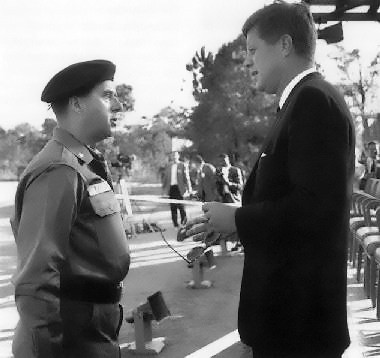
President John F. Kennedy had a special relationship with the United States Army Special Forces. That relationship was sealed on Oct. 12, 1961, when the President visited Fort Bragg, N.C., to review the troops. At the now-historic meeting between Kennedy and Lt. Gen (then-Brig. Gen) William Yarborough, Kennedy embraced the iconic Green Beret. That relationship was celebrated with the dedication of the Kennedy-Yarborough statue at the U.S. Army John F. Kennedy Special Warfare Center and School at Fort Bragg.

The statue was created and paid for by Ross Perot, a long-time supporter of special operations. Perot is responsible for a number of statues on Fort Bragg, including the Bull Simons statue on the JFK Plaza and the Dick Meadows statue at the U.S. Army Special Operations Command headquarters. These two memorials, both cast in bronze, preserve the memory of two Special Forces trailblazers. 

The Simons statue was dedicated in 1999. Simons served as a company commander of the 6th Ranger Battalion in the Pacific during World War II. After the war, he had a short break in service, before being recalled to active duty to serve in several special-operations assignments. Some of his assignments included deputy commander and chief of staff of the U.S. Army Special Warfare Center, commander of a Mobile Training Team in Laos from 1961 to 1962, and the first commander of the 8th Special Forces Group. Simons is best remembered as the commander of Operation Ivory Coast, or the Son Tay Raid, to free American prisoners of war in North Vietnam.

The other statue is dedicated to Maj. Richard "Dick" Meadows. After serving as a combat infantryman in Korea, he joined Special Forces in 1953. Meadows was a highly respected team leader in the Military Assistance Command Vietnam Studies and Observation Group and is also known for his planning and leadership during the Son Tay raid. Meadows was a key member in Operation Eagle Claw, better known as the Iran hostage-rescue mission, which ultimately led to the establishment of today's special-operations forces.

Perot was first introduced to special operations by long-time friend Col. Arthur "Bull" Simons back during the Vietnam era.

"Bull Simons was a very close friend of mine," said Perot during a recent telephone interview. "He goes all the way back to World War II, where he fought in the Pacific and then on into Vietnam, where he was very successful.

"I really got to know him during the Vietnam War and worked closely with him over the years at Fort Bragg and with several others there," said Perot.

In April 2009, Perot was given his own Green Beret when he was inducted as an honorary Green Beret by the members of the Special Forces Regiment.

"I was inducted as an honorary member of the Special Forces, though my friends say I'm an ornery member," joked Perot. "Either way, I am extremely honored."

It was while visiting Fort Bragg for the induction into the regiment that the idea for the Kennedy-Yarborough statue began.

"The statue came about from a conversation between a number of people at Fort Bragg," said Perot. "Some folks were standing right there in that area (where the statue is now located in front of Kennedy Hall) and were talking about the meeting between Kennedy and Yarborough and how it would be nice to commemorate it. That's how the idea came about and that's why it is where it is."

Perot said that once he heard the idea, he decided to have the statue designed and to donate it to the JFK Special Warfare Center and School.

"The idea behind the statue is to honor one of the founders of modern Special Forces -- (Lieutenant) General Yarborough -- and to honor President John F. Kennedy not only for his presidency, but also for his service in World War II," explained Perot.

Perot contacted New Mexico-based sculptor Paul Moore and commissioned him to create the statue.

"It was important to find someone who would take great care with the statue and ensure that it is done just right," said Perot.

A strong believer in the idea that the devil is in the details, Perot, along with Moore and members of the Fort Bragg community worked closely to make sure that the statue was perfect.

"We all worked together on it," said Perot. "We spent a lot of time with the people at Fort Bragg, and I spent a lot of time here working on it -- but most of the work was done by the sculptor. He came up with sketches and then made a small model. We sent the plans to Fort Bragg and made changes as they were needed.

"We've worked very hard to make sure it is just right, and that you folks at Fort Bragg agree that it is just right -- and that's what it is -- just right," he said.

Perot said he has the highest respect for the Kennedy and Yarborough families.

"I can't think of finer people to honor, so it means a lot to me that their families will be at Fort Bragg on this very special day," he said, referencing attendance at the dedication by members of both families. "I wanted to build this memorial to them out of respect for these men and all the sacrifices they made for our country."

Perot hopes that people will understand how important the meeting was between Kennedy and Yarborough and what a significant impact it had on the quality of the Special Forces who are sent off "to do missions impossible."

"General Yarborough had a stellar service record, and was known for his vision to build the capabilities of Special Forces," said Perot, adding that he also wanted to honor President Kennedy, not only for his relationship with Special Forces, but for his service in World War II and as the president of the United States.

"Sadly, he was killed while in office, and that was just a heart-breaking event for our entire nation."

Perot said that he has been anxiously awaiting the statue dedication.

"I think it will be great for us to finally see everything all in place," he concluded.

Monday, August 9, 2010

Wednesday, April 30, 2008

Hoo-ah: Wyrick Robbins appointed counsel to the Special Forces Association

Wyrick Robbins has been appointed counsel to the Special Forces Association (SFA), a non-profit fraternal organization for current and former U.S. Army Special Forces soldiers. Established in 1964, SFA is based in Fayetteville, North Carolina, with 84 chapters located around the world, promoting the interests of Special Forces and the families of soldiers killed in action.

Attorneys W. David Mannheim, Joshua J. Otto and Steven D. Simpson had been providing pro bono support to SFA prior to formal engagement of the firm. Wyrick Robbins is an entrepreneurial law firm with a focus on growth oriented businesses. For more information on the firm, go to www.wyrick.com or call (919)781-4000.

Friday, April 18, 2008

HOO-AH: These 4 men are selfless, inspirational leaders


These 4 men are selfless, inspirational leaders


I grew up going to Catholic schools and being surrounded by a pretty religious family.

I remember my grandmother praying to St. Christopher before my family would make the long drive from Massachusetts back home to Maryland.

She told me he was the patron saint of travelers and that praying to him would ensure our safe journey home.

Once, I lost a necklace that my great aunt had given me. When I called her to tell her how sorry I was, she told me to say a prayer to St. Anthony, the patron saint of lost items.

My great aunt said, “Pray, then go retrace your steps, you will find the necklace.”

I prayed with all my might, mostly because I did not want to disappoint my great aunt. To my surprise, I found the necklace. Was it the saint answering my prayers or was it a young girl actually opening her eyes for the first time and looking in all the right places? Maybe it was a little of both.

I have been waxing nostalgic about saints lately because of a presentation ceremony I attended on Fort Bragg last week. I watched as four Special Forces soldiers were awarded the Order of the St.Philip of Neri award. it is an honor presented annually by the command on behalf of the Special Forces Association to deserving Special Forces soldiers. These soldiers embody the characteristics of a selfless and superb teacher and inspirational leader, as demonstrated by the patron saint of Special Forces, St. Philip of Neri.

Maj. Gen. Thomas R. Csrnko, commanding general of U.S. Army Special Forces Command (Airborne), and Mel Smith, executive director of the Special Forces Association’s national chapter, were the presenters for the ceremony. They presented the St. Philip of Neri Bronze award, which is given to active-duty and National Guard soldiers who have contributed in a significant way to the Army Special Forces regiment.

The four soldiers receiving the award were Command Sgt. Maj. Donald A. White of 2nd Battalion, 1st Special Forces Group (Airborne), Command Sgt. Maj. Mario G. Vigil, formerly of 5th Group and now Special Forces Command’s top noncommissioned officer, Command Sgt. Maj. Christopher Zets of 7th Special Forces Group (Airborne) and last year’s recipient and my husband, Master Sgt. Brendan W. O’Connor of 7th Group.

All four of these men have shown dedication to duty and exceptionally meritorious conduct and achievements throughout their many years of service to their country. It was I, and the other members of the audience, who were honored and humbled to be in the presence of men who have dedicated their lives to serving their country. All of these men had at least 23 years of service in the Army, some had 30. It should be a reminder to us all that selfless sacrifice and devotion to duty are traits that we should attempt to emulate and always be thankful for.

It is written that St. Philip of Neri made himself available to everyone at any hour to guide his followers. Philip believed humility is the most important virtue, and he strived to achieve it in himself and others. It seems clear why there could be no other patron saint for Special Forces. Special Forces soldiers are, after all, the “quiet professionals.” They are forever professional and always humble. Thanks to all who serve us so proudly. Peace to all.


Margaret O’Connor can receive messages at military@fayobserver.com or 486-3585.


Wednesday, April 9, 2008

Army must develop process to wage war in cyberspace


Army must develop process to
wage war in cyberspace

By Greg Grant
ggrant@govexec.com


With wars increasingly fought among the people, information is now an element of combat power as important as lethal action in determining a conflict's eventual outcome, said an Army officer who heads the services computer warfare efforts.

The battle for a population's state of mind demands a sophisticated information operations campaign that responds more rapidly than terrorists and insurgent groups to exploit the virtual battlefield. "There was a day when we were operating at foot speed," said Army Col. Wayne Parks, who directs the service's Computer Network Operations and Electronic Warfare at Fort Leavenworth, Kan. "Now we're moving at cyber speed.

Digitization has dramatically increased the speed at which information moves about the battlefield, he said. Unlike the air and space domains, the Army operates on the ground, which means among the people, Parks said in a conference call with reporters. America's enemies influence a populations' mind-set by using Web sites and chat rooms to spread propaganda that casts the U.S. military in a bad light.

"We have to pick up the pace, ... respond, react, be proactive enough to stay out ahead of the speed of megabytes," he said.

The Army has turned to academia for expertise in the humanities and social sciences to better understand foreign cultures and how to influence societies with information operations.

The service now must find a way to "maneuver around" a potential enemy's information campaign, Parks said. Being proactive, rather than simply reacting to an enemy's misinformation, is of utmost importance, he said, because members of the public often believe the first thing they hear, even if it's not true. In addition, the military also "hacks" into jihadi Web sites to try to stop the spread of enemy propaganda.

Recent surveys conducted by the Center for Army Lessons Learned at Fort Leavenworth on operations in Iraq and Afghanistan found that the service's training and officers' past combat experience left them "ill-prepared" for the "interactive complexity" of information operations. Operating with the speed and agility that the 21st century information age demands is "not part of their DNA," and the Army "continues to grope for a staff process" to best leverage the power of information, according to a discussion paper e-mailed to reporters.

Rather than the ad hoc approach to information operations the Army has pursued, the paper designated specific staff responsibilities for everything from informing and educating the public (delegated to the public affairs and psychological operations staff) to hacking into enemy computer networks (a task for intelligence officers). The service is recruiting a younger generation of hackers, Parks said, for, as the Army puts it, "computer network attack and computer network defend."

The United States finds itself more often fighting small, distributed terrorist and insurgent cells that are able to communicate and coordinate attacks using cell phones and that can share on Web sites lessons on the best way to attack U.S. forces. The challenge is finding weaknesses in the enemy's computer network that can be hacked, Parks said.

Wednesday, March 5, 2008

HOO-AH: 5th SFG Soldiers Honor ‘Green Berets’ Novelist

5th SFG Soldiers Honor
‘Green Berets’ Novelist


HOPKINSVILLE, Ky. (USASOC News Service, Mar. 3, 2008) – Soldiers from 5th Special Forces Group (Airborne) honored Robin Lowell Moore, the author of “The Green Berets,” during his funeral service March 1, 2008.

The modest service took place in the historic Grace Episcopal Church, of which Moore was a member. Several hundred attended the funeral, the majority being former and current Green Berets.

The 82-year-old Moore, a novelist, World War II veteran and Special Forces advocate, died February 21 after a long battle with cancer.

Being a Harvard graduate, and partial heir to the Sheraton Hotel chain, gave Moore the ability to travel the world and have a variety of experiences. Of all his experiences in life, it was his time spent working on “The Green Berets” that had the most meaning and impact on his life.

“It meant everything to him,” said his widow Helen Moore of his time spent with the Special Forces. “He felt tremendously honored that he was allowed to go through the course that he was allowed to go to jump school that he was allowed to wear the beret as a civilian. He always used to say meeting general Yarborough, going through the training and writing the book made him a man. Before that he always used to say he was a playboy, a hard working playboy but, it’s the Green Berets that made him a man.”

When starting work on “The Green Berets,” Moore was introduced to Lt. Gen. William Yarborough, who told him if he was to do this book he would have to go through the Special Forces Qualification Course and then to Viet Nam. Moore accepted the challenge and by doing so earned the respect of the SF Soldiers.

“After Robin had been with us about a week, I said we are going out on an operation tomorrow and we will be leaving about 0300,” said retired Maj. Gen. Victor Hugo Jr. the detachment commander featured in the novel. “If you would like to leave with us you can but here are the ground rules: you take with you whatever you want and that is all you got; no one will carry anything for you; you go out and you don’t come back in until all of us come back unless you need a MEDIVAC. Those are the conditions would you like to go? To my surprise he said yes.”

Hugo then lifted a copy of the original of “The Green Berets” and pointed to a picture on the back cover of Robin just after a successful ambush during the operation. He continued stating Moore’s bravery was one the qualities he remembered most about his friend.

The respect and admiration, for this honorary member of the 5th Special Forces Group, is still evident in today’s Green Beret.

“I had an opportunity to spend some time and talk to Robin,” said Maj. Gen. Thomas Csrnko, commander, Special Forces Command. “He was an absolutely amazing man. If you read all of his bio, I would say he lived a full life. It is quite an accomplishment that he has given back so much to the Special Forces community as well as the nation.”

To end the service, full military honors were given ending with the playing of “The Ballad of the Green Beret,” the song he co-wrote with Barry Sadler that is now the theme song for all those who earn the right to don the honored headgear.

Moore will be buried in a cemetery near his home town of Concord, Mass. later this spring.

--De Oppresso Liber--

--sine pari--

"Your Mind is Your Best Weapon"
-- Dedicated to the "Quiet Professionals"


Maj. Gen. Thomas Csrnko, commander, Special Forces Command speaks during a memorial service for Novelist Robin Lowell Moore at the Grace Episcopal Church in Hopkinsville, Ky. March 1, 2008. (photo by Sgt. 1st Class Jason B. Baker, USASOC PAO)

Lt. Gen. William Yarborough and Robin Moore's berets rest on Moore's casket during a memorial service for the Novelist at the Grace Episcopal Church in Hopkinsville, Ky. March 1, 2008. (photo by Sgt. 1st Class Jason B. Baker, USASOC PAO)


Sunday, February 24, 2008

HOO-AH: 'The Green Berets' author Moore dies


Robin Moore, whose novel “The Green Berets” helped shape the public image of Special Forces, died Thursday in Hopkinsville, Ky., after a long illness. He was 82.

The Fort Bragg Special Forces community Friday mourned the passing of the author, who also helped Staff Sgt. Barry Sadler write its anthem, ‘‘The Ballad of the Green Berets.’’ The song is played at Special Forces ceremonies.

Maj. Gen. Gary L. Harrell, deputy commanding general of U.S. Army Special Operations Command at Fort Bragg, said in a statement: “All Special Forces soldiers, past and present, mourn the passing of Robin Moore; he was a valued and trusted member of the special operations family. Robin was a devoted advocate and a true ambassador for the ‘Green Beret’ and all they stand for.”

Visitations will be held Friday from 4 to 8 p.m. and at 10 a.m. March 1 at Lamb Funeral Home in Hopkinsville, Ky. The funeral will be held at 2 p.m. March 1 at Grace Episcopal Church in Hopkinsville.

Memorial donations may be made to Special Forces Association Chapter 38, P.O. Box 223, Fort Campbell, KY 42223.

Mr. Moore also was the author of ‘‘The French Connection,’’ and ‘‘The Happy Hooker.’’


Mr. Moore continued to visit Fayetteville and stayed in touch with the Special Forces community. His 2003 book, ‘‘The Hunt for Bin Laden: Task Force Dagger,’’ takes readers from the initial top secret meeting of the task force in Tampa, Fla., on Sept. 11, 2001, through the war in Afghanistan.

In 1989, Mr. Moore received a Special Forces tab at Fort Bragg for being the only civilian to complete the Special Forces Qualification Course in 1963 for research of his novel, on which a John Wayne movie was later based. The movie, released in 1968, was one of the few pro-military films during the turbulent Vietnam era.

Successful completion of the course entitles soldiers to don the green beret and wear the Special Forces tab, a curved cloth insignia, on their left shoulder, and join a Special Forces group.

Mr. Moore got a standing ovation at the graduation ceremony of the latest Special Forces “Q” course at the auditorium of Fort Bragg’s John F. Kennedy Special Warfare Center and School, which conducts Special Forces training.

“Twenty-six years later!” Mr. Moore said after returning to his seat. “I can’t think of a more glorious way of getting it. It was worth waiting all those years.”

He said he also took airborne training at Fort Benning, Ga., several months before enrolling in the “Q” course.

Mr. Moore said the Special Forces tab was not awarded when he went through the course, and he “never got around to” obtaining one.

It was Mr. Moore’s partnership with the late Lt. Gen. William P. Yarborough that helped form the public perception of Special Forces.

Mr. Moore said Lt. Gen. Yarborough enabled him to go through the course “and kept an eye on me like you wouldn’t believe.” Lt. Gen. Yarborough died in Pinehurst in 2005 at age 93. Lt. Gen. Yarborough helped develop Army parachuting and prompted President John F. Kennedy to approve the green beret as official headgear for Special Forces in 1961.

Asked if officials gave him special consideration for being a civilian, Mr. Moore said, “None at all. I didn’t want them to.”

Mr. Moore died Thursday night at a hospital in southwestern Kentucky, said Dennis Monroe with Lamb Funeral Home.

Mr. Moore has said he moved to the small town in 2005 with his wife, Helen, because it borders Fort Campbell, a sprawling Army post on the Tennessee border that is headquarters to a Green Beret group.

Published books
Born Robert L. Moore Jr. on Oct. 31, 1925, in Massachusetts, he wrote his books under the name Robin Moore. Among his best known were “The Green Berets,” published in 1965 and “The French Connection,” published in 1969. He also helped write “The Happy Hooker,” which was published in 1972.

He co-wrote “The Ballad of the Green Berets,” which became the signature song of the Special Forces unit.

Maj. Gen. Gary L. Harrell, deputy commander of the Army’s Special Operations Command at Fort Bragg, called Mr. Moore a “devoted advocate” for the Special Forces and said his writings became textbooks for the Army’s unconventional forces.

“They were both educational and inspirational and introduced the world to the Green Berets,” Maj. Gen. Harrell said in a statement posted Friday on an Army Special Forces Web site. “He will be missed.”

“The Green Berets” was written following Mr. Moore’s service alongside soldiers with the 5th Special Forces Group (Airborne) in Vietnam as a civilian author.

“The French Connection,” about a New York drug bust, inspired a movie that won five Academy Awards in 1971, including best picture.

A complete list of Mr. Moore’s survivors wasn’t available.


The Associated Press contributed to this report.

Military editor Henry Cuningham can be reached at cuninghamh@fayobserver.com or 486-3585.