Showing posts with label Fort Bragg. Show all posts

Wednesday, April 18, 2012

Hooah U.S. Army John F. Kennedy Special Warfare Center dedicate Kennedy-Yarborough statue


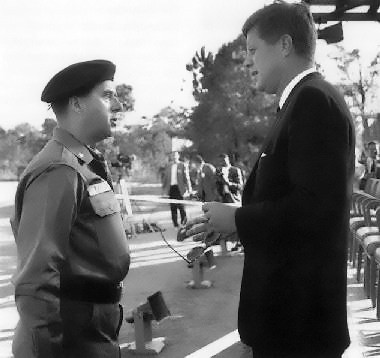
President John F. Kennedy had a special relationship with the United States Army Special Forces. That relationship was sealed on Oct. 12, 1961, when the President visited Fort Bragg, N.C., to review the troops. At the now-historic meeting between Kennedy and Lt. Gen (then-Brig. Gen) William Yarborough, Kennedy embraced the iconic Green Beret. That relationship was celebrated with the dedication of the Kennedy-Yarborough statue at the U.S. Army John F. Kennedy Special Warfare Center and School at Fort Bragg.

The statue was created and paid for by Ross Perot, a long-time supporter of special operations. Perot is responsible for a number of statues on Fort Bragg, including the Bull Simons statue on the JFK Plaza and the Dick Meadows statue at the U.S. Army Special Operations Command headquarters. These two memorials, both cast in bronze, preserve the memory of two Special Forces trailblazers. 

The Simons statue was dedicated in 1999. Simons served as a company commander of the 6th Ranger Battalion in the Pacific during World War II. After the war, he had a short break in service, before being recalled to active duty to serve in several special-operations assignments. Some of his assignments included deputy commander and chief of staff of the U.S. Army Special Warfare Center, commander of a Mobile Training Team in Laos from 1961 to 1962, and the first commander of the 8th Special Forces Group. Simons is best remembered as the commander of Operation Ivory Coast, or the Son Tay Raid, to free American prisoners of war in North Vietnam.

The other statue is dedicated to Maj. Richard "Dick" Meadows. After serving as a combat infantryman in Korea, he joined Special Forces in 1953. Meadows was a highly respected team leader in the Military Assistance Command Vietnam Studies and Observation Group and is also known for his planning and leadership during the Son Tay raid. Meadows was a key member in Operation Eagle Claw, better known as the Iran hostage-rescue mission, which ultimately led to the establishment of today's special-operations forces.

Perot was first introduced to special operations by long-time friend Col. Arthur "Bull" Simons back during the Vietnam era.

"Bull Simons was a very close friend of mine," said Perot during a recent telephone interview. "He goes all the way back to World War II, where he fought in the Pacific and then on into Vietnam, where he was very successful.

"I really got to know him during the Vietnam War and worked closely with him over the years at Fort Bragg and with several others there," said Perot.

In April 2009, Perot was given his own Green Beret when he was inducted as an honorary Green Beret by the members of the Special Forces Regiment.

"I was inducted as an honorary member of the Special Forces, though my friends say I'm an ornery member," joked Perot. "Either way, I am extremely honored."

It was while visiting Fort Bragg for the induction into the regiment that the idea for the Kennedy-Yarborough statue began.

"The statue came about from a conversation between a number of people at Fort Bragg," said Perot. "Some folks were standing right there in that area (where the statue is now located in front of Kennedy Hall) and were talking about the meeting between Kennedy and Yarborough and how it would be nice to commemorate it. That's how the idea came about and that's why it is where it is."

Perot said that once he heard the idea, he decided to have the statue designed and to donate it to the JFK Special Warfare Center and School.

"The idea behind the statue is to honor one of the founders of modern Special Forces -- (Lieutenant) General Yarborough -- and to honor President John F. Kennedy not only for his presidency, but also for his service in World War II," explained Perot.

Perot contacted New Mexico-based sculptor Paul Moore and commissioned him to create the statue.

"It was important to find someone who would take great care with the statue and ensure that it is done just right," said Perot.

A strong believer in the idea that the devil is in the details, Perot, along with Moore and members of the Fort Bragg community worked closely to make sure that the statue was perfect.

"We all worked together on it," said Perot. "We spent a lot of time with the people at Fort Bragg, and I spent a lot of time here working on it -- but most of the work was done by the sculptor. He came up with sketches and then made a small model. We sent the plans to Fort Bragg and made changes as they were needed.

"We've worked very hard to make sure it is just right, and that you folks at Fort Bragg agree that it is just right -- and that's what it is -- just right," he said.

Perot said he has the highest respect for the Kennedy and Yarborough families.

"I can't think of finer people to honor, so it means a lot to me that their families will be at Fort Bragg on this very special day," he said, referencing attendance at the dedication by members of both families. "I wanted to build this memorial to them out of respect for these men and all the sacrifices they made for our country."

Perot hopes that people will understand how important the meeting was between Kennedy and Yarborough and what a significant impact it had on the quality of the Special Forces who are sent off "to do missions impossible."

"General Yarborough had a stellar service record, and was known for his vision to build the capabilities of Special Forces," said Perot, adding that he also wanted to honor President Kennedy, not only for his relationship with Special Forces, but for his service in World War II and as the president of the United States.

"Sadly, he was killed while in office, and that was just a heart-breaking event for our entire nation."

Perot said that he has been anxiously awaiting the statue dedication.

"I think it will be great for us to finally see everything all in place," he concluded.

Friday, October 24, 2008

SECDEF visits home of Army Special Operations for first-time

Special Operations Soldiers at Fort Bragg, N.C., showed off their expertise for a special, first-time visitor to the U.S. Army Special Operations Command, Oct. 23.

Secretary of Defense Robert M. Gates visited USASOC for the first time since taking his current post in December 2006. Gates, who has said Special Operations Forces are the connective tissue for the U.S. military in the War on Terror, had the opportunity to talk with Army SOF Soldiers during his visit.

Accompanied by Lt. Gen. Robert W. Wagner, commanding general of USASOC, Gates was able to observe a USASOC capabilities demonstration and briefing, which presented some of the most advanced equipment and tactics used by Army Special Operations Forces.

Wagner, who escorted Gates through the demonstration and briefings, said they spoke of how SOF units in all branches of the military could better cooperate with each other and intelligence community organizations.
Secretary of Defense Robert Gates (middle) speaks with Lt. Gen. Robert W. Wagner (right), commanding general of the U.S. Army Special Operations Command, and Col. Curtis Boyd, commander of the 4th Psychological Operations Group (Airborne), during a visit to Fort Bragg, N.C., Oct. 23, 2008. Gates toured several facilities used to train Army Special Operations Forces during the vist.
“[We] are fighting a war, and no one organization is fighting it alone,” Wagner said.

Gates brought a unique perspective to the meeting. A former intelligence officer with the U.S. Air Force during Vietnam, Gates was recruited by the Central Intelligence Agency, working his way up from operations officer eventually to the Director of Central Intelligence.

The two also spoke regarding the current state of ARSOF and future growth of the force.
After the demonstration, Gates sat down for lunch with a group of NCO and officer SOF operators. Speaking directly with servicemembers is how he gets some of his best ideas, Gates said. He also noted that morale seemed high amongst those he met.

“[These Soldiers] believe they have been successful in Iraq,” he said. “There is nothing for morale like being successful. So my perception is … morale is very high, and I think it’s in no small part because of the success that’s been enjoyed, but also by the fact that they know the American people support them.”

Later in the day, Gates was met by Maj. Gen. Thomas R. Csrnko, commanding general of the U.S. Army John F. Kennedy Special Warfare Center and School, and Brig. Gen. Michael Repass, commanding general of U.S. Army Special Forces Command (Airborne).

Repass and USASFC(A) Command Sgt. Maj. Mario Vigil escorted Gates through a Faces of Special Forces display. Gates was able to speak with SF Soldiers representing each specialty on an Operational
Detachment-Alpha team. Here Soldiers showcased some of the unique equipment required by each SF military occupational specialty.

To display the type of sophisticated communications equipment used while deployed, Gates also received an operations brief from a SOF sergeant in Afghanistan through a secure video teleconference.

After meeting with the SF Soldiers, Gates was accompanied by Csrnko on a tour of the school’s state-of-the-art Joint Special Operations Medical Training Center. There he was able to witness life-saving training procedures taught to SOF medical servicemembers throughout the entire Department of Defense.

Approximately 1,400 students from Army Special Forces, Civil Affairs, Rangers, Navy corpsmen, Marine and Air Force Special Operations pass through the JSOMTC annually before deploying across the globe with their fellow SOF operators to provide world-class medical care under austere conditions in the most remote locations.

The 75,000 square-foot JSOMTC facility is also home to the Naval Special Operations Medical Institute and Operating Location E for the Air Force’s 16th Special Operations Wing.

Gates’ last stop while visiting USASOC facilities was the 4th Psychological Operations Group’s Media Operations Complex, which he toured with Col. Curtis Boyd, 4th POG commander. Gates was greeted by several tactical
psyop Soldiers who demonstrated some of the equipment they use, as well as Soldiers from a Mobile Information Support Team.

Soldiers from the 3rd Psychological Operations Battalion, the 4th POG’s
psyop dissemination battalion, provide media expertise in the production of print and audio visual products for the MOC. Since June 2003, it has produced more than 30 million printed products, 300 videos and 10,000 hours of radio programs in support of psychological operations throughout the world. Its daily operations continue to enable psyop reach-back support in multiple theaters in a wide variety of psyop missions worldwide.

“Our efforts within the 4th PSYOP Group are designed to show various foreign audiences that the ideology and actions of violent extremists are not in their best interests,” said Lt. Col. Richard Springett, 3rd POB commander. “So, we are using the tools of ideological engagement in many nations to create an environment that is hostile to violent extremism.”

“We provide development, production, distribution, archival and post-production capabilities for products designed to communicate alternative visions to and divert potential recruits from violent extremist organizations worldwide,” he said.

During his tour of the facility, Gates was able to witness this process first-hand. He watched as multimedia specialists worked on a real-world psyop product for use in Africa, allowing him to see Soldiers directly affecting the War on Terror.

“It can best be described as a product that will help insulate a particularly vulnerable audience from the voices that call for violence and extremism,” Springett said.

Overall, Gates said meeting with Soldiers and seeing them hard at work training was the highlight of the visit.

“The best part of the day is that I’ve met some incredible Soldiers, and I’ve seen various kinds of specialized training,” he said. “These people are in the forefront of protecting our country, and I am just very proud to be associated with them in any way.


Wednesday, March 5, 2008

HOO-AH: 5th SFG Soldiers Honor ‘Green Berets’ Novelist

5th SFG Soldiers Honor
‘Green Berets’ Novelist


HOPKINSVILLE, Ky. (USASOC News Service, Mar. 3, 2008) – Soldiers from 5th Special Forces Group (Airborne) honored Robin Lowell Moore, the author of “The Green Berets,” during his funeral service March 1, 2008.

The modest service took place in the historic Grace Episcopal Church, of which Moore was a member. Several hundred attended the funeral, the majority being former and current Green Berets.

The 82-year-old Moore, a novelist, World War II veteran and Special Forces advocate, died February 21 after a long battle with cancer.

Being a Harvard graduate, and partial heir to the Sheraton Hotel chain, gave Moore the ability to travel the world and have a variety of experiences. Of all his experiences in life, it was his time spent working on “The Green Berets” that had the most meaning and impact on his life.

“It meant everything to him,” said his widow Helen Moore of his time spent with the Special Forces. “He felt tremendously honored that he was allowed to go through the course that he was allowed to go to jump school that he was allowed to wear the beret as a civilian. He always used to say meeting general Yarborough, going through the training and writing the book made him a man. Before that he always used to say he was a playboy, a hard working playboy but, it’s the Green Berets that made him a man.”

When starting work on “The Green Berets,” Moore was introduced to Lt. Gen. William Yarborough, who told him if he was to do this book he would have to go through the Special Forces Qualification Course and then to Viet Nam. Moore accepted the challenge and by doing so earned the respect of the SF Soldiers.

“After Robin had been with us about a week, I said we are going out on an operation tomorrow and we will be leaving about 0300,” said retired Maj. Gen. Victor Hugo Jr. the detachment commander featured in the novel. “If you would like to leave with us you can but here are the ground rules: you take with you whatever you want and that is all you got; no one will carry anything for you; you go out and you don’t come back in until all of us come back unless you need a MEDIVAC. Those are the conditions would you like to go? To my surprise he said yes.”

Hugo then lifted a copy of the original of “The Green Berets” and pointed to a picture on the back cover of Robin just after a successful ambush during the operation. He continued stating Moore’s bravery was one the qualities he remembered most about his friend.

The respect and admiration, for this honorary member of the 5th Special Forces Group, is still evident in today’s Green Beret.

“I had an opportunity to spend some time and talk to Robin,” said Maj. Gen. Thomas Csrnko, commander, Special Forces Command. “He was an absolutely amazing man. If you read all of his bio, I would say he lived a full life. It is quite an accomplishment that he has given back so much to the Special Forces community as well as the nation.”

To end the service, full military honors were given ending with the playing of “The Ballad of the Green Beret,” the song he co-wrote with Barry Sadler that is now the theme song for all those who earn the right to don the honored headgear.

Moore will be buried in a cemetery near his home town of Concord, Mass. later this spring.

--De Oppresso Liber--

--sine pari--

"Your Mind is Your Best Weapon"
-- Dedicated to the "Quiet Professionals"


Maj. Gen. Thomas Csrnko, commander, Special Forces Command speaks during a memorial service for Novelist Robin Lowell Moore at the Grace Episcopal Church in Hopkinsville, Ky. March 1, 2008. (photo by Sgt. 1st Class Jason B. Baker, USASOC PAO)

Lt. Gen. William Yarborough and Robin Moore's berets rest on Moore's casket during a memorial service for the Novelist at the Grace Episcopal Church in Hopkinsville, Ky. March 1, 2008. (photo by Sgt. 1st Class Jason B. Baker, USASOC PAO)


Sunday, February 24, 2008

HOO-AH: 'The Green Berets' author Moore dies


Robin Moore, whose novel “The Green Berets” helped shape the public image of Special Forces, died Thursday in Hopkinsville, Ky., after a long illness. He was 82.

The Fort Bragg Special Forces community Friday mourned the passing of the author, who also helped Staff Sgt. Barry Sadler write its anthem, ‘‘The Ballad of the Green Berets.’’ The song is played at Special Forces ceremonies.

Maj. Gen. Gary L. Harrell, deputy commanding general of U.S. Army Special Operations Command at Fort Bragg, said in a statement: “All Special Forces soldiers, past and present, mourn the passing of Robin Moore; he was a valued and trusted member of the special operations family. Robin was a devoted advocate and a true ambassador for the ‘Green Beret’ and all they stand for.”

Visitations will be held Friday from 4 to 8 p.m. and at 10 a.m. March 1 at Lamb Funeral Home in Hopkinsville, Ky. The funeral will be held at 2 p.m. March 1 at Grace Episcopal Church in Hopkinsville.

Memorial donations may be made to Special Forces Association Chapter 38, P.O. Box 223, Fort Campbell, KY 42223.

Mr. Moore also was the author of ‘‘The French Connection,’’ and ‘‘The Happy Hooker.’’


Mr. Moore continued to visit Fayetteville and stayed in touch with the Special Forces community. His 2003 book, ‘‘The Hunt for Bin Laden: Task Force Dagger,’’ takes readers from the initial top secret meeting of the task force in Tampa, Fla., on Sept. 11, 2001, through the war in Afghanistan.

In 1989, Mr. Moore received a Special Forces tab at Fort Bragg for being the only civilian to complete the Special Forces Qualification Course in 1963 for research of his novel, on which a John Wayne movie was later based. The movie, released in 1968, was one of the few pro-military films during the turbulent Vietnam era.

Successful completion of the course entitles soldiers to don the green beret and wear the Special Forces tab, a curved cloth insignia, on their left shoulder, and join a Special Forces group.

Mr. Moore got a standing ovation at the graduation ceremony of the latest Special Forces “Q” course at the auditorium of Fort Bragg’s John F. Kennedy Special Warfare Center and School, which conducts Special Forces training.

“Twenty-six years later!” Mr. Moore said after returning to his seat. “I can’t think of a more glorious way of getting it. It was worth waiting all those years.”

He said he also took airborne training at Fort Benning, Ga., several months before enrolling in the “Q” course.

Mr. Moore said the Special Forces tab was not awarded when he went through the course, and he “never got around to” obtaining one.

It was Mr. Moore’s partnership with the late Lt. Gen. William P. Yarborough that helped form the public perception of Special Forces.

Mr. Moore said Lt. Gen. Yarborough enabled him to go through the course “and kept an eye on me like you wouldn’t believe.” Lt. Gen. Yarborough died in Pinehurst in 2005 at age 93. Lt. Gen. Yarborough helped develop Army parachuting and prompted President John F. Kennedy to approve the green beret as official headgear for Special Forces in 1961.

Asked if officials gave him special consideration for being a civilian, Mr. Moore said, “None at all. I didn’t want them to.”

Mr. Moore died Thursday night at a hospital in southwestern Kentucky, said Dennis Monroe with Lamb Funeral Home.

Mr. Moore has said he moved to the small town in 2005 with his wife, Helen, because it borders Fort Campbell, a sprawling Army post on the Tennessee border that is headquarters to a Green Beret group.

Published books
Born Robert L. Moore Jr. on Oct. 31, 1925, in Massachusetts, he wrote his books under the name Robin Moore. Among his best known were “The Green Berets,” published in 1965 and “The French Connection,” published in 1969. He also helped write “The Happy Hooker,” which was published in 1972.

He co-wrote “The Ballad of the Green Berets,” which became the signature song of the Special Forces unit.

Maj. Gen. Gary L. Harrell, deputy commander of the Army’s Special Operations Command at Fort Bragg, called Mr. Moore a “devoted advocate” for the Special Forces and said his writings became textbooks for the Army’s unconventional forces.

“They were both educational and inspirational and introduced the world to the Green Berets,” Maj. Gen. Harrell said in a statement posted Friday on an Army Special Forces Web site. “He will be missed.”

“The Green Berets” was written following Mr. Moore’s service alongside soldiers with the 5th Special Forces Group (Airborne) in Vietnam as a civilian author.

“The French Connection,” about a New York drug bust, inspired a movie that won five Academy Awards in 1971, including best picture.

A complete list of Mr. Moore’s survivors wasn’t available.


The Associated Press contributed to this report.

Military editor Henry Cuningham can be reached at cuninghamh@fayobserver.com or 486-3585.