Showing posts with label Fred Thompson. Show all posts
Showing posts with label Fred Thompson. Show all posts
Sunday, December 21, 2008


Fred Thompson on the Economy
Trying to fix problems caused by excess consumption with more spending is like telling a fat guy that the way to lose weight is to eat more donuts.
Saturday, November 8, 2008
The 2012 GOP Field (First Call)
Hat Tip to Dan
What the Republican field will look like in four years. Obviously, there are many variables along the way, ranging from how beatable Obama looks to the 2010 midterms; I'm just forecasting with the known knowns we have today. As usual there will probably be 10 or so candidates, but from where we sit today there look to be four slots from which to put together a credible primary campaign:
(1) The Populist Candidate: With its Washington leadership beheaded, the GOP is likely to become more of a populist and culturally conservative party in the next four years. Mike Huckabee showed this year the power and the limitations of a pure populist campaign, far exceeding expectations with nearly no resources or name recognition (although Huck was out of step with the populists on one of the major causes of grassroots frustration with DC, immigration). Against the backdrop of a tax-spend-regulate Obama Administration, a crucial challenge will be squaring populism with the GOP's need to appeal to economic and fiscal conservatives to expand out of the Huck-size niche. Realistically, the populist candidate is likely to end up as the most moderate serious candidate in the field.
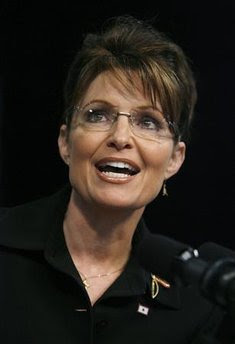 As things stand today, Sarah Palin is the obvious populist candidate and, for now, the very-very-early frontrunner for the 2012 nomination, given her now-massive name recognition (the woman's every TV appearance is a ratings bonanza), amazing talents as a retail politician, appeal to the base, and the GOP tendency towards nominating the next in line.
Granted, only two candidates in the part century (Bob Dole and Franklin D. Roosevelt) have won a major party nomination after being the VP nominee for a losing ticket (not counting Mondale, who'd already been VP), those two waited 12 and 20 years before doing so, respectively, and recent history has been unkind to those who tried (Edwards 2008, Lieberman 2004 - see also Quayle 2000).
I'll expand another day on the challenges facing Gov. Palin - the short answer is that inexperience is the easiest thing in the world to fix, but she'll have to face tougher budgetary times in Alaska in light of falling oil revenues, she'll have to withstand what is likely to be an ongoing national campaign by the Democrats to take her down or hobble her re-election efforts to cut off the likeliest threat to Obama, and she'll have to develop and sell her own, independent agenda and demonstrate a greater breadth and depth of knowledge on national politics than are required from the running mate slot.
Upside in the primaries: the socially conservative, moose-hunting hockey mom could potentially be well-suited to the early GOP primary/caucus electorates in Iowa, New Hampshire and Michigan.
(2) The Establishment Candidate: The GOP by tradition tends to fall in behind whoever is the candidate of the establishment - of country clubs and boardrooms and Beltway insiders. Part of being a Republican, of course, is having the maturity to understand that being the establishment candidate is not a bad thing. But an angry grassroots is going to take some serious persuading to pick another establishment figure.
The best establishment candidate should be Jeb Bush, for a variety of reasons, but four years won't be enough - if any length of time is - to rebuild the Bush brand within the GOP, let alone the general electorate.
That leaves Mitt Romney as the logical next step; Mitt is currently out of office and thus less equipped to get more experience, but he'll have the money and energy to spend four years staking himself out as a consistent conservative voice and putting the distance of time between 2012 and the flip-flop charges of 2008.
South Dakota Senator John Thune is also sometimes mentioned, but after 1964, 1996 and now 2008, the GOP has hopefully learned its lesson about nominating legislators for President, especially sitting Senators. Newly re-elected Indiana Governor and former Bush budget director Mitch Daniels (see here and here) will have his name come up but more likely as a VP nominee.
(3) The Full-Spectrum Conservative: The Fred Thompson role from 2008 but one that will pack a lot more potential appeal in 2012.
Bobby Jindal is the best of the lot, but while he's already got an impressive resume, Jindal's so young (he's 37, which makes him the age Romney was in 1985), so he can afford to wait out several more election cycles; he's up for re-election in 2011, which makes running in 2012 very problematic; and he really and genuinely wants to stay in Louisiana long enough to make real changes in his beloved home state's legendarily corrupt and dysfunctional political culture.
The other main contender for this slot is South Carolina's Governor Mark Sanford, now in his second term as Governor after 3 in Congress. SC is the most favorable turf for a candidate of this type among the early primary states, so with Sanford running as a favorite son he could basically block out any other challengers, and if he doesn't run for re-election in 2010 (offhand I don't know whether he's term-limited), he'd have a logistical advantage over Palin, who will presumably still be in office as governor of a geographically remote state.
(4) The National Security Candidate: After four years of Obama, there's also likely to be strong sentiment for adult leadership on national security. Traditionally, the GOP has tended to prioritize this issue (in 2008, both McCain and Giuliani ran primarily as national security candidates).
But especially with Senators in disfavor, the supply of candidates with more national security credentials than a typical Governor is short - most of the Dick Cheney and Don Rumsfeld types in the party will be past their prime by 2012, and I continue to doubt that Condi Rice could be a viable candidate for a multitude of reasons.
The name you're likely to hear is CENTCOM commander General David Petraeus, but Gen. Petraeus - who I assume will remain on active duty for another year or two, at least, and who President Obama dare not fire - has no political experience and no known domestic-policy profile (we don't even know if he's a Republican). My guess is that if we nominate a governor in 2012, Gen. Petraeus will be much in demand as a running mate. After that, I'm not sure who will even try to fill this slot in the primaries.
Sorry, but that's the list; the no-more-McCains sentiment among the base will make it impossible for someone like Tim Pawlenty to mount a credible campaign as a moderate, nobody will bother trying to re-create the crippling damage inflicted on Rudy Giuliani from running with a record as a social liberal, and no Ron Paul type candidate (especially Ron Paul) is ever going to make a serious dent. It's those four slots or bust.
And I, for one, am definitely not committing yet to who I'll support as between Palin or a Sanford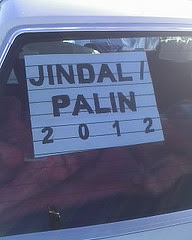 or Jindal run or maybe somebody else (obviously I'm not a Mitt fan). There's two long years ahead of us before that choice begins to arise.
Saw this on a car in
Moore, Oklahoma USA

What the Republican field will look like in four years. Obviously, there are many variables along the way, ranging from how beatable Obama looks to the 2010 midterms; I'm just forecasting with the known knowns we have today. As usual there will probably be 10 or so candidates, but from where we sit today there look to be four slots from which to put together a credible primary campaign:
(1) The Populist Candidate: With its Washington leadership beheaded, the GOP is likely to become more of a populist and culturally conservative party in the next four years. Mike Huckabee showed this year the power and the limitations of a pure populist campaign, far exceeding expectations with nearly no resources or name recognition (although Huck was out of step with the populists on one of the major causes of grassroots frustration with DC, immigration). Against the backdrop of a tax-spend-regulate Obama Administration, a crucial challenge will be squaring populism with the GOP's need to appeal to economic and fiscal conservatives to expand out of the Huck-size niche. Realistically, the populist candidate is likely to end up as the most moderate serious candidate in the field.
 As things stand today, Sarah Palin is the obvious populist candidate and, for now, the very-very-early frontrunner for the 2012 nomination, given her now-massive name recognition (the woman's every TV appearance is a ratings bonanza), amazing talents as a retail politician, appeal to the base, and the GOP tendency towards nominating the next in line.
 Granted, only two candidates in the part century (Bob Dole and Franklin D. Roosevelt) have won a major party nomination after being the VP nominee for a losing ticket (not counting Mondale, who'd already been VP), those two waited 12 and 20 years before doing so, respectively, and recent history has been unkind to those who tried (Edwards 2008, Lieberman 2004 - see also Quayle 2000).
I'll expand another day on the challenges facing Gov. Palin - the short answer is that inexperience is the easiest thing in the world to fix, but she'll have to face tougher budgetary times in Alaska in light of falling oil revenues, she'll have to withstand what is likely to be an ongoing national campaign by the Democrats to take her down or hobble her re-election efforts to cut off the likeliest threat to Obama, and she'll have to develop and sell her own, independent agenda and demonstrate a greater breadth and depth of knowledge on national politics than are required from the running mate slot.
Upside in the primaries: the socially conservative, moose-hunting hockey mom could potentially be well-suited to the early GOP primary/caucus electorates in Iowa, New Hampshire and Michigan.
(2) The Establishment Candidate: The GOP by tradition tends to fall in behind whoever is the candidate of the establishment - of country clubs and boardrooms and Beltway insiders. Part of being a Republican, of course, is having the maturity to understand that being the establishment candidate is not a bad thing. But an angry grassroots is going to take some serious persuading to pick another establishment figure.
The best establishment candidate should be Jeb Bush, for a variety of reasons, but four years won't be enough - if any length of time is - to rebuild the Bush brand within the GOP, let alone the general electorate.
That leaves Mitt Romney as the logical next step; Mitt is currently out of office and thus less equipped to get more experience, but he'll have the money and energy to spend four years staking himself out as a consistent conservative voice and putting the distance of time between 2012 and the flip-flop charges of 2008.
South Dakota Senator John Thune is also sometimes mentioned, but after 1964, 1996 and now 2008, the GOP has hopefully learned its lesson about nominating legislators for President, especially sitting Senators. Newly re-elected Indiana Governor and former Bush budget director Mitch Daniels (see here and here) will have his name come up but more likely as a VP nominee.
(3) The Full-Spectrum Conservative: The Fred Thompson role from 2008 but one that will pack a lot more potential appeal in 2012.
Bobby Jindal is the best of the lot, but while he's already got an impressive resume, Jindal's so young (he's 37, which makes
 him the age Romney was in 1985), so he can afford to wait out several more election cycles; he's up for re-election in 2011, which makes running in 2012 very problematic; and he really and genuinely wants to stay in Louisiana long enough to make real changes in his beloved home state's legendarily corrupt and dysfunctional political culture.
The other main contender for this slot is South Carolina's Governor Mark Sanford, now in his second term as Governor after 3 in Congress. SC is the most favorable turf for a candidate of this type among the early primary states, so with Sanford running as a favorite son he could basically block out any other challengers, and if he doesn't run for re-election in 2010 (offhand I don't know whether he's term-limited), he'd have a logistical advantage over Palin, who will presumably still be in office as governor of a geographically remote state.
(4) The National Security Candidate: After four years of Obama, there's also likely to be strong sentiment for adult leadership on national security. Traditionally, the GOP has tended to prioritize this issue (in 2008, both McCain and Giuliani ran primarily as national security candidates).
But especially with Senators in disfavor, the supply of candidates with more national security credentials than a typical Governor is short - most of the Dick Cheney and Don Rumsfeld types in the party will be past their prime by 2012, and I continue to doubt that Condi Rice could be a viable candidate for a multitude of reasons.
The name you're likely to hear is CENTCOM commander General David Petraeus, but Gen. Petraeus - who I assume will remain on active duty for another year or two, at least, and who President Obama dare not fire - has no political experience and no known domestic-policy profile (we don't even know if he's a Republican). My guess is that if we nominate a governor in 2012, Gen. Petraeus will be much in demand as a running mate. After that, I'm not sure who will even try to fill this slot in the primaries.
Sorry, but that's the list; the no-more-McCains sentiment among the base will make it impossible for someone like Tim Pawlenty to mount a credible campaign as a moderate, nobody will bother trying to re-create the crippling damage inflicted on Rudy Giuliani from running with a record as a social liberal, and no Ron Paul type candidate (especially Ron Paul) is ever going to make a serious dent. It's those four slots or bust.
And I, for one, am definitely not committing yet to who I'll support as between Palin or a Sanford
 or Jindal run or maybe somebody else (obviously I'm not a Mitt fan). There's two long years ahead of us before that choice begins to arise.
Saw this on a car in
Moore, Oklahoma USA
Friday, October 31, 2008
Fred Thompson for RNC Chair ?
Hat Tip to The Griffin Room


Yesterday, I spoke extensively with a prominent (understatement) Republican strategist, and he informed me that he believes there is great interest in Sen. Fred Thompson serving as the next Chairman of the Republican National Committee. Fred is a mainstream conservative who made a lot of sense during the Republican debates. Watch for more and more chatter about this because there is a great deal of dissatisfaction with some of the other names who have been floated so far.
BTW, I attended a forum at the Harvard Kennedy School yesterday where Sen. Thompson spoke and answered questions for almost two hours. He was well received and spoke with much passion.

Saturday, February 2, 2008
Why did the Fred Thompson Blog Work?

the Fred FileAs most of you know, The Bivings Group was a part of the team that built Fred Thompson’s Presidential campaign website. Our main client contact on the project, Michael Turk, has a good post up rounding up the good, the bad and the ugly aspects of the online program we all put together. It is worth a read.
In the piece, Turk points out that one of the most successful aspects of the program was the campaign blog, the Fred File. He writes:
As an example of the strength of Thompson’s online effort, look at the Thompson campaign blog and you’ll see something remarkable for GOP candidates - comments. And not just a few comments, but hundreds and even thousands of comments.I think Turk is right on here. With any successful blog, 90% of the battle is producing readable content and engaging with readers. Many, many campaigns want a blog in theory but don’t have the stomach to do the heavy lifting that will make it actually work. The Thompson campaign, lead by staffers Sean Hackbarth and Austin Walne, deserve the lion’s share of the credit for the success of the Fred File. But I also think there were some small, more technical decisions that were made that helped give the blog a greater chance to succeed.
Rudy’s blog doesn’t allow comments. Romney’s gets a few per post. Ron Paul just recently launched a blog (despite the fact that blog software is largely free). He currently gets between a handful and a few dozen comments.
I don’t think this indicates a lack of supporter enthusiasm as much as it indicates that the campaigns have created a blog with nothing to say on sites that are so scrubbed of interesting content they’re almost sterile. Most of the posts are rehashed press releases, rehashed campaign e-mails, or occasionally a video so overscripted it becomes almost completely unwatchable.
First, the blog was built in a real blogging platform, Wordpress (Wordpress Mu specifically). On a lot of political sites you’ll see blogs that are built as an extension of the overall Content Management System. The results is blogs that don’t really look or act like blogs (no RSS feed, no pinging, no plug-ins, no categories, no comments, etc.). Using Wordpress gave us all the functionality we needed out of the box and made it relatively easy to add new features.
Second, in order to post comments users had to create an account using our main volunteer sign up form. There were no anonymous comments and people’s full names appeared next to their words. In addition to that, Turk made the decision early on to force people to have site accounts to even view comments. Due to these decisions, the site had almost no trolls, as you had to be pretty committed to even view the comments, much less post. Forcing people to use their real names creates a sense of accountability in posters, creating a really civil environment. We also included the number of comments a user had made next to their name, which lead people to welcome in newbies and provided a way to reward those who spent lots of time in the comments. The atmosphere was like a comfy neighborhood bar. This is in stark contrast to the comment areas on a lot of campaign and newspaper sites, which come closer to the chaos of Times Square on New Years Eve.
Third, we used a plugin called WP-Sticky to pin important posts to the top of the blog. The intent in installing this was so that we could highlight our more substantive posts (those written by Fred himself or announcements). The unintended consequence was that long discussions would occur around these featured posts, as people just sort of hung out and read and posted comments almost like you see on a message board.
Anyway, the content drove the bus here. But I think these smaller decisions that were made helped create a good environment for the Fredheads and contributed to the success of the Fred File.
Saturday, January 26, 2008
Fred08.com: An Outside Insider’s View
Hat Tip to Michael @ Kung Fu Quip

Fred08.com:
An Outside Insider’s View
A lot has been written about the Thompson campaign in the past two days. I have read a bunch of post-mortems all focused on what went wrong, but I thought I would spend a little time telling you what went right. For people interested in online politics and the way candidates use the web, the Thompson campaign is a great case study in what can go well, and go badly in our world.
On May 22nd, I was sitting at Inova Fairfax hospital as my wife was rehydrated. A vicious stomach flu was circulating through the house and had brought my wife and son down. As we sat there that evening, I received an e-mail on my Blackberry from the brother of a friend of the Thompson’s. A few days earlier, they had seen an article in the Washington Post wherein I chastised my party for not using the Internet effectively.
I had been sweating the fallout from that article for two days. I was not exactly loved by the RNC for my critical assessment of their online operation. That article, which was about 180 degrees removed from the series of conversations I had with the reporter, was not going to help.
The Thompson team, however, agreed with my assessment that campaigns could use the Internet differently and wanted me to come out to “The House” to chat about it. We agreed to meet the next day despite what would become a full-blown case of the flu. The Thompson team, it seems, had circulated that same flu about a week earlier and none of them were afraid of catching it again.
On May 23rd, I met with Team Fred and after a three hour discussion of new and innovative ways you could use the Internet to supplement a traditional campaign, I left with an assignment - build a Presidential website in the height of a media storm, that would withstand a huge rush of traffic the moment it launched, and do it all in 10 days.
The Launch
On June 5, 2007, we launched ImWithFred.com. The site was originally envisioned as a simple splash page that would gather low hanging fruit - early donors and supporters looking to sign up. A requirement that all forms be pre-populated so visitors would not have to fill in information more than once threw in a wrinkle and we ended up building personalization into a splash page - not something most people would do. We also ended up building tools that would allow viral recruitment for both donors and volunteers.
Now these tools were hardly new or innovative, but the combination of designing the data architecture, doing the graphic design work, cutting up the site, coding it all, and allowing time to test for bugs in 10 days (over Memorial Day weekend, no less) was about the craziest thing I have ever tried. The data architecture alone had to support huge traffic, and getting the servers provisioned, hardened and tested would eat into our ability to deploy a test environment. Doing all of this over the holiday made me very popular with the development team.
Speaking of the team, I have to give credit to Dan Hopkins, Blaise Hazelwood, Todd Zeigler, Ken Smith, Brian Lyle and the gang that pulled this together. They did an outstanding job getting the site launched under those conditions and rarely complained (to me at least).
On Hannity and Colmes, Fred announced his website url and the flood came in. We took a lot of heat for the thin site, but we didn’t have time for much else. Had we had a month to design, build and test, we could have done more. Given the time we had, and the limitations of working under the “Testing the Waters” rules, I thought we did fine. We attracted over 100,000 unique visitors, raised over a quarter million dollars, and added nearly 30,000 names to our list in the first 24 hours.
On June 12, we rolled out the Fred File, added Fred’s bio, and added tools to spread the word through traditional media by contacting talk radio and newspapers. I was traveling back from a meeting in Colorado that night on a flight that was seriously delayed. I ended up doing the go-live countdown from a seat just inside the arrival gate at Dulles airport on their wi-fi connection. We made the rollout about 30 minutes ahead of Fred’s appearance on Leno that night.
The blog was a hit almost instantly and led me to believe the path we had chosen was right. Fred’s commentaries were getting a lot of comments and I saw the beginning of an online community I’ve never seen around a GOP candidate’s online operation. What’s more, nobody wrote a single word about what supporters were saying online. Nobody accused us of endorsing the random beliefs espoused by the occasional nut, and nobody on the campaign had to answer a single press call (that I am aware of) about the blog or anything said on it.
ImWithFred.com Version 2.0 - The New McKinley
Described inappropriately as ImWithFred.com 2.0 by some creative types, the actual site was finished the week of July 9th. We had been asked to shoot for having the live site ready the first week of July (timed to be released with the announcement). The site was delayed by a week. The announcement was delayed by two months.
Originally I saw the campaign’s Internet operation as the modern day equivalent of McKinley in 1896. As Fred took his message to the people, they could, at the same moment, come and visit him sitting on the front porch of this virtual house. FDT could simultaneously campaign in Iowa and around the world, by carrying the coffee shop conversations online - posting about questions he was asked at a rally, or continuing to develop regular, and lengthy posts about the issues we face.
While the pundits will discuss and debate exactly where the campaign went wrong, the one thing I believe they misunderstand is the way the Internet could have, and should have, shaped this campaign. That misunderstanding contributed to the “Fred is lazy” storyline early on.
The campaign still had to do the things necessary to win - talking to, registering, IDing, and mobilizing voters. Nobody questioned that. That the campaign strategy was written off as “relying entirely on the Internet” was simply not accurate.
The idea, from my perspective, was to harness the power of the Net to build a robust community that would become an integral part of the ground game. The Bush-Cheney campaign had begun the process of enabling volunteer action online. It pioneered activism tools that allowed voters to create and run phone bank and canvass operations from their home. It allowed people to participate on their own terms, rather than forcing them to attend a Saturday morning walk.
I saw this campaign as the natural evolution of that effort, but it would go further in the one arena where BC04 fell short. The Bush campaign was innovative in allowing people to participate in the mechanics of the campaign, but it never developed the community that could interact, inspire, and spur each other into action. I felt in 2004, and still feel today, that is the missing pieces required to fully realize the benefit of these applications.
The Thompson web operation would be different. With Jon Henke, Howard Mortman and William Beutler constantly opening new channels through local, state and national blogs, and the campaign site providing a vehicle for those attracted to participate in the campaign, we could reach the tipping point where engaged people are empowered to contribute in ways never attempted by the GOP.
Buy In
When I first met with Linda Rozett, Mark Corallo and Ed McFadden, I was distrustful. I unfairly stereotyped them as traditional communications people. It has been my experience in dealing with campaign Communications staff that they have developed a sort of impenetrable cocoon around themselves. Any thought that runs contrary to the way they did things on their first campaign is somehow filtered out as a bad idea. I would describe it as a mild form of mental illness. It’s a cognitive dissonance of the first order and it seems to afflict nearly all of them.
Mark, Ed and Linda didn’t fit that mold. They understood that we needed to be part of the dialog on blogs and online forums like Townhall, but they also understood the need to drive traffic to our own property and to develop a community. The chatter about Fred online, the traffic to the site, and the money coming in led me to believe the theory was right and we could introduce a paradigm shift.
I knew from my RNC days and the Bush days that buy-in for a radically different approach would be critical. I was pleased to see that everyone in the campaign from Fred and Jeri through Linda, Mark and Ed was onboard. It really did make a difference.
The Little Red Truck
Unfortunately, the staff turnover that began in the late summer had an almost immediate effect on the Internet operation.
As the Communications team focused on traditional media tactics, their attention increasingly turned away from the Internet. The commentaries became less frequent, online initiatives were no longer part of the equation.
In October, we began discussions of an end of quarter fundraising drive featuring a real-time disclosure of our success. The concept was shot down over concerns that it would place too much emphasis on money. As we moved through November, we began to hear rumblings of Fredsgiving Day - a third party money bomb effort scheduled the day before Thanksgiving.
It was unclear whether the campaign would support the effort. There were concerns (voiced by many online) that the timing was off - nobody would pay attention the day before the holiday. In the event the campaign decided to jump in, we went ahead and built the little red truck to track contributions that day. It was never deployed.
It was late in December when the little red truck finally saw the sunlight. Over the next three weeks, that little red pickup helped the campaign raise 1.25 million dollars. Had it been unveiled sooner, who knows what might have happened.
Lessons Learned
I share all of this anecdotally in the hopes of illustrating something for GOP campaigns (and more broadly for campaigns in general). I’m afraid that the withdrawal of Fred Thompson will lead people to conclude that the model was wrong. I really don’t feel it was.
As I said, I think the Thompson Internet operation, in the early days, and in the final days, was really second to none. Political campaign professionals should study the Thompson effort not as a case study in what went badly, but as an example of what was going very well, and could have been extraordinary had it not been for the media’s obsessive demand for ‘the tried and true tactics of the 1980s’.
As an example of the strength of Thompson’s online effort, look at the Thompson campaign blog and you’ll see something remarkable for GOP candidates - comments. And not just a few comments, but hundreds and even thousands of comments.
Rudy’s blog doesn’t allow comments. Romney’s gets a few per post. Ron Paul just recently launched a blog (despite the fact that blog software is largely free). He currently gets between a handful and a few dozen comments.
I don’t think this indicates a lack of supporter enthusiasm as much as it indicates that the campaigns have created a blog with nothing to say on sites that are so scrubbed of interesting content they’re alsmost sterile. Most of the posts are rehashed press releases, rehashed campaign e-mails, or occasionally a video so overscripted it becomes almost completely unwatchable.
Most campaigns think of comments as a way for people to respond to the post. Almost nobody on the GOP side sees this as a way for their supporters to network, to share ideas, or to brainstorm ways to help the campaign.
Most Republicans fear the rogue comment that will be used to tarnish their campaign. What they fail to realize is in a vibrant community that rogue comment is always surrounded by dozens of voices or more shouting them down. If anything, they typically dispel arguments that your base is crazy.
For the rabidly partisan Democrats reading this, please don’t mischaracterize this post as “Republican Internet guru just discovers blogs and comments.” That is not at all the point. The point is something much larger that I have been shouting at my party for several years now - they need to trust and engage the people. Since the people are online, they need to engage people online. There are just as many Democtrats who need to learn this lesson (cough, cough, Hillary, cough, cough).
They need to build online operations so they invite people to the discussion rather than turning them off of it. Get candidates to write, in their own words, frequent posts. Understand that a ground game is critical, but it must be viewed in terms of ROI. A thoughtful, honest post from a candidate may be discussed and passed around by thousands of people online. It takes little time to write if it’s sincere and not obsessive studied and focus grouped.
If your candidate honestly doesn’t have time to write, have staff carry a video camera and a MacBook to post from the road. Forgo the hair, the makeup, and the lighting. You’re on a bus 50 miles from Waterloo. Nobody is going to believe that your makeup is perfect and so is the lighting. Be real. We don’t expect perfection, but we do expect honesty.
My last piece of advice is this… In your interview process, ask your Communications Director to name his five favorite blogs. If they can’t, ask them for a suggestion on how best to target communications to specific demographic segments using banner ads. If they can’t answer either of those questions, don’t hire them. They don’t get what’s going on in the world around them.
This entry was posted on Thursday, January 24th, 2008 at 5:16 pm and is filed under Bloggers, Candidates, Elections, Fred Thompson, News Media, Operatives, Politics, Republicans, The Internet. You can follow any responses to this entry through the RSS 2.0 feed. You can leave a response, or trackback from your own site.


NPR's Audie Cornish followed former Tenn. Sen Fred Thompson during this past summer when he was still thinking about starting his run for the Republican presidential nomination - which he dropped this past week. She offers this analysis of why he wasn't able to capitalize on the initial surge of interest in his candidacy.
First, Thompson focused a lot on conservative blogs and radio, and some Fox News shows. It was very difficult to get him or through to that campaign in those first few weeks. After a certain amount of time Thompson's so-called "earned media" diminished - and he pretty much fell off the radar. The campaign sort of squandered the attention they had from the mainstream media at the start.
Second, Thompson did not defy the "lazy" label with his campaign schedule. While he made strong and hard pushes in the final week or two before Iowa and again in South Carolina, I would be very surprised if his schedule matched up to say a Mitt Romney or a John McCain - or any of the Democrats. Just a week before his announcement in September his campaign manager-to-be Bill Lacy told me this in an interview when I asked about the "lazy" thing.
By not putting in the trail time and making good use of initial media interest I think Thompson made it less likely he would be able to exploit potentially "big" debate performances that could have elevated him above the pack.
-- Audie Cornish

Fred08.com:
An Outside Insider’s View
A lot has been written about the Thompson campaign in the past two days. I have read a bunch of post-mortems all focused on what went wrong, but I thought I would spend a little time telling you what went right. For people interested in online politics and the way candidates use the web, the Thompson campaign is a great case study in what can go well, and go badly in our world.
On May 22nd, I was sitting at Inova Fairfax hospital as my wife was rehydrated. A vicious stomach flu was circulating through the house and had brought my wife and son down. As we sat there that evening, I received an e-mail on my Blackberry from the brother of a friend of the Thompson’s. A few days earlier, they had seen an article in the Washington Post wherein I chastised my party for not using the Internet effectively.
I had been sweating the fallout from that article for two days. I was not exactly loved by the RNC for my critical assessment of their online operation. That article, which was about 180 degrees removed from the series of conversations I had with the reporter, was not going to help.
The Thompson team, however, agreed with my assessment that campaigns could use the Internet differently and wanted me to come out to “The House” to chat about it. We agreed to meet the next day despite what would become a full-blown case of the flu. The Thompson team, it seems, had circulated that same flu about a week earlier and none of them were afraid of catching it again.
On May 23rd, I met with Team Fred and after a three hour discussion of new and innovative ways you could use the Internet to supplement a traditional campaign, I left with an assignment - build a Presidential website in the height of a media storm, that would withstand a huge rush of traffic the moment it launched, and do it all in 10 days.
The Launch
On June 5, 2007, we launched ImWithFred.com. The site was originally envisioned as a simple splash page that would gather low hanging fruit - early donors and supporters looking to sign up. A requirement that all forms be pre-populated so visitors would not have to fill in information more than once threw in a wrinkle and we ended up building personalization into a splash page - not something most people would do. We also ended up building tools that would allow viral recruitment for both donors and volunteers.
Now these tools were hardly new or innovative, but the combination of designing the data architecture, doing the graphic design work, cutting up the site, coding it all, and allowing time to test for bugs in 10 days (over Memorial Day weekend, no less) was about the craziest thing I have ever tried. The data architecture alone had to support huge traffic, and getting the servers provisioned, hardened and tested would eat into our ability to deploy a test environment. Doing all of this over the holiday made me very popular with the development team.
Speaking of the team, I have to give credit to Dan Hopkins, Blaise Hazelwood, Todd Zeigler, Ken Smith, Brian Lyle and the gang that pulled this together. They did an outstanding job getting the site launched under those conditions and rarely complained (to me at least).
On Hannity and Colmes, Fred announced his website url and the flood came in. We took a lot of heat for the thin site, but we didn’t have time for much else. Had we had a month to design, build and test, we could have done more. Given the time we had, and the limitations of working under the “Testing the Waters” rules, I thought we did fine. We attracted over 100,000 unique visitors, raised over a quarter million dollars, and added nearly 30,000 names to our list in the first 24 hours.
On June 12, we rolled out the Fred File, added Fred’s bio, and added tools to spread the word through traditional media by contacting talk radio and newspapers. I was traveling back from a meeting in Colorado that night on a flight that was seriously delayed. I ended up doing the go-live countdown from a seat just inside the arrival gate at Dulles airport on their wi-fi connection. We made the rollout about 30 minutes ahead of Fred’s appearance on Leno that night.
The blog was a hit almost instantly and led me to believe the path we had chosen was right. Fred’s commentaries were getting a lot of comments and I saw the beginning of an online community I’ve never seen around a GOP candidate’s online operation. What’s more, nobody wrote a single word about what supporters were saying online. Nobody accused us of endorsing the random beliefs espoused by the occasional nut, and nobody on the campaign had to answer a single press call (that I am aware of) about the blog or anything said on it.
ImWithFred.com Version 2.0 - The New McKinley
Described inappropriately as ImWithFred.com 2.0 by some creative types, the actual site was finished the week of July 9th. We had been asked to shoot for having the live site ready the first week of July (timed to be released with the announcement). The site was delayed by a week. The announcement was delayed by two months.
Originally I saw the campaign’s Internet operation as the modern day equivalent of McKinley in 1896. As Fred took his message to the people, they could, at the same moment, come and visit him sitting on the front porch of this virtual house. FDT could simultaneously campaign in Iowa and around the world, by carrying the coffee shop conversations online - posting about questions he was asked at a rally, or continuing to develop regular, and lengthy posts about the issues we face.
While the pundits will discuss and debate exactly where the campaign went wrong, the one thing I believe they misunderstand is the way the Internet could have, and should have, shaped this campaign. That misunderstanding contributed to the “Fred is lazy” storyline early on.
The campaign still had to do the things necessary to win - talking to, registering, IDing, and mobilizing voters. Nobody questioned that. That the campaign strategy was written off as “relying entirely on the Internet” was simply not accurate.
The idea, from my perspective, was to harness the power of the Net to build a robust community that would become an integral part of the ground game. The Bush-Cheney campaign had begun the process of enabling volunteer action online. It pioneered activism tools that allowed voters to create and run phone bank and canvass operations from their home. It allowed people to participate on their own terms, rather than forcing them to attend a Saturday morning walk.
I saw this campaign as the natural evolution of that effort, but it would go further in the one arena where BC04 fell short. The Bush campaign was innovative in allowing people to participate in the mechanics of the campaign, but it never developed the community that could interact, inspire, and spur each other into action. I felt in 2004, and still feel today, that is the missing pieces required to fully realize the benefit of these applications.
The Thompson web operation would be different. With Jon Henke, Howard Mortman and William Beutler constantly opening new channels through local, state and national blogs, and the campaign site providing a vehicle for those attracted to participate in the campaign, we could reach the tipping point where engaged people are empowered to contribute in ways never attempted by the GOP.
Buy In
When I first met with Linda Rozett, Mark Corallo and Ed McFadden, I was distrustful. I unfairly stereotyped them as traditional communications people. It has been my experience in dealing with campaign Communications staff that they have developed a sort of impenetrable cocoon around themselves. Any thought that runs contrary to the way they did things on their first campaign is somehow filtered out as a bad idea. I would describe it as a mild form of mental illness. It’s a cognitive dissonance of the first order and it seems to afflict nearly all of them.
Mark, Ed and Linda didn’t fit that mold. They understood that we needed to be part of the dialog on blogs and online forums like Townhall, but they also understood the need to drive traffic to our own property and to develop a community. The chatter about Fred online, the traffic to the site, and the money coming in led me to believe the theory was right and we could introduce a paradigm shift.
I knew from my RNC days and the Bush days that buy-in for a radically different approach would be critical. I was pleased to see that everyone in the campaign from Fred and Jeri through Linda, Mark and Ed was onboard. It really did make a difference.
The Little Red Truck
Unfortunately, the staff turnover that began in the late summer had an almost immediate effect on the Internet operation.
As the Communications team focused on traditional media tactics, their attention increasingly turned away from the Internet. The commentaries became less frequent, online initiatives were no longer part of the equation.
In October, we began discussions of an end of quarter fundraising drive featuring a real-time disclosure of our success. The concept was shot down over concerns that it would place too much emphasis on money. As we moved through November, we began to hear rumblings of Fredsgiving Day - a third party money bomb effort scheduled the day before Thanksgiving.
It was unclear whether the campaign would support the effort. There were concerns (voiced by many online) that the timing was off - nobody would pay attention the day before the holiday. In the event the campaign decided to jump in, we went ahead and built the little red truck to track contributions that day. It was never deployed.
It was late in December when the little red truck finally saw the sunlight. Over the next three weeks, that little red pickup helped the campaign raise 1.25 million dollars. Had it been unveiled sooner, who knows what might have happened.
Lessons Learned
I share all of this anecdotally in the hopes of illustrating something for GOP campaigns (and more broadly for campaigns in general). I’m afraid that the withdrawal of Fred Thompson will lead people to conclude that the model was wrong. I really don’t feel it was.
As I said, I think the Thompson Internet operation, in the early days, and in the final days, was really second to none. Political campaign professionals should study the Thompson effort not as a case study in what went badly, but as an example of what was going very well, and could have been extraordinary had it not been for the media’s obsessive demand for ‘the tried and true tactics of the 1980s’.
As an example of the strength of Thompson’s online effort, look at the Thompson campaign blog and you’ll see something remarkable for GOP candidates - comments. And not just a few comments, but hundreds and even thousands of comments.
Rudy’s blog doesn’t allow comments. Romney’s gets a few per post. Ron Paul just recently launched a blog (despite the fact that blog software is largely free). He currently gets between a handful and a few dozen comments.
I don’t think this indicates a lack of supporter enthusiasm as much as it indicates that the campaigns have created a blog with nothing to say on sites that are so scrubbed of interesting content they’re alsmost sterile. Most of the posts are rehashed press releases, rehashed campaign e-mails, or occasionally a video so overscripted it becomes almost completely unwatchable.
Most campaigns think of comments as a way for people to respond to the post. Almost nobody on the GOP side sees this as a way for their supporters to network, to share ideas, or to brainstorm ways to help the campaign.
Most Republicans fear the rogue comment that will be used to tarnish their campaign. What they fail to realize is in a vibrant community that rogue comment is always surrounded by dozens of voices or more shouting them down. If anything, they typically dispel arguments that your base is crazy.
For the rabidly partisan Democrats reading this, please don’t mischaracterize this post as “Republican Internet guru just discovers blogs and comments.” That is not at all the point. The point is something much larger that I have been shouting at my party for several years now - they need to trust and engage the people. Since the people are online, they need to engage people online. There are just as many Democtrats who need to learn this lesson (cough, cough, Hillary, cough, cough).
They need to build online operations so they invite people to the discussion rather than turning them off of it. Get candidates to write, in their own words, frequent posts. Understand that a ground game is critical, but it must be viewed in terms of ROI. A thoughtful, honest post from a candidate may be discussed and passed around by thousands of people online. It takes little time to write if it’s sincere and not obsessive studied and focus grouped.
If your candidate honestly doesn’t have time to write, have staff carry a video camera and a MacBook to post from the road. Forgo the hair, the makeup, and the lighting. You’re on a bus 50 miles from Waterloo. Nobody is going to believe that your makeup is perfect and so is the lighting. Be real. We don’t expect perfection, but we do expect honesty.
My last piece of advice is this… In your interview process, ask your Communications Director to name his five favorite blogs. If they can’t, ask them for a suggestion on how best to target communications to specific demographic segments using banner ads. If they can’t answer either of those questions, don’t hire them. They don’t get what’s going on in the world around them.
This entry was posted on Thursday, January 24th, 2008 at 5:16 pm and is filed under Bloggers, Candidates, Elections, Fred Thompson, News Media, Operatives, Politics, Republicans, The Internet. You can follow any responses to this entry through the RSS 2.0 feed. You can leave a response, or trackback from your own site.


Thompson Failed to
Capitalize On Initial
Media Interest
01-25-2008
Capitalize On Initial
Media Interest
01-25-2008
NPR's Audie Cornish followed former Tenn. Sen Fred Thompson during this past summer when he was still thinking about starting his run for the Republican presidential nomination - which he dropped this past week. She offers this analysis of why he wasn't able to capitalize on the initial surge of interest in his candidacy.
First, Thompson focused a lot on conservative blogs and radio, and some Fox News shows. It was very difficult to get him or through to that campaign in those first few weeks. After a certain amount of time Thompson's so-called "earned media" diminished - and he pretty much fell off the radar. The campaign sort of squandered the attention they had from the mainstream media at the start.
Second, Thompson did not defy the "lazy" label with his campaign schedule. While he made strong and hard pushes in the final week or two before Iowa and again in South Carolina, I would be very surprised if his schedule matched up to say a Mitt Romney or a John McCain - or any of the Democrats. Just a week before his announcement in September his campaign manager-to-be Bill Lacy told me this in an interview when I asked about the "lazy" thing.
He knows how important it is to prepare and be ready for big events. I think that preparation is important and that is going to involve - maybe I don't ask him to have a grinding schedule every day where he spends 18 or 20 hours out because frankly I'd much rather have him able to be deliver better performances.
By not putting in the trail time and making good use of initial media interest I think Thompson made it less likely he would be able to exploit potentially "big" debate performances that could have elevated him above the pack.
-- Audie Cornish
Jeff Cloud Endorses McCain
 Jeff Cloud Endorses McCain
Corporation Commissioner Jeff Cloud, who had been one of Fred Thompson's Oklahoma coordinators, has endorsed John McCain for the Republican presidential nomination.

Oklahoma House speaker endorses McCain for president
Wednesday, January 23, 2008
to the woodshed, rinos!
Hat Tip to my buddy Beth @ 'my vast right wing conspiracy'

Posted by Beth on January 23rd, 2008
Excuse me while I join the Anchoress in escorting Reaganites In Name Only (oops! I mean angry conservatives! or did I?) to the woodshed. I’ll be the one holding a whip, just itching to use it.
Attention, fellow former Fredheads–you who say you’re a Reagan conservative, but refuse to learn the art of politics and teamwork in the pursuit of achieving big-picture common goals: If you plan on sitting out the elections, or, God forbid, voting Democrat to “teach a lesson” or whatever, you are not a Reagan conservative. You are not a real Fredhead, either. Neither of these men would do such a thing.
Don’t believe me? Don’t just take my word for it, although I know this to be an absolute truth–here’s another thing the Anchoress mentions:
Oh, how soon those dragging around Reagan’s corpse forget.
I find it literally jaw-dropping when I read someone invoking the name of Ronald Reagan, while in the same sentence (!) petulantly announcing that none of the candidates are conservative enough and that voting this year is simply not an option. Or even more amusingly, announcing that Candidate X has “betrayed” conservatives or “stabbed us in the back,” while betraying conservatism themselves. Huh??? Epic FAIL.
I’ll allow the Anchoress to finish. (Read the comments, too.) God bless her for saving me from a head explosion.
And thank you, Wuzzadem, for making me laugh as you always do. After the last couple of days, I needed it. :)

Posted by Beth on January 23rd, 2008
Excuse me while I join the Anchoress in escorting Reaganites In Name Only (oops! I mean angry conservatives! or did I?) to the woodshed. I’ll be the one holding a whip, just itching to use it.
It seems the standard GOP voter - and apparently Rush Limbaugh - wants to disinter Ronald Reagan from his noble tomb and hoist him onto the campaign trail because he is their saint and savior, and if they can’t vote for someone exactly like him “Ronaldus Magnus” well, they’re going to sit out this all-important election.
Excuse me, but Ronald Reagan would have had no patience for the likes of you.
Attention, fellow former Fredheads–you who say you’re a Reagan conservative, but refuse to learn the art of politics and teamwork in the pursuit of achieving big-picture common goals: If you plan on sitting out the elections, or, God forbid, voting Democrat to “teach a lesson” or whatever, you are not a Reagan conservative. You are not a real Fredhead, either. Neither of these men would do such a thing.
Don’t believe me? Don’t just take my word for it, although I know this to be an absolute truth–here’s another thing the Anchoress mentions:
Ronald Reagan above all was a pragmatist and a realist. He understood something that some voters seem to have forgotten:
“When I began entering into the give and take of legislative bargaining in Sacramento, a lot of the most radical conservatives who had supported me during the election didn’t like it. “Compromise” was a dirty word to them and they wouldn’t face the fact that we couldn’t get all of what we wanted today. They wanted all or nothing and they wanted it all at once. If you don’t get it all, some said, don’t take anything. I’d learned while negotiating union contracts that you seldom got everything you asked for. And I agreed with FDR, who said in 1933: ‘I have no expectations of making a hit every time I come to bat. What I seek is the highest possible batting average.’ If you got seventy-five or eighty percent of what you were asking for, I say, you take it and fight for the rest later, and that’s what I told these radical conservatives who never got used to it.“
– Ronald Reagan, An American Life
Oh, how soon those dragging around Reagan’s corpse forget.
I find it literally jaw-dropping when I read someone invoking the name of Ronald Reagan, while in the same sentence (!) petulantly announcing that none of the candidates are conservative enough and that voting this year is simply not an option. Or even more amusingly, announcing that Candidate X has “betrayed” conservatives or “stabbed us in the back,” while betraying conservatism themselves. Huh??? Epic FAIL.
I’ll allow the Anchoress to finish. (Read the comments, too.) God bless her for saving me from a head explosion.
And thank you, Wuzzadem, for making me laugh as you always do. After the last couple of days, I needed it. :)
Tuesday, January 22, 2008
FDT quits; may position himself for VP bid
 Fred Thompson quits; may position himself for VP bid
by Bill Sammon, The Examiner
Washington DC - Republican presidential candidate Fred Thompson dropped out of the race Tuesday and, according to a top adviser, can now position himself as a vice presidential candidate.
"We're all grownups in this game and he has said he's not going to be a hanger on," Thompson adviser Rich Galen told The Examiner, explaining Thompson's decision.
Thompson spent the last several days in Tennessee with his ailing mother, who is in her 90s, and he decided not to participate in Thursday's GOP debate in Florida, which holds its primary next Tuesday. Previously, Thompson never missed a debate, even if it was in a state where he was not actively campaigning.
Galen said Thompson could end up as vice president because he could mitigate the conservative shortcomings of potential nominees such as Rudy Giuliani.
"Having somebody like Thompson on the ticket, it seems to me, could go a long way toward unifying and energizing the base," Galen told The Examiner.
"I don't even know if he'd take it, although I'm not sure I've ever heard of anybody turning it down," he added. "He has said flat out he's not interested in becoming vice president, but that's what they all say."
bsammon@dcexaminer.com
Fred Thompson Quits Presidential Race
Fred Thompson Quits Presidential Race
Jan 22 02:29 PM US/Eastern
Jan 22 02:29 PM US/Eastern
NAPLES, Fla. (AP) - Former Tennessee Sen. Fred Thompson quit the Republican presidential race on Tuesday, after a string of poor finishes in early primary and caucus states.
"Today, I have withdrawn my candidacy for president of the United States. I hope that my country and my party have benefited from our having made this effort," Thompson said in a statement.
Thompson's fate was sealed last Saturday in the South Carolina primary, when he finished third in a state that he had said he needed to win.
In the statement, Thompson did not say whether he would endorse any of his former rivals. He was one of a handful of members of Congress who supported Arizona Sen. John McCain in 2000 in his unsuccessful race against George W. Bush for the party nomination.
Friday, January 11, 2008
Muskogee County GOP hear presidential reps

Muskogee County Republicans wanting to strengthen America’s borders, empower the states and get rid of the Internal Revenue Service heard about presidential candidates who want most of those same things at their monthly meeting Thursday.
Representatives for former New York Mayor Rudy Giuliani, former Arkansas governor Mike Huckabee, Texas Congressman Ron Paul and former U.S. Senator Fred Thompson promoted their candidates’ position before about 50 GOP supporters at Jasper’s Restaurant. Absent were representatives for U.S. Sen. John McCain and former Massachusetts Gov. Mitt Romney.
Speaking for Huckabee, former state Sen. Scott Pruitt got the most rounds of applause from those in the room.
“Mike’s not for reducing the tax code but eliminating the tax code,” Pruitt said. “Huckabee said we don’t need a tax on production, we need a tax on consumption. We need to get rid of the imbedded costs of production. He’d like to see a ‘vacancy’ sign at the IRS.”
Huckabee also supports modernizing the efforts to curb illegal immigration and for making borders more secure, he said.
“He was the only candidate talking about illegals going back and starting over” and coming into the United States legally, Pruitt said.
Sharon Caliendo, a Norman political consultant speaking for Giuliani, reminded Republicans that the United States has “two borders to secure.”
“The northern border is the more dangerous because Canadian immigration policies are so open,” she said, adding that Giuliani proposes Border Patrol outposts every 50 miles along the borders.
Giuliani, who was mayor when terrorists hit the World Trade Center in 2001, feels national security is a big issue, Caliendo said. “But so is border security.”
State Rep. Charles Key said Ron Paul wants to shrink the federal government, eliminate the Internal Revenue Service and return power to the states.
“Paul is against income tax,” Key said. “Our problems stem from being so used to big government.”
Paul also opposes American involvement in Iraq, but supports efforts in Afghanistan, Key said.
“The war alone will bankrupt us if we continue on the path we’re on,” he said. “It is costing us $3.5 trillion.”
Several in the audience challenged Paul’s opposition to involvement with Iraq.
“If we just bring them home, who is going to fight the war on terror?” asked Tom Tinnin of Fort Gibson. “The Islamic world wants to kill us.”
Friday, January 4, 2008
Inhofe Weighs In On Presidential Race
 Sen. Inhofe Weighs In On Presidential Race
Maintains Iowa result won't be particularly significant.
By Tim Granahan
Thursday, January 3, 2008

U.S. Senator Jim Inhofe says the beginning of the presidential selection process is interesting, but says the overall effect of Iowa caucuses won't have a particularly important role in determing the end result.
On the Republican side, he notes the battle which has pitted former Arkansas Governor Mike Huckabee and former Massachusetts Governor Mitt Romney has been particularly heated. But Inhofe doesn't think either man will end up as his party's nominee, although he says Huckabee is a close friend.
Inhofe says he believes there's a sleeper at this early juncture, in the person of former Senator Fred Thompson. Although some observers have noted a lack of spark in Thompson's campaign so far, Inhofe says he believes the 'Law and Order' star has been holding back, and will become an increasingly forceful candidate in coming weeks.
Among Democrats, Inhofe continues to predict New York Senator Hilary Clinton will overcome the efforts of others in the field, and go on to win her party's nomination.
But in the process, he says she'll be pushed further to the left, which will benefit the Republican party's eventual nominee.
Subscribe to:
Posts (Atom)